Get Certified for
Capital Markets (CMSA®)
From equities and fixed income to derivatives, the CMSA certification bridges the gap from where you are now to where you want to be — a world-class capital markets analyst.
A regional development bank finances development projects in its member states across Asia
The Asian Development Bank (ADB) is a regional development bank headquartered in Manila, Philippines. The bank was set up in 1966 under the leadership of Japan as one of the first industrialized states in Asia. The ADB finances development projects in its member states across Asia.
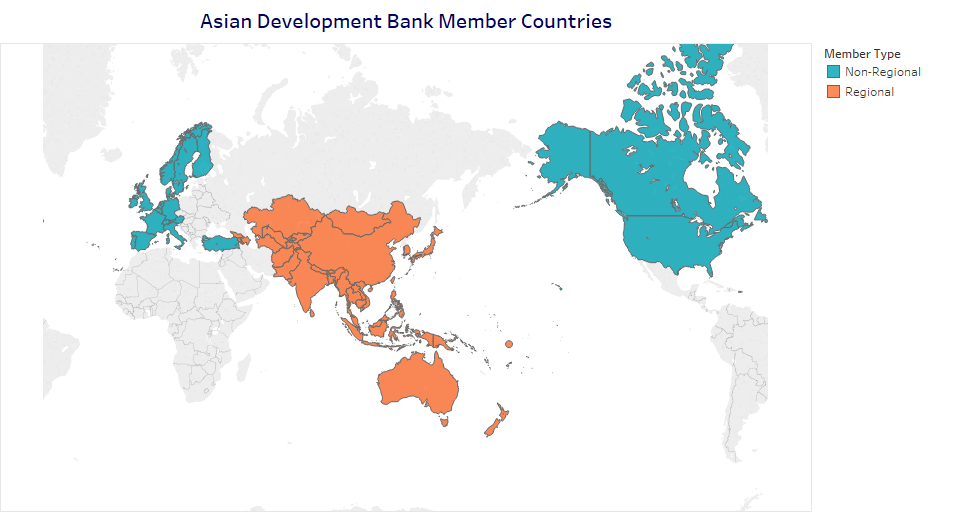
As of 2019, the bank listed 68 members, which is composed of 49 regional members and 19 non-regional members. The regional members are geographically situated in Asia and are primary beneficiaries of the bank’s programs, whereas the non-regional members primarily from Western countries, mainly Europe and North America, are contributors of capital to the bank.
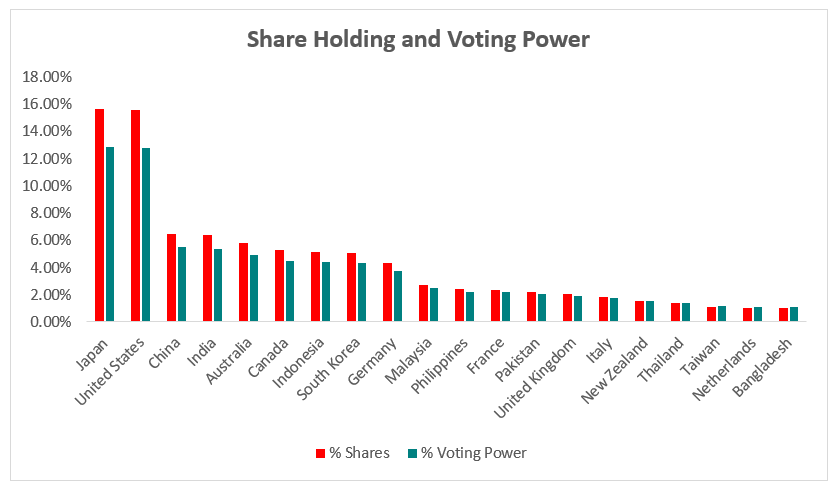
The decision-making process at the Asian Development Bank is like that of the World Bank. The number of votes controlled by a member is commensurate with the number of shares held by that member. Today, Japan controls the highest number of shares, which is about 15.5% of the ownership of the bank. The following figure summarizes the ownership structure and the voting power of member states:
The bank focuses on the key areas of development that are aligned with the World Bank’s Sustainable Development Goals (SDGs). These key areas are:
The ADB aims to provide for sustainable and inclusive economic growth by financing projects in areas like education and health, while also helping improve the capital markets and business infrastructure in target countries. There are other more specialized areas as well, such as Public-Private Partnerships (PPPs), Information Technology, Regional Cooperation and Integration, etc., which serve as secondary capacity building programs.
The Asian Development Bank runs multiple financing programs, which it offers under various categories listed below:
Sovereign financing is the financing provided to governments to run specific development programs. The money is provided either in the form of a loan, a grant, or a blend of both. Within the sovereign financing programs, the bank also provides a special category of loans called the Result-Based Loans (RBLs).
The money from RBLs is an advance contingent upon achieving specific goals. The bank uses a variety of financial products to conduct its financing activities. A few examples are discussed below:
Multitranche Financing Facility (MFFs): Multitranche Financing products are used to finance large ongoing projects that are carried out in phases. Investors with ADB are able to access multiple tranches. They can choose to invest in the tranches that meet their investment goals.
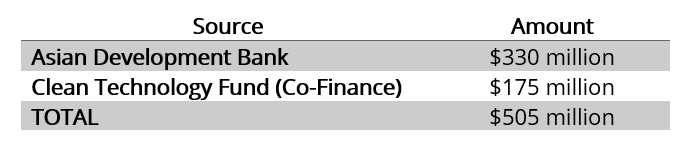
The Solar Rooftop Investment Program aims to develop a 40-gigawatt (GW) solar power capacity in India. It is a long-term project and requires a high amount of investment. In the program, the ADB used an MFF to finance the project in different phases. Details from one of the phases are listed below:
Non-Sovereign financing is provided directly to private businesses or organizations for carrying out specific projects. This is different from Sovereign financing, where the funds are provided to the government. The ADB can provide this financing in various forms. Three main routes to non-sovereign assistance are:
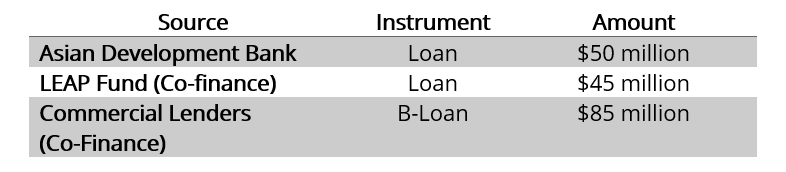
The Eastern Economic Corridor Independent Power Project is aimed at building a 2500-megawatt (MW) natural-gas power plant in the Rayong province of Thailand. The power plant will be used to increase the power production capacity of the region to meet its industrial development plans under the Eastern Economic Corridor Development Plan.
The ADB, in the project, is funding a private company to build the power plant. The details of its funding are in the table below:
Co-Financing arrangements involve external partners pooling their funds with the ADB to finance a project. There are two broad categories of co-financing arrangements – official and commercial. Official arrangements are in cooperation with other multilateral banks, such as the World Bank, while commercial arrangements are with more traditional financial institutions or investors.
The Border Town Development Project aims at improving waste management services as a part of developing urban infrastructure in the border towns of Mongolia. The project commenced in 2016 and is co-financed by the Asian Development Bank ($19 million) and the Bill and Melinda Gates Foundation ($1 million).
CFI offers the Capital Markets & Securities Analyst (CMSA)® certification program for those looking to take their careers to the next level. To keep learning and developing your knowledge base, please explore the additional relevant resources below:


