Functional Resume
A resume format that emphasizes an individual’s set of skills
What is a Functional Resume?
A functional resume is one that emphasizes an individual’s set of skills. It is one of three other types of resumes, which include reverse-chronological and a combination of the functional and chronological. The chronological type is the one that highlights a person’s professional experience, starting with their latest position.
While the chronological resume is ideal for persons with few gaps in professional experience, a functional one is often better suited for individuals with such employment gaps. The functional resume shifts the emphasis from job titles to the applicant’s skills.
When to Use a Functional Resume
Job seekers can choose among several resume formats. Given that a functional resume emphasizes an individual’s skill set over other things such as length of employment, it’s perfect for applicants with a few gaps between jobs. For example, if the applicant is a student, they may only have internship-based experience.
However, a functional resume is less popular than the chronological one that stresses the candidate’s work background. The reason for this is that most recruiters and interviewers prefer such a resume. Thus, unless there’s a specific reason for using the functional resume, one should stick to the traditional chronological resume. With a combination resume, the candidate’s skills are outlined first, followed by their work history.
Tips on Writing a Functional Resume
1. Start with a summary
When writing a functional resume, it’s a good idea to incorporate a summary at the beginning. This section should summarize all the skills the individual possesses, particularly ones relevant to the position he’s applying for. That way, the employer gets a vivid picture of who the applicant is at first glance.
2. Organize by theme
Another good tactic in creating a functional resume is to structure the resume by themes. The themes are chosen based on expertise or the qualifications for the position being sought. Examples of themes are “Recruiting Experience” or “Customer Service Experience.” Grouping skills in this manner enables the employer to easily identify and assess the applicant’s skills.
3. Incorporate keywords
A job seeker should always include keywords that were used in the job description. One of the best ways to do this is by incorporating keywords into subheading titles. Alternatively, one can include them as a bulleted list, listing skills and achievements in a more detailed way. This helps the potential employer to match one’s skill set with specific job requirements.
4. Include relevant projects
Highlight relevant projects to showcase your accomplishments. Whether the projects are personal or professional, they can help prove to potential employers that you are someone who can deliver results.
5. Highlight employment history
Even though the functional resume focuses on one’s skills, that doesn’t mean that one shouldn’t include work experience at all. Employment history can be added at the bottom of the resume or worked into the skills listings. For example, one might put employer names in boldface type: “Created advertising campaign for Envy Clothing Inc.”
Pros and Cons of a Functional Resume
There are many benefits of using functional resumes. They include the following:
- It provides applicants with a good strategy for covering periods of unemployment.
- Individuals with minimal experience — such as new graduates and career-changers — have a nice way of showcasing themselves.
- It comes in handy for applicants who are entering the workforce after a long period of time away. For example, people who leave corporate work temporarily to do mission work find functional resumes beneficial.
- A functional resume can be used to outline project-based or contractual work experience that one has gained by working with different companies.
- It emphasizes the most relevant work experience, particularly if the applicant has a long work history with a lot of different employers.
- Potential employers get a snapshot of the applicant’s expertise in the advertised position.
- It places focus on diverse functions, skills, knowledge, and expertise.
- It can be very effective for applying for unconventional roles.
Unfortunately, using a functional resume also poses certain challenges, such as the following:
- If it fails to adequately explain gaps in employment, it may give an employer the impression that one has an unstable work history.
- It likely does not reveal a clear career path.
- It may highlight skills and expertise of the candidate but without providing a reference to how the abilities were acquired.
Functional Resume Template
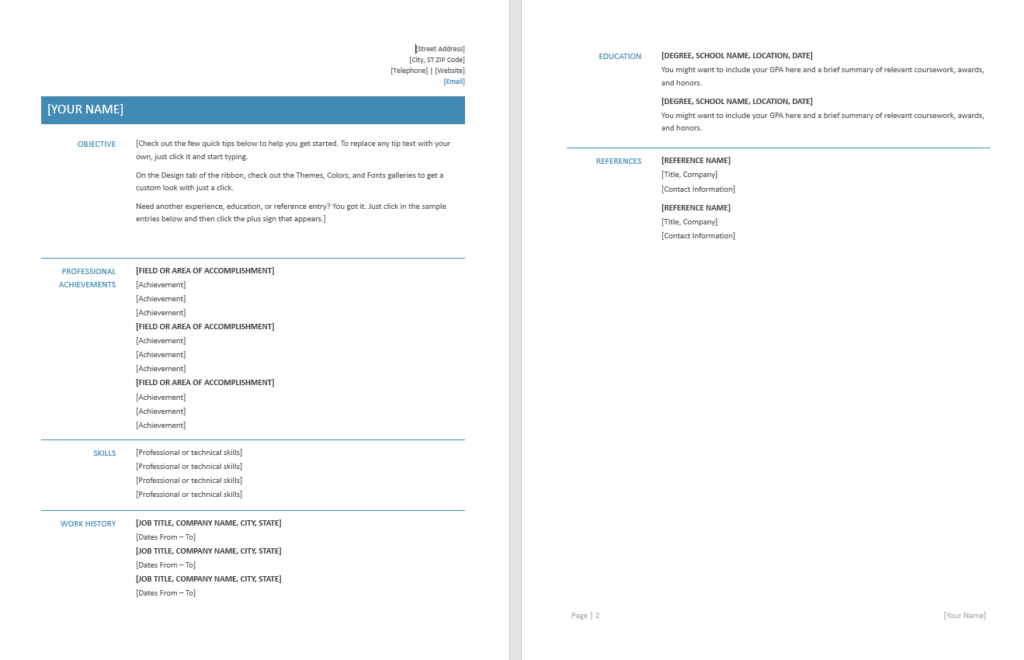
With a functional resume, an individual’s work experience is explained by highlighting his skills and abilities. The skills are often grouped into themes, appearing above chronological work history. The functional resume format is beneficial for applicants who are changing careers and those with minimal experience.


