Get Certified for
Capital Markets (CMSA®)
From equities and fixed income to derivatives, the CMSA certification bridges the gap from where you are now to where you want to be — a world-class capital markets analyst.
A country that imports more than it exports
A net importer is defined as a country that imports more than it exports. Imports are the goods and services brought into the country from a foreign country. Exports refer to the goods and services provided by a country to foreign clients. Imports and exports summed up constitute the total trade by a country.

Countries worldwide try to increase their exports and decrease imports to become self-dependent and reduce their consumption cost. It is because goods and services produced in one’s own country are generally cheaper.
Balance of trade refers to the difference between imports and exports. The balance of trade is recorded in the current account of a country. Some countries export more than they import, achieve a positive balance of trade, and are called net exporters. They include countries like China, Germany, and oil-exporting countries in the Middle East.
Countries such as the U.S., the U.K., and Spain incur a negative balance of trade. They import more than they export; thus, they are called net importers. Net importers see their currency weakening, as they need to pay for their imports in foreign currencies.
Net importers face significant foreign exchange and economic hurdles. Some of the disadvantages include:
However, there are some advantages, which include:
The U.S. economy is worth approximately $20 trillion, making it the world’s largest economy for nearly a century now. It also has been considered the largest importer for a long time now. With $3.12 trillion of imports in 2019, it provides economies across the world a great deal of business.
Being a big buyer, the U.S. generally dictates favorable terms on its imports. The number of imports allows the country to influence foreign policy. The recent imposition of tariffs on goods from China is a good example.
Also, the U.S. enjoys a significant advantage because the U.S. dollar is used for international trade across the globe. It helps the U.S. pay for its imports easily, given the easy access to its own currency.
In the case of exports, the U.S. comes second only to China, with the former exporting $1.65 trillion worth of goods to different countries. A significant portion of U.S. exports includes highly advanced goods, such as machinery, medical systems, aircraft, automobiles, and petroleum products.
China is the country with the largest trade surplus or highest negative net imports. In other words, it is the biggest net exporter in total value terms. This is because China serves as the manufacturing hub of the world, and the vast majority of electronics, machinery, toys, etc., are manufactured in the country.
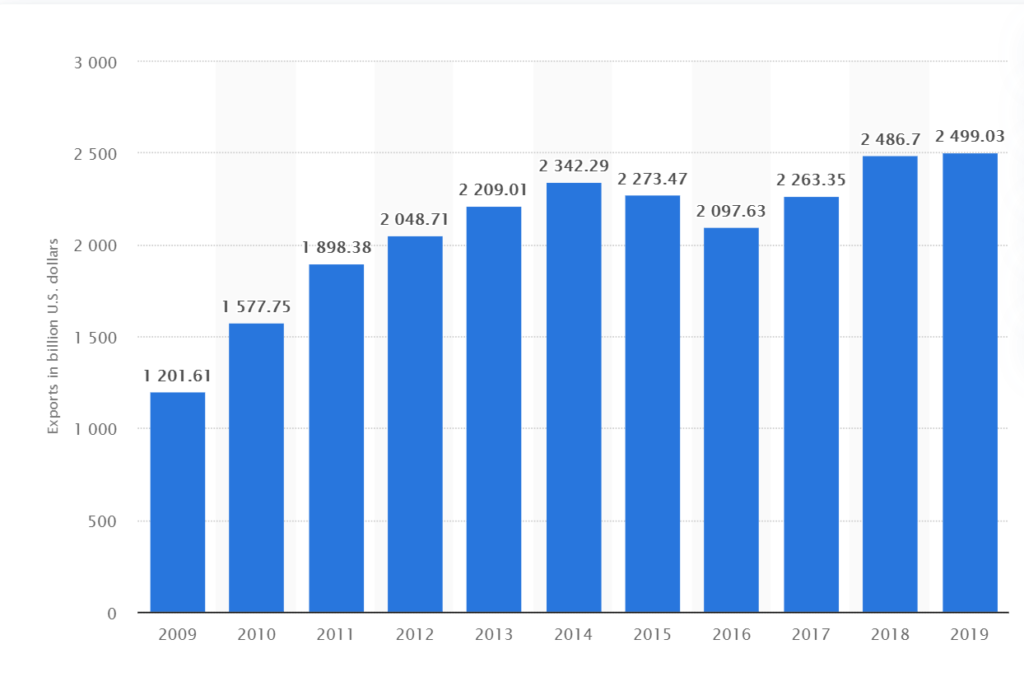
The image above shows exports from China from 2009 to 2019. China’s exports in 2019 were worth approximately $2.5 trillion. China’s GDP is nearly $14.6 trillion, and with a high growth rate of around 8%, it is expected to take over the U.S. in the near future.
CFI is the official provider of the Commercial Banking & Credit Analyst (CBCA)™ certification program, designed to transform anyone into a world-class financial analyst.
In order to help you become a world-class financial analyst and advance your career to your fullest potential, these additional resources will be very helpful:


