Get Certified for
Capital Markets (CMSA®)
From equities and fixed income to derivatives, the CMSA certification bridges the gap from where you are now to where you want to be — a world-class capital markets analyst.
A bond classification used to denote bonds that carry a relatively low credit risk compared to other bonds
An investment-grade bond is a bond classification used to denote bonds that carry a relatively low credit risk compared to other bonds. There are three major credit rating agencies (Standard & Poor’s, Moody’s, and Fitch) that provide ratings on bond. Each credit rating agency sets a minimum bond rank to be classified as investment-grade:

An understanding of credit ratings is extremely important as they convey information regarding the credit risk of a bond. In other words, the credit rating imposed on a bond denotes the likelihood of the bond defaulting. Of the credit ratings, bonds can be investment-grade or non-investment grade. For example, the bond ratings for Standard & Poor’s (S&P) are provided below:
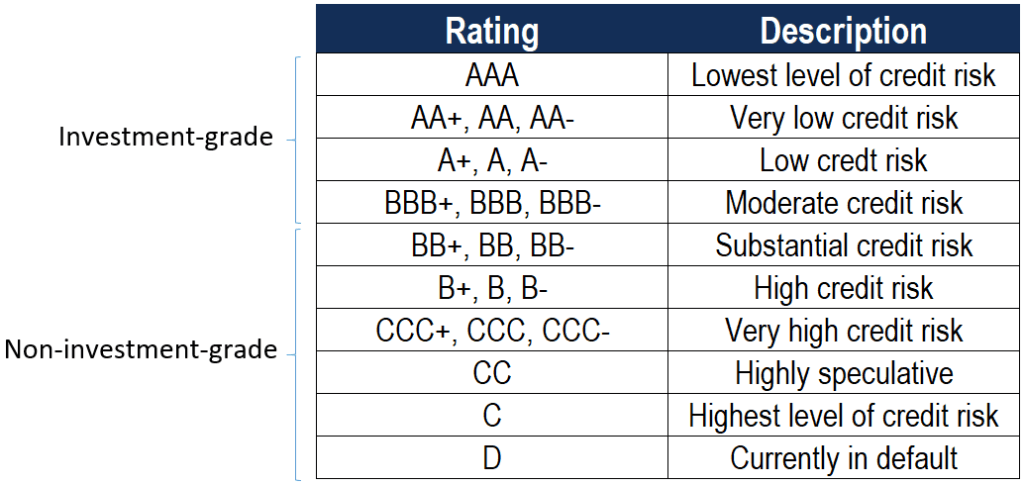
As such, the credit risk of investment-grade bonds ranges from the lowest level of credit risk to moderate credit risk – investment-grade bonds are generally likely to meet payment obligations. Bonds that are not investment-grade are called junk bonds, high-yield bonds, or non-investment-grade bonds.
In the 2018 Annual Global Corporate Default and Rating Transition Study by S&P Global, information regarding the global default rates of certain bond ratings can be found.
Historically, investment-grade bonds witness a low default rate compared to non-investment grade bonds. For example, S&P Global reported that the highest one-year default rate for AAA, AA, A, and BBB-rated bonds (investment-grade bonds) were 0%, 0.38%, 0.39%, and 1.02%, respectively. It can be contrasted with the maximum one-year default rate for BB, B, and CCC/C-rated bonds (non-investment-grade bonds) of 4.22%, 13.84%, and 49.28%, respectively. Therefore, institutional investors generally adhere to a policy of limiting bond investments to only investment-grade bonds due to their historically low default rates.
An investor is looking to invest in a floating rate fund. His criterion is that the bonds in the fund must majority (>50%) consist of investment-grade bonds. The fund follows the credit rating system of S&P and shows the following credit allocation of the fund:
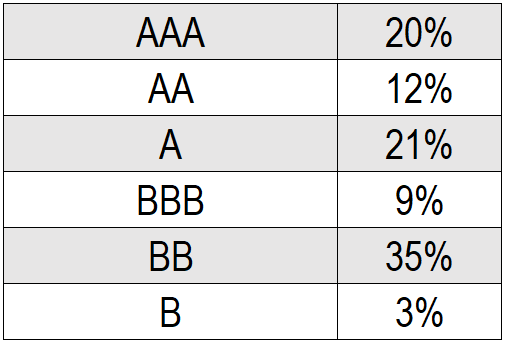
Does the floating rate fund satisfy the criteria of being comprised of majority investment-grade bonds?
In the credit rating system by S&P, bonds that are rated BBB- or higher are considered investment-grade. Therefore, the floating rate fund above shows 62% of its fund invested in investment-grade bonds. Therefore, the floating rate fund satisfies the investor’s criterion.
The higher rated the bond, the lower the bond yield. Bond yield refers to the return realized on a bond. As such, investment-grade bonds will always provide a lower yield than non-investment grade bonds. It is due to investors demanding a higher yield to compensate for the higher credit risk in holding non-investment-grade bonds.
For example, an investor may demand a yield of 3% for a 10-year bond rated AAA (investment-grade) due to the extremely low credit risk but demand a yield of 7% for a 10-year bond rated B (non-investment-grade) due to the higher implied credit risk associated with the bond.
Thank you for reading CFI’s guide on Investment-Grade Bonds. To keep learning and advancing your career, the following resources will be helpful:


