Get Certified for
Capital Markets (CMSA®)
From equities and fixed income to derivatives, the CMSA certification bridges the gap from where you are now to where you want to be — a world-class capital markets analyst.
The rate at which new ideas and technology spread
Diffusion of Innovation (DOI) is a theory popularized by American communication theorist and sociologist Everett Rogers in 1962 that aims to explain how, why, and the rate at which a product, service, or process spreads through a population or social system.
In other words, the diffusion of innovation explains the rate at which new ideas and technology spread. The diffusion of innovation theory is used extensively by marketers to understand the rate at which consumers are likely to adopt a new product or service.

The adoption of a new product, service, or idea is not an overnight phenomenon – it does not happen simultaneously across all people in a social system. According to research, consumers who adopt an innovation earlier demonstrate different characteristics than someone who adopts an innovation later. Therefore, for marketers, understanding the characteristics of each segment that will either help or hinder the adoption of an innovation is important.
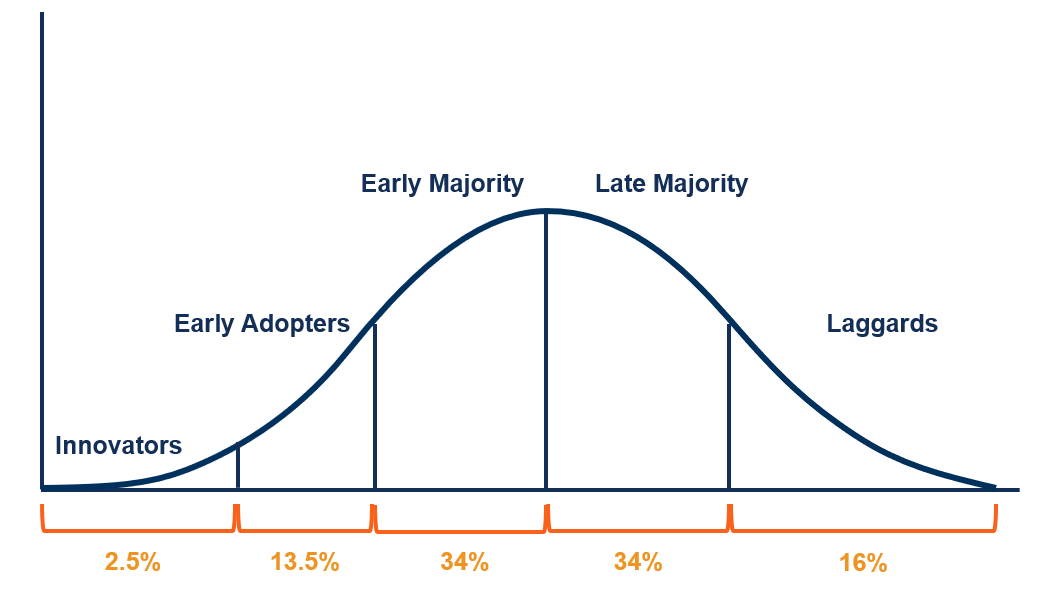
In the diffusion of innovation theory, there are five adopter categories:
Rogers provides the distribution of the five adopter categories as follows: Innovators represent the first 2.5% of the group to adopt an innovation, followed by 13.5% as early adopters, 34% as early majorities, 34% as late majorities, and finally,16% as laggards. Note that the size of the laggards category is much larger than that of the innovators category on the opposite end of the spectrum.
Innovators are those who want to be the first to acquire a new product or service. They are risk-takers, price-insensitive, and are able to cope with a high degree of uncertainty. Innovators are crucial to the success of any new product or service, as they help it to gain market acceptance.
For example, individuals who stay overnight outside a movie theatre to be the first to purchase the first showing of a movie are considered innovators.
Early adopters are those who are not quite as risk-taking as innovators and typically wait until the product or service receives some reviews before making a purchase. Early adopters are referred to as “influencers” or “opinion leaders”, and are often regarded as role models within their social system. They are key in helping the spread of a product or service achieve “critical mass”.
Therefore, if early adopters of a product or service are small, the total number of people who adopt the product or service will likely be small as well. Individuals who wait a couple of days and spend some time reading reviews before going to see a movie are regarded as early adopters.
Early majorities represent the majority of the market – 34%. Early majorities are not risk-taking and typically wait until a product or service is tested or used by a trusted peer. These individuals are prudent and want to purchase things that are proven to work.
Individuals who go to a movie after it’s been out several weeks and gotten good reviews and made profits at the box office are early majorities.
Late majorities also represent an important percentage of the market – 34%. Late majorities are the last large group of consumers to enter the market. They are deemed conservative and are often technologically shy, very cost-sensitive, skeptical, and cautious in making a purchase. In addition, late majorities are often peer pressured into purchasing the product or service.
People who wait for a movie to become available online or on Netflix are regarded as late majorities.
Laggards are the last to adopt a new product or service. They resent change and may continue to rely on traditional products or services until they are no longer available. In other words, they typically only adopt the new technology when virtually forced to.
Laggards perhaps finally catch a hit movie when it’s shown on network TV.
The diffusion of innovation theory explains the rate at which consumers will adopt a new product or service. Therefore, the theory helps marketers understand how trends occur, and helps companies in assessing the likelihood of success or failure of their new introduction.
By applying the diffusion of innovation theory, firms can predict which consumer segments will purchase their product/service and develop effective marketing strategies to accelerate adoption within each segment.
Connect what you just learned to a clear career path with CFI’s role‑based courses and certification programs.
CFI is the official provider of the Financial Modeling and Valuation Analyst (FMVA)™ certification program, designed to transform anyone into a world-class financial analyst. To keep learning and developing your knowledge of financial analysis, we highly recommend the additional CFI resources below: