Get Certified for
Capital Markets (CMSA®)
From equities and fixed income to derivatives, the CMSA certification bridges the gap from where you are now to where you want to be — a world-class capital markets analyst.
The responsiveness to change in consumers’ income with the change in the demand for a certain good
Income elasticity of demand measures the relationship between the consumer’s income and the demand for a certain good. It may be positive or negative, or even non-responsive for a certain product. The consumer’s income and a product’s demand are directly linked to each other, dissimilar to the price-demand equation.

Demand for a normal good grows with an increase in customer wages and vice versa, assuming other factors of demand are constant. Income elasticity of demand is the level of response in demand to the adjustment in customer income. The larger the income elasticity of demand for a certain product, the greater the shift in demand there is from a change in consumer income.
The following formula is used:
Where:
Based on numerical value, the income elasticity of demand is divided into three classes as follows:
It refers to a condition in which demand for a commodity rises with a rise in consumer income and declines with a decline in consumer income. Commodities with positive income elasticity of demand are normal goods.
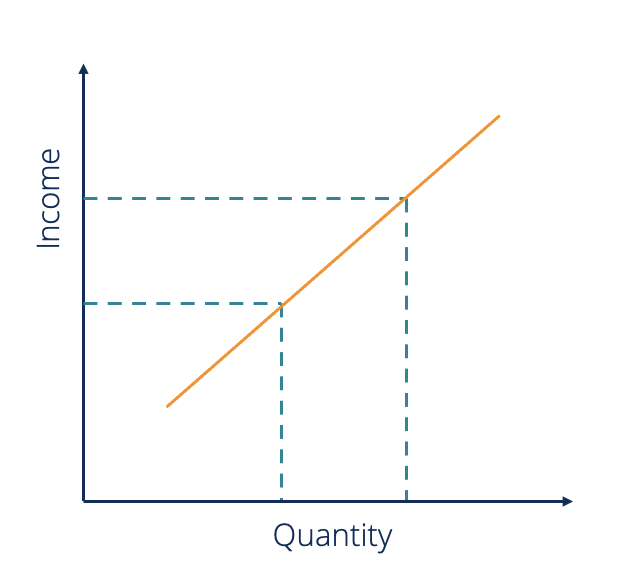
The upward slope implies that the rise in income contributes to a rise in demand and vice versa. There are three forms of positive income elasticity of demand stated as follows:
It refers to a condition in which demand for a commodity decreases with a rise in consumer income and increases with a fall in consumer income. Inferior goods are such commodities. For example, the demand for millet will decrease if the income of consumers increases since they will prefer to purchase wheat instead of millet. Thus, millet is an inferior good to wheat for customers.

The downward slope implies that the increase in income contributes to a fall in demand, and a decrease in income causes a rise in demand.
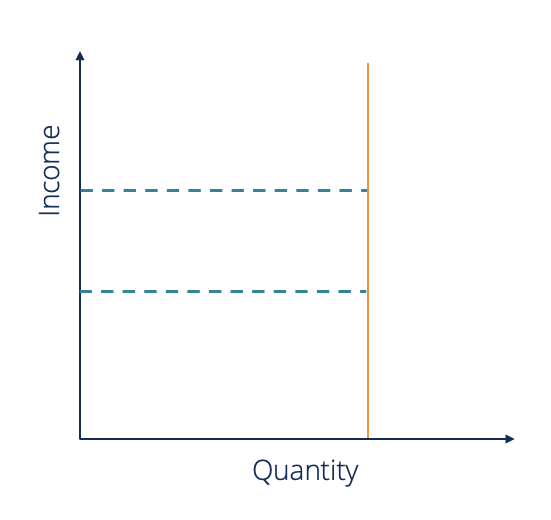
It corresponds to the situation when there is no impact of rising household income on commodity production. Such goods are termed essential goods. For example, a high-income consumer and a low-income consumer will need salt in the same quantity.
Forecasting demand applies to the idea that the income elasticity of demand tends to predict demand for commodities in the future. If there is a substantial change in wages, the change in demand for products will also be significant. This is because when buyers become aware of a shift in income, they will change their preferences and expectations for such products.
The idea of national income is very important to businesses as it helps them to decide which sectors they should invest their money in. In general, investors tend to invest in markets where they can predict that the demand for commodities is related to a growth in national income or where the income elasticity of demand is greater than negligible.
Thank you for reading CFI’s guide to Income Elasticity of Demand. To keep advancing your career, the additional CFI resources below will be useful:


