
Get In-Demand Finance Certifications
Plans for the future liquidation of a financial position
Exit strategies are plans executed by business owners, investors, traders, or venture capitalists to liquidate their position in a financial asset upon meeting certain criteria. An exit plan is how an investor plans to get out of an investment.

An exit plan may be used to:
Examples of some of the most common exit strategies for investors or owners of various types of investments include:
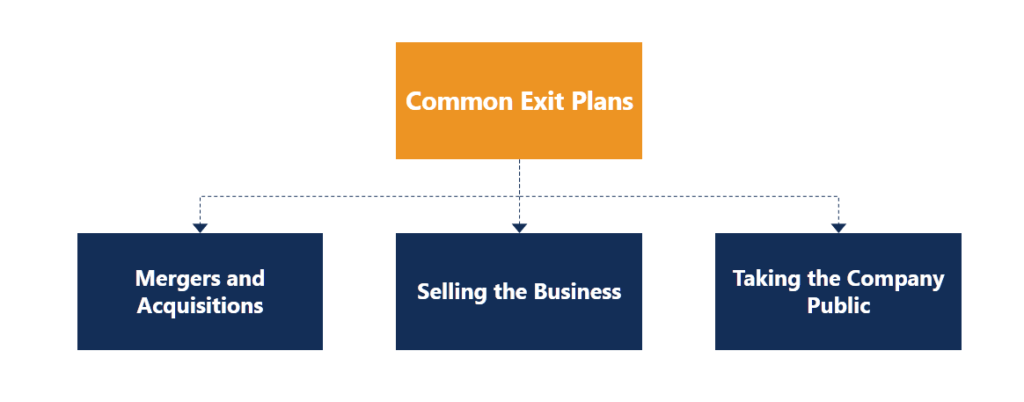
Exit plans are commonly used by entrepreneurs to sell the company that they founded. Entrepreneurs will typically develop an exit strategy before going into business because the choice of exit plan has a significant influence on business development choices.
For example, if your plan is to get listed on the stock market (an IPO), it is important that your company follow certain accounting regulations. In addition, most entrepreneurs are not interested in a big-company role and are only interested in starting up companies. A well-defined exit plan helps entrepreneurs swiftly move on to their next big project.
Common types of exit strategies:
The exit plan chosen by the entrepreneur depends on the role they want in the future of the company. For example, a strategic acquisition will relieve the entrepreneur of all roles and responsibilities in his or her founding company as they give up control of it.
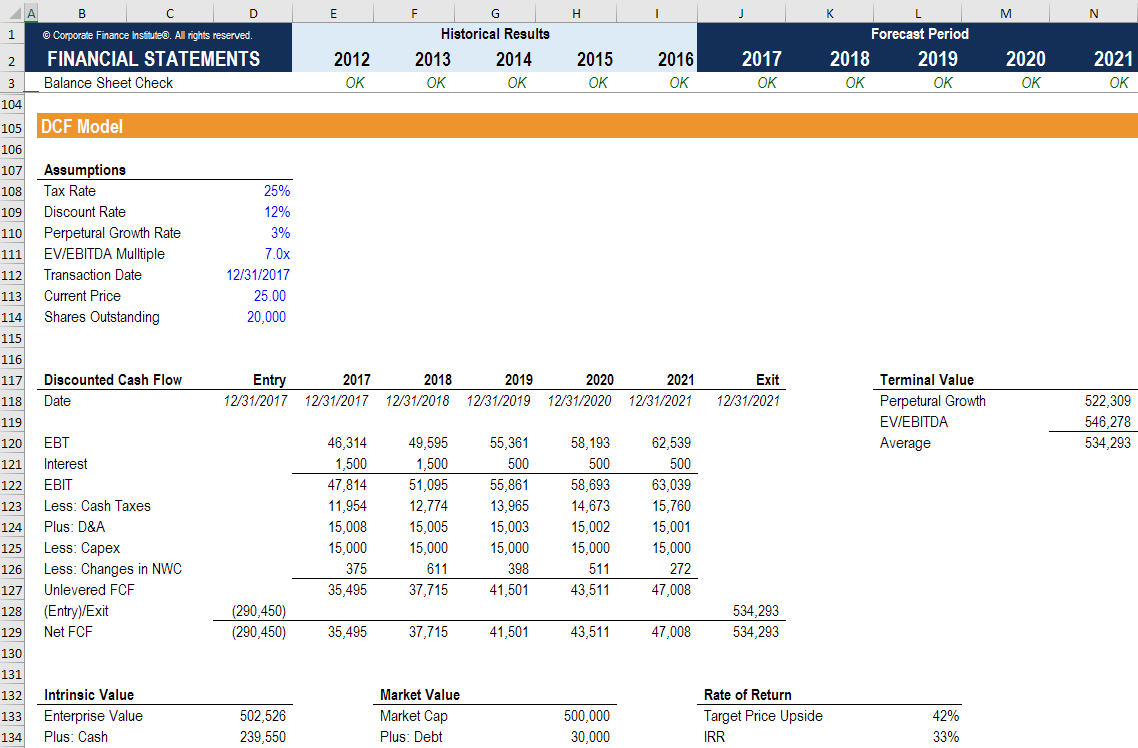
In financial modeling, it’s necessary to have a terminal value when building a DCF model. The terminal value can be calculated in two different ways – using a perpetual growth rate and using an exit multiple. The latter method is more common among industry practitioners and assumes that the business is sold for a “multiple” of some metric, like EBITDA.
In the example of a DCF model below you can see the terminal value section, which assumes the company is sold for 7.0x EBITDA.
Learn more in CFI’s DCF modeling courses online now!
It may seem counter-intuitive for a business owner to develop exit strategies. For example, if you are an e-commerce business owner with increasing revenue, why would you want to exit your company?
In fact, it is important to consider an exit plan even if you do not intend to sell your company immediately. For example:
Thank you for reading CFI’s guide to developing an Exit Strategy. To keep learning and advancing your career as a financial analyst, these CFI resources will be a big help:


