Get In-Demand Finance Certifications
A strategy in which a firm attempts to take (“push”) their products to consumers
A push marketing strategy, also called a push promotional strategy, refers to a strategy in which a firm attempts to take its products to consumers – to “push” them onto consumers. In a push marketing strategy, the goal is to use various active marketing techniques to push their products to be seen by consumers, sometimes right at the point of purchase. One of the main objectives of push marketing is to reduce to as small as possible the amount of time that elapses between the customer seeing a product and making a purchase decision to buy the product.

Push marketing strategies are commonly used to gain and increase product exposure. Push marketing relies mainly upon traditional avenues of advertising/marketing, such as a series of television ads or a series of direct mail pieces. Again, a primary goal is simply making as many consumers as possible aware of the product and its benefits. “Push” refers to the fact that the company that sells the product is continually pushing it into the potential customer’s purview, their field of vision, so to speak.
Although virtually every company seeks to establish and nurture relationships with its customers or clients, push marketing is more concerned with gaining an immediate sale than with fostering relationships that create brand loyalty. Establishing a brand identity and building a loyal customer base falls more under the heading of “pull marketing.” Therefore, it is quite commonplace to see a company utilizing both push marketing and pull marketing to create a more complete, overarching marketing strategy with maximum effectiveness in terms of expanding the company’s market share and increasing revenues and profitability.
With a push marketing strategy, the firm takes the product to consumers. Consumers are introduced to, or reminded of, the product through any of several available push marketing methods:
A push marketing strategy is illustrated as follows:
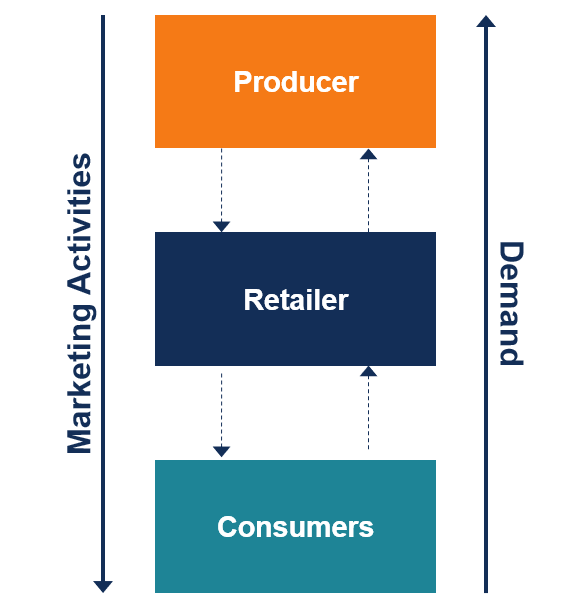
With reference to the illustration above, a production company may try to convince a retailer to stock its product. Once the retailer stocks the product, the manufacturer or wholesaler may further “push” the product at consumers with an eye-catching and informative point-of-sale display.
Explore further topics on Corporate Strategy, with CFI’s Strategy Course.
Colin recently launched a new product – the Fanner 3000. After spending months in the hot weather of Hong Kong, Colin developed an innovative fan product that emits no sound, is priced competitively, is energy efficient, and is able to cool the room to the desired temperature.
To market this product, Colin prepares to present and sell his product at an upcoming trade show. Creating visibility is a top priority, so Colin aims to persuade major retailers to display the Fanner 3000 near check-out counters. In addition, he ensures that his product is stocked and abundant as customer demand rolls in.
Thank you for reading CFI’s guide to Push Marketing Strategy. To keep learning and advancing your career, the following CFI resources will be helpful: