Get Certified for Financial Modeling (FMVA)®
Gain in-demand industry knowledge and hands-on practice that will help you stand out from the competition and become a world-class financial analyst.
The number of shares after adjustments in the share capital over a reporting period
Weighted average shares outstanding refers to the number of shares of a company calculated after adjusting for changes in the share capital over a reporting period. The number of shares of a company outstanding is not constant and may change at various times throughout the year, due to a share buyback, new issues, conversion, etc.
The number of weighted average shares outstanding is used in calculating metrics such as Earnings per Share (EPS) in order to provide a fair view of a company’s financial condition.
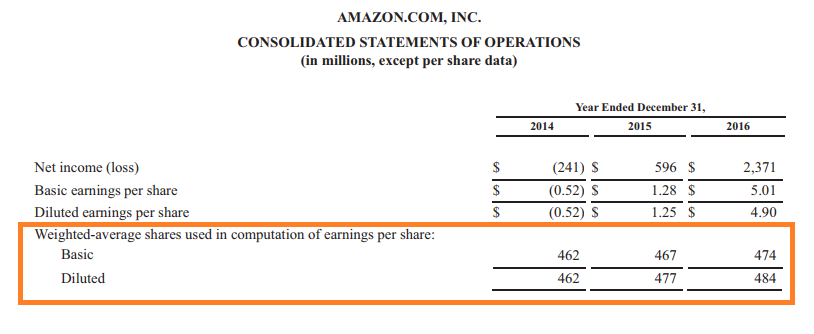
Simply using the number of shares outstanding at the end of the reporting period might give a distorted picture of the company. Imagine a situation where the company exercises a share buyback at the end of the year. If that figure is taken and used to calculate EPS, then the EPS would be much higher, and it would eventually amount to polishing the financial figures.
Suppose that Company XYZ Corporation has 500,000 shares at the beginning of its fiscal year. At the beginning of the second quarter, the company’s debenture holders decided to convert their holdings into equity shares, totaling 100,000 shares. At the beginning of the fourth quarter, the company repurchased 50,000 shares using its cash surplus.
Now, the shares outstanding at the end of the year stand at 500,000 + 100,000 – 50,000 = 550,000. Now, should we use the figure to calculate EPS? No.
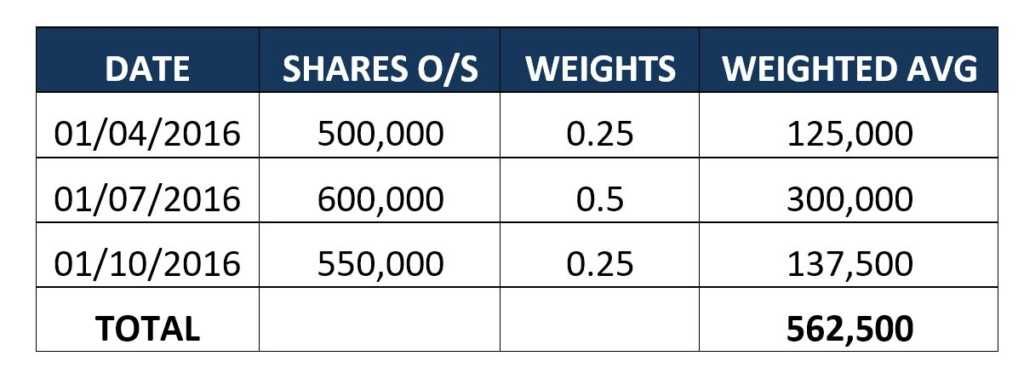
We will use 562,500 because, in the above calculation, we assigned weights according to the time proportion that the share outstanding figure was unchanged. For example, the opening figure of 500,000 remained unchanged for three months (i.e., 25% of the total year) until the start of the second quarter, after which it changed.
Click the button below to download our free Weighted Average Shares Outstanding template!
Shares outstanding include shares owned by retail and institutional investors and restricted shares held by company officials and employees. Changes in the composition of the holdings do not alter the total number of shares outstanding. New share issues, the exercise of stock options, conversion, and cancellations through buybacks will change the figure.
To achieve a proper and fair view of the changes in the number of shares and for the calculation of EPS, the method of weighted average shares outstanding is used.
The EPS calculated using the “Weighted Average Shares Outstanding” is actually the “Basic EPS.”
The formula is as follows:
Basic EPS uses outstanding shares, which are actually held by the public and company insiders. These shares are non-dilutive because they do not include any options or securities that can be converted.
On the other hand, while calculating the dilutive EPS, the denominator includes all possible conversions that can take place and increase the number of shares held by parties. Diluted EPS is always less than the basic EPS, as the denominator in the latter is higher. Companies with options, convertible bonds, etc., disclose both basic as well as diluted EPS in their financial disclosures.
If there is a significant difference between basic and diluted EPS, investors should be aware of the potential increase in the number of shares outstanding in the future.
Thank you for reading CFI’s guide to Weighted Average Shares Outstanding. To prepare for the FMVA curriculum, these additional CFI resources will be helpful:


