Get Certified for
Capital Markets (CMSA®)
From equities and fixed income to derivatives, the CMSA certification bridges the gap from where you are now to where you want to be — a world-class capital markets analyst.
One 1-hundredth of one percent
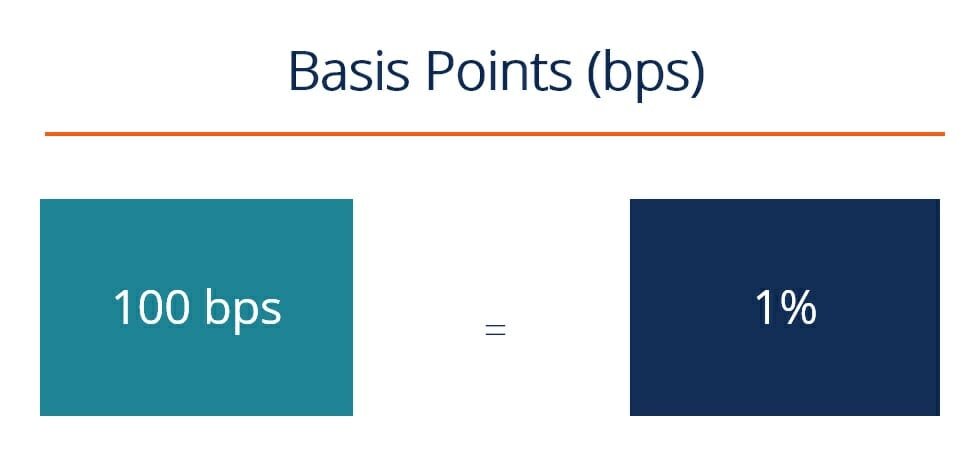
In finance, Basis Points (BPS) are a unit of measurement equal to 1/100th of 1 percent. BPS are used for measuring interest rates, the yield of a fixed-income security, and other percentages or rates used in finance.
This metric is commonly used for loans and bonds to signify percentage changes or yield spreads in financial instruments, especially when the difference in material interest rates is less than one percent.
One basis point is equal to .01 percent or 1/100th of 1 percent. The succeeding points move up gradually to 100%, which equals 10000 basis points, as illustrated in the diagram below.
| Percentage | Basis Points |
|---|---|
| 0.01% | 1 |
| 0.1% | 10 |
| 0.5% | 50 |
| 1% | 100 |
| 10% | 1000 |
| 100% | 10000 |
Examples:
To convert the number of basis points to a percentage and, in turn, a percentage to basis points, without using a conversion template or chart, review the following:
The main reasons investors use BPS points are:
The usage of basis points is primarily applied to yields and interest rates, but they may also apply to the change in the value of an asset, such as the percentage changes of stock values. Common examples include the following:
Thank you for reading CFI’s guide on Basis Points (BPS). To keep learning and developing your knowledge base, please explore the additional relevant resources below:
Learn accounting fundamentals and how to read financial statements with CFI’s online accounting classes.
These courses will give you the confidence to perform world-class financial analyst work. Start now!
Boost your confidence and master accounting skills effortlessly with CFI’s expert-led courses! Choose CFI for unparalleled industry expertise and hands-on learning that prepares you for real-world success.


