Get Certified for Financial Modeling (FMVA)®
Gain in-demand industry knowledge and hands-on practice that will help you stand out from the competition and become a world-class financial analyst.
A hurdle rate is the minimum rate of return that must be achieved
A hurdle rate, which is also known as the minimum acceptable rate of return (MARR), is the minimum required rate of return or target rate that investors are expecting to receive on an investment.
The hurdle rate is determined by assessing the cost of capital, risks involved, current opportunities in business expansion, rates of return for similar investments, and other factors that could directly affect an investment.

Before accepting and implementing a certain investment project, its internal rate of return (IRR) should be equal to or greater than the hurdle rate. Any potential investment must possess a return rate that is higher than the hurdle rate in order for it to be acceptable in the long run.
Most companies use their weighted average cost of capital (WACC) as a hurdle rate for investments. This stems from the fact that companies can buy back their own shares as an alternative to making a new investment, and would presumably earn their WACC as the rate of return. In this way, investing in their own shares (earning their WACC) represents the opportunity cost of any alternative investment.
Another way of looking at the hurdle rate is that it’s the required rate of return investors demand from a company. Therefore, any project the company invests in must be equal to or ideally greater than its cost of capital.
A more refined approach is to look at the risk of individual investments and add or deduct a risk premium based on that. For example, a company has a WACC of 12% and half its assets are in Argentina (high risk), and half its assets are in the United States (low risk).
If the company is looking at one new investment in Argentina and one new investment in the United States, it should not use the same hurdle rate to compare them. Instead, it should use a higher rate for the investment in Argentina and a lower one for the investment in the U.S.
In analyzing a potential investment, a company must first hold a preliminary evaluation to test if a project has a positive net present value. Care must be exercised, as setting a very high rate could be a hindrance to other profitable projects and could also favor short-term investments over long-term ones. A low hurdle rate could also result in an unprofitable project.
Key considerations include:
The most common way to use the hurdle rate to evaluate an investment is by performing a discounted cash flow (DCF) analysis. The DCF analysis method uses the concept of the time value of money (opportunity cost) to forecast all future cash flows and then discount them back to today’s value to provide the net present value.
In order to do this, the company needs to perform some financial modeling. The first step is to model out all the revenues, expenses, capital costs, etc., in an Excel spreadsheet and develop a forecast. The forecast needs to include the free cash flow of the investment over its lifetime.
Once all the cash flows are in place, use the XNPV function in Excel to discount the cash flows back to today at the set hurdle rate. If the resulting Net Present Value (NPV) is greater than zero, the project exceeds the hurdle rate, and if the NPV is negative, it does not meet it.
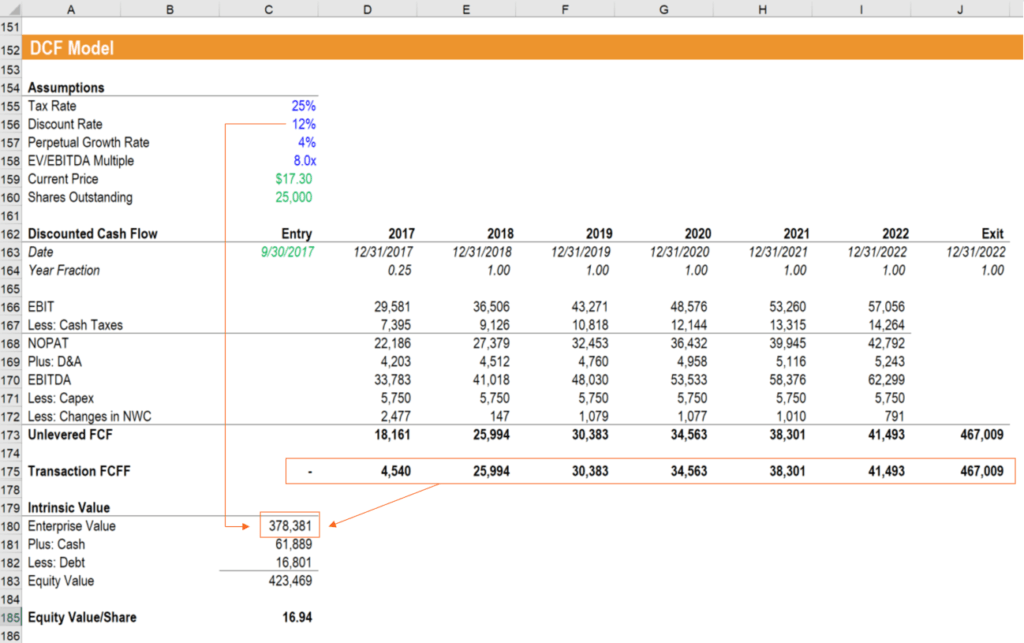
As you can see in the example above, if a hurdle rate (discount rate) of 12% is used, the investment opportunity has a net present value of $378,381. This means if the cost of making the investment is less than $378,381, then its expected return will exceed the hurdle rate. If the cost is more than $378,381, then the expected return will be lower than the hurdle rate.
Learn more about rates of return in CFI’s financial modeling & valuation courses.
The hurdle rate is often set to the weighted average cost of capital (WACC), also known as the benchmark or cut-off rate. Generally, it is utilized to analyze a potential investment, taking the risks involved and the opportunity cost of foregoing other projects into consideration.
One of the main advantages of a hurdle rate is its objectivity, which prevents management from accepting a project based on non-financial factors. Some projects get more attention due to popularity, while others involve the use of new and exciting technology.
It’s not always as straightforward as picking the investment with the highest internal rate of return. A few important points to note are:
Thank you for reading CFI’s guide on Hurdle Rate. To keep advancing your career, the additional CFI resources below will be useful:


