Get Certified for
Capital Markets (CMSA®)
From equities and fixed income to derivatives, the CMSA certification bridges the gap from where you are now to where you want to be — a world-class capital markets analyst.
How sensitive the demand of a product is over a shift of a corresponding product price
Cross-price elasticity measures how sensitive the demand of a product is over a shift of a corresponding product price. Often, in the market, some goods can relate to one another. This may mean a product’s price increase or decrease can positively or negatively affect the other product’s demand.

While explaining cross-price elasticity, there are three categories of product relationships to examine.

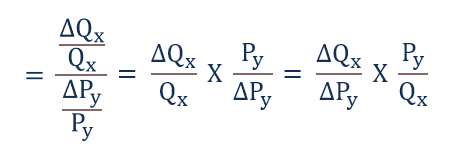
Where:
Note: In cross-price elasticity, unlike in income elasticity, the ΔQx and ΔPy are calculated by finding the averages between the change in either price or quantity demanded.
For substitute products, an increase in the price of a substitute product increases the demand for the competing product. This is often because consumers always try to maximize utility. The less they spend on something, the higher the perceived satisfaction.
Similarly, when the competing product price is reduced, the mirroring effect is depicted by an increase in demand for the substitute product. In either of these scenarios, the change will either drive a negative or a positive cross-price elasticity. For cross-price elasticity, where there is an increase in the price of the competing products, there will be a positive coefficient.
Practical Example
Two competing airlines – A and B – are a perfect example of substitute products. If Airline A decides to increase their flights’ round-trip ticket price by even a small margin, consumers will likely notice the difference. As a result, more people will opt for Airline B because it is cheaper.
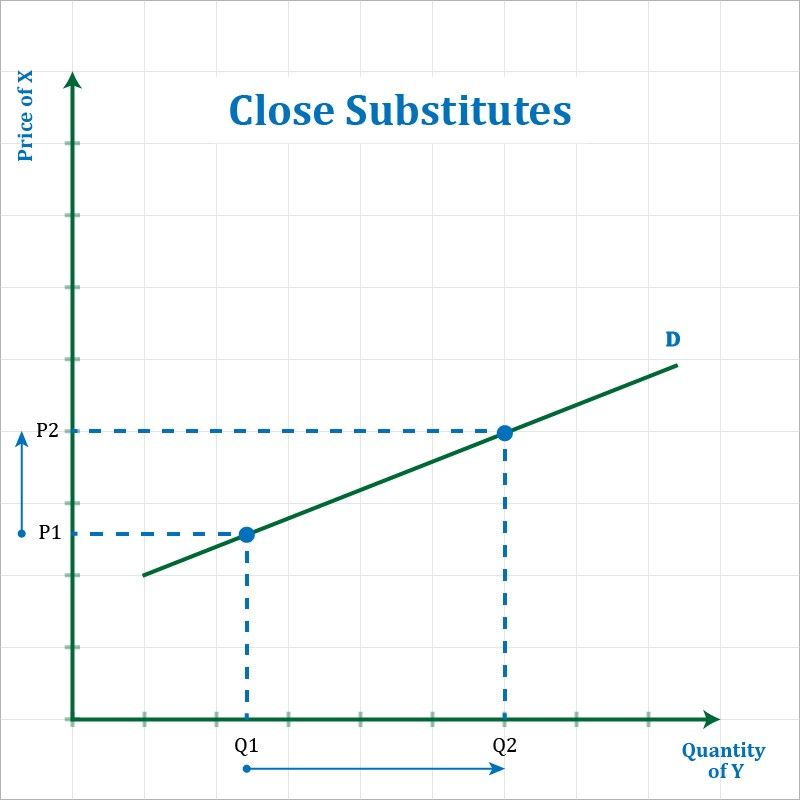
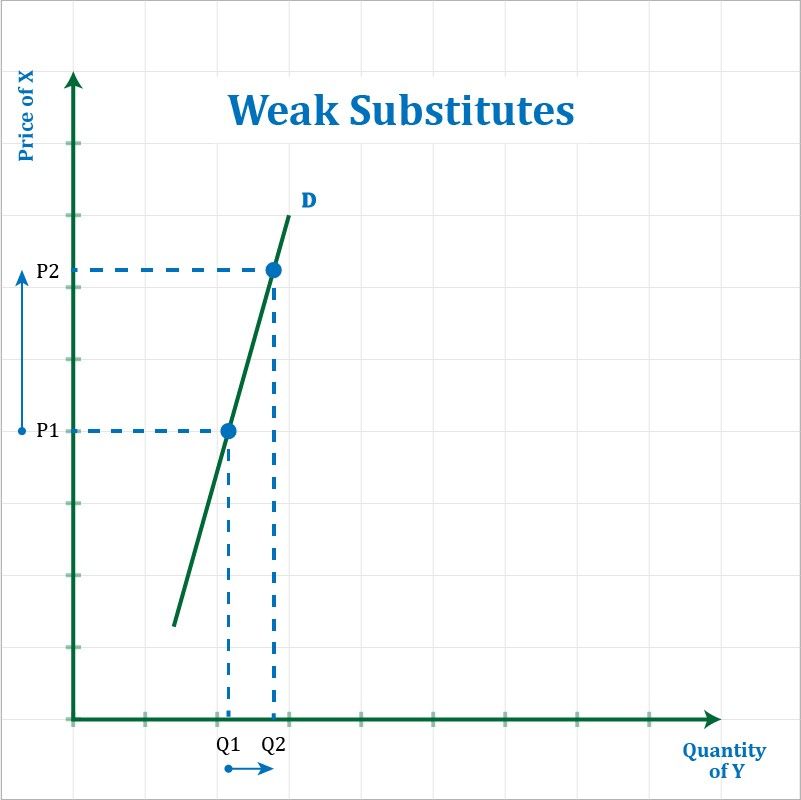
Substitute products can be categorized as either close or weak.
A close substitute is realized when a minimal increase in price leads to a large demand increase of the substitute product. The graph below shows this interpretation.
For a weak substitute, a large increase in the price of product X will lead to only a small increase in demand for product Y. See the graph below for the interpretation.
Complementary products have the opposite effect. If the price of one product increases, the demand for the complementary product decreases. To consumers, the increased joint cost will force them to buy less.
Practical Example
An example of a complementary product is an eBook reader. If the price of an eBook reader drops, the consumption of eBooks and audiobooks will increase because more consumers can afford the reader.
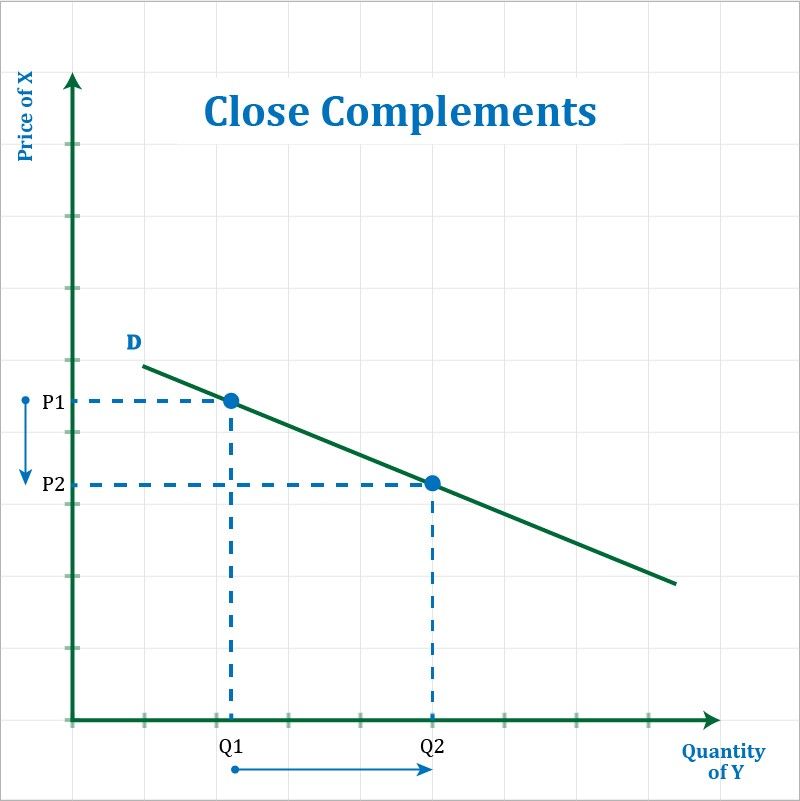
Complementary products can either be close or weak complements.
In the case of a strong complement product, a minimal price decrease leads to a large increase in demand for the complement product. The graph below shows this impact.
For weak complementary products, a large price decrease leads to a small increase in demand for the complementing products. The graph below shows this shift.

Unrelated products do not affect one another. It means the cross-effect elasticity is zero, and a vertical line would represent the graph.
CFI offers the Capital Markets & Securities Analyst (CMSA®) certification program for those looking to take their careers to the next level. To keep learning and advance your career, the following resources will be helpful:


