Get Certified for Financial Modeling (FMVA)®
Gain in-demand industry knowledge and hands-on practice that will help you stand out from the competition and become a world-class financial analyst.
The process of assigning a value to a specific property
Asset valuation simply pertains to the process to determine the value of a specific property, including stocks, options, bonds, buildings, machinery, or land, that is conducted usually when a company or asset is to be sold, insured, or taken over. The assets may be categorized into tangible and intangible assets. Valuations can be done on either an asset or a liability, such as bonds issued by a company.

Tangible assets refer to a company’s assets that have a physical form, which have been purchased by an organization to produce its products or goods or to provide the services that it offers. Tangible assets can be categorized as either fixed asset, such as structures, land, and machinery, or as a current asset, such as cash.
Other examples of assets are company vehicles, IT equipment, investments, payments, and on-hand stocks.
To compute the net tangible assets of a company:
Consider the following simple example:
In the example above, the total assets of Company ABC equal $5 million. When the total intangible assets of $1.5 million are deducted, that leaves $3.5 million. After the total liabilities are deducted, which is another $1 million, only $2.5 million is left, which is the value of the net tangible assets.
Intangible assets are assets that take no physical form, but still provide a future benefit to the company. They may include patents, logos, franchises, and trademarks.
Say, for example, a multinational company with assets of $15 billion goes bankrupt one day, and none of its tangible assets are left. It can still have value because of its intangible assets, such as its logo and patents, that many investors and other companies may be interested in acquiring.
Valuing fixed assets can be done using various methods, which include the following:
The cost method is the easiest way of asset valuation. It is done by basing the value on the historical price for which the asset was bought.
The market value method bases the value of the asset on its market price or its projected price when sold in the open market. In the absence of similar assets in the open market, the replacement value method or the net realizable value method is used.
The base stock method requires a company to keep a certain level of stocks whose value is assessed based on the value of a base stock.
The standard cost method uses expected costs instead of actual costs, often based on the company’s past experience. The costs are obtained by recording differences between expected and actual costs.
To learn more, check out CFI’s Business Valuation Modeling course.
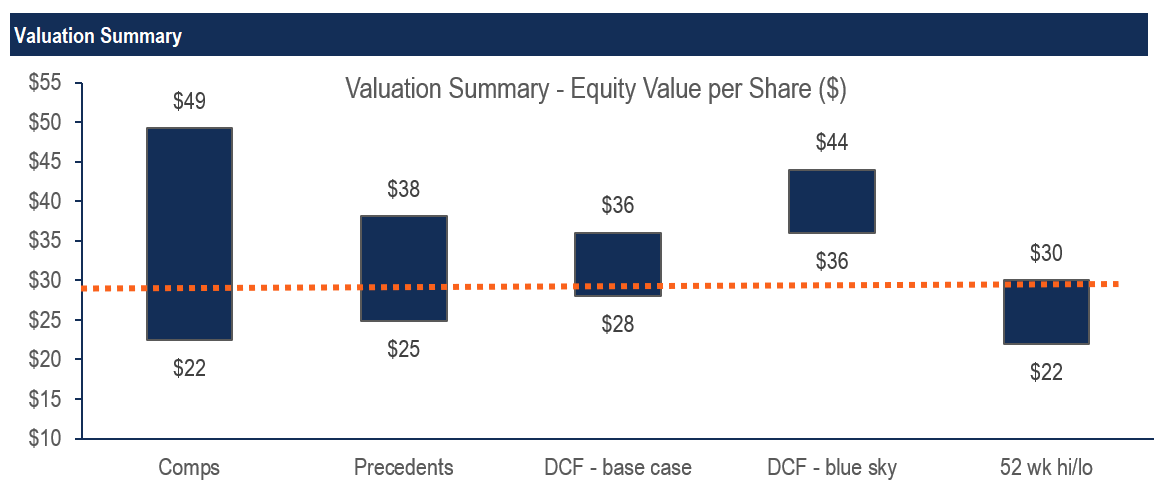
Asset valuation is one of the most important things that need to be done by companies and organizations. There are many reasons for valuing assets, including the following:
Asset valuation helps identify the right price for an asset, especially when it is offered to be bought or sold. It is beneficial to both the buyer and the seller because the former won’t mistakenly overpay for the asset, nor will the latter erroneously accept a discounted price to sell the asset.
In the event that two companies are merging, or if a company is to be taken over, asset valuation is important because it helps both parties determine the true value of the business.
When a company applies for a loan, the bank or financial institution may require collateral as protection against possible debt default. Asset valuation is needed for the lender to determine whether the loan amount is covered by the assets as collateral.
All public companies are regulated, which means they need to present audited financial statements for transparency. Part of the audit process involves verifying the value of assets.
See how CFI's Capital Markets & Securities Analyst (CMSA®) certification can help you advance your career. Download the CMSA® brochure to get an overview of our key course offerings.
Thank you for reading CFI’s guide to Asset Valuation. To keep learning and advancing your career, the following CFI resources will be helpful:
Below is a break down of subject weightings in the FMVA® financial analyst program. As you can see there is a heavy focus on financial modeling, finance, Excel, business valuation, budgeting/forecasting, PowerPoint presentations, accounting and business strategy.
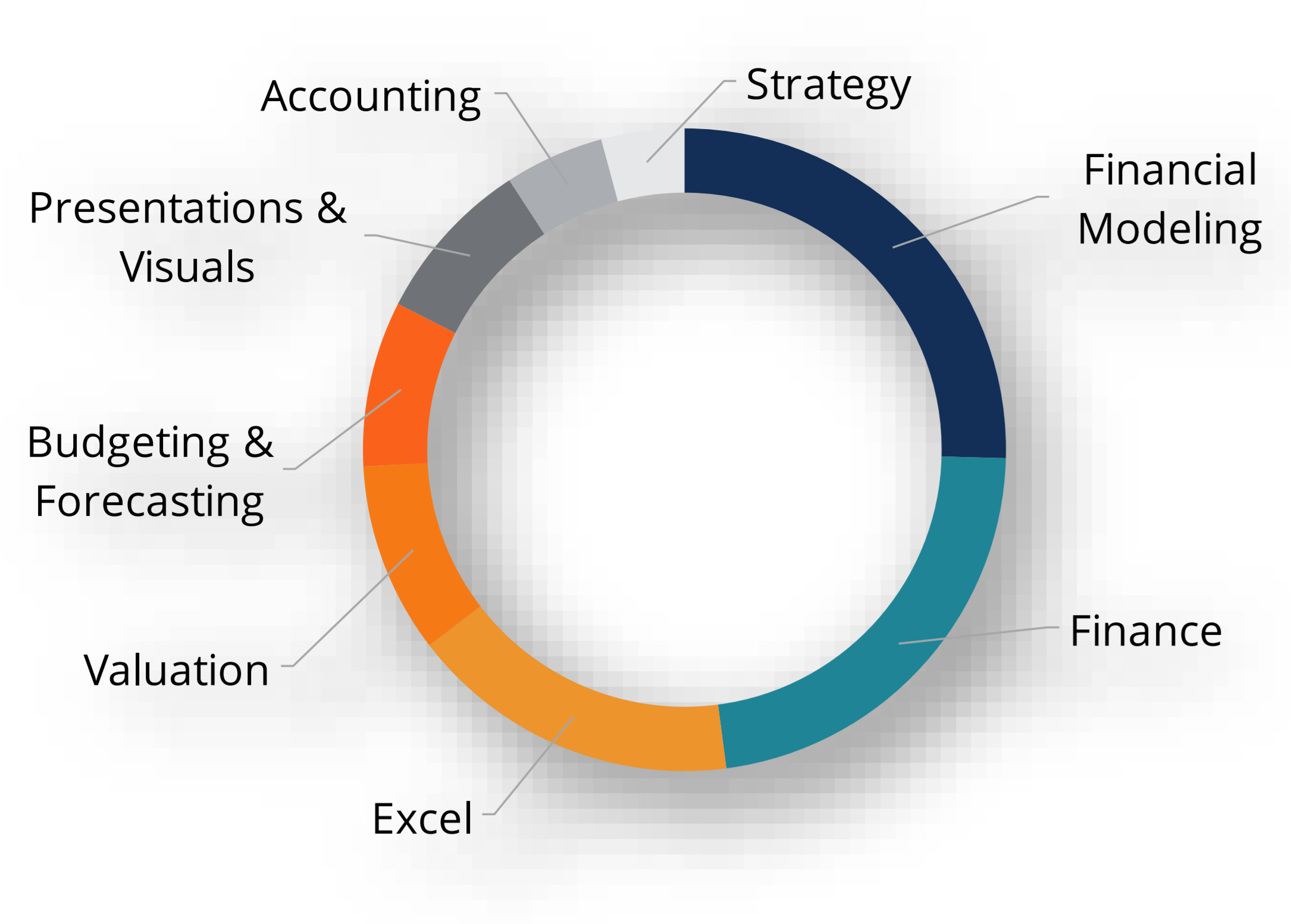
A well rounded financial analyst possesses all of the above skills!
CFI is the global institution behind the financial modeling and valuation analyst FMVA® Designation. CFI is on a mission to enable anyone to be a great financial analyst and have a great career path. In order to help you advance your career, CFI has compiled many resources to assist you along the path.
In order to become a great financial analyst, here are some more questions and answers for you to discover:


