Get Certified for Financial Modeling (FMVA)®
Gain in-demand industry knowledge and hands-on practice that will help you stand out from the competition and become a world-class financial analyst.
The level of engagement generated from a created content or a brand campaign
The engagement rate is a metric used to gauge the level of engagement generated from created content or a brand campaign. In other words, the engagement rate refers to the level of interaction with followers that is generated from content created by a user.


Where:
Total engagement is calculated differently depending on the platform. For example:
It is important to note that the makeup of “total engagement” can be altered in any way by the user who is using the metric. For example, the user may want the total engagement on Facebook to include only the total amount of likes. Such alterations are valid if the user uses the same method of determining total engagement across all their calculations. For example, consider the following Facebook pages that each created a brand campaign post:

If an individual deemed that “total engagement” should comprise only total likes and comments, the individual should use that same measurement standard across the other Facebook pages to ensure consistency.
An analyst is conducting an analysis on Company ABC, which maintains a social media page on Facebook. Part of the analysis process involves determining how engaged followers are with the company’s Facebook page. The analyst also found two comparable companies. Given the information below, does Company ABC see a higher rate of engagement than the comparables?
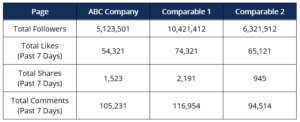
Using total likes, total shares, and total comments as the method for determining total engagement, the rate of engagement for each company is as follows:
Company ABC = (54,321 + 1,523 + 105,231) / 5,123,501 x 100 = 3.14%
Comparable 1 = (74,321 + 2,191 + 116,954) / 10,421,412 x 100 = 1.86%
Comparable 2 = (65,121 + 945 + 94,512) / 6,321,512 x 100 = 2.54%
From the resulting figures above, Company ABC saw a higher engagement rate than the comparables. Note that Company ABC recorded the lowest number of followers but enjoyed the highest engagement rate. It only garnered about 105,000 comments to Comparable 1’s 116,000, but that number came from just about half as many followers as Comparable 1’s page has. The numbers imply that the content on the company’s Facebook page is more appealing to followers than that of similar pages.
The engagement rate provides a more accurate representation of content performance than simply looking at individual absolute measures such as the number of likes, comments, shares, etc. It is a more comprehensive metric.
As shown in the example above, although Comparable 1 attracted the highest number of followers, their engagement rate was the lowest. This potentially indicates that the content on Comparable 1 is not of high quality. It is a useful metric to use to (1) gauge the level of audience interaction, and (2) to gain insight into the quality of the content.
The engagement rate is unable to differentiate between interactions that are more important than others. For example, an individual may consider a “share” on a Facebook page more important than a “like.” However, the engagement metric does not account for that – both interactions are “equal” in the calculation. The metric must be customized to provide deeper insight.
Thank you for reading CFI’s guide to Engagement Rate. To keep learning and developing your knowledge base, please explore the additional relevant CFI resources below:
Below is a break down of subject weightings in the FMVA® financial analyst program. As you can see there is a heavy focus on financial modeling, finance, Excel, business valuation, budgeting/forecasting, PowerPoint presentations, accounting and business strategy.
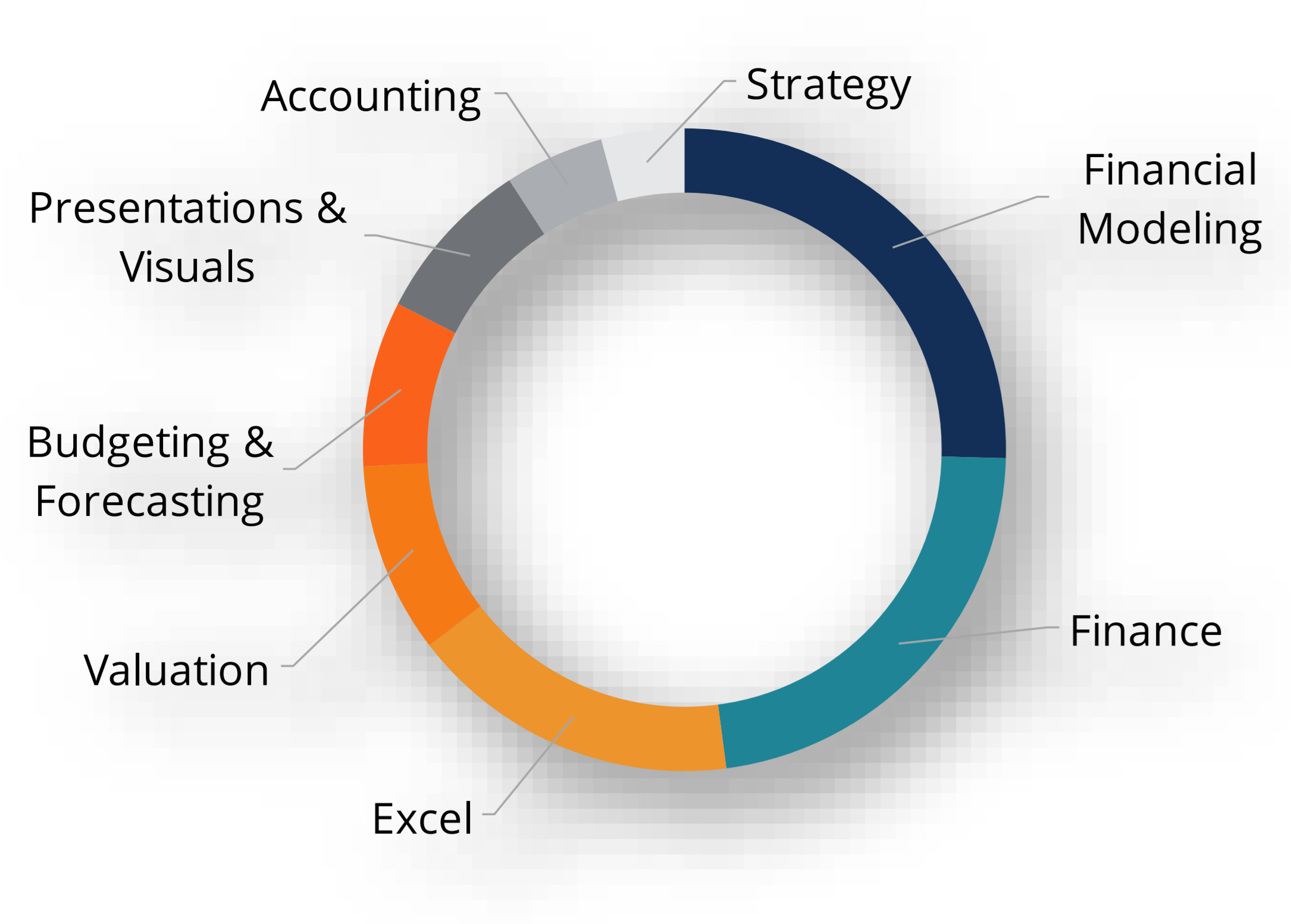
A well rounded financial analyst possesses all of the above skills!
CFI is the global institution behind the financial modeling and valuation analyst FMVA® Designation. CFI is on a mission to enable anyone to be a great financial analyst and have a great career path. In order to help you advance your career, CFI has compiled many resources to assist you along the path.
In order to become a great financial analyst, here are some more questions and answers for you to discover:


