Get Certified for Financial Modeling (FMVA)®
Gain in-demand industry knowledge and hands-on practice that will help you stand out from the competition and become a world-class financial analyst.
Total amount of dividend attributed to each share outstanding
Dividend Per Share (DPS) is the total amount of dividends attributed to each individual share outstanding of a company. Calculating the dividend per share allows an investor to determine how much income from the company he or she will receive on a per-share basis. Dividends are usually a cash payment paid to the investors in a company, although there are other types of payment that can be received (discussed below).
The formula for calculating dividend per share has two variations:
or
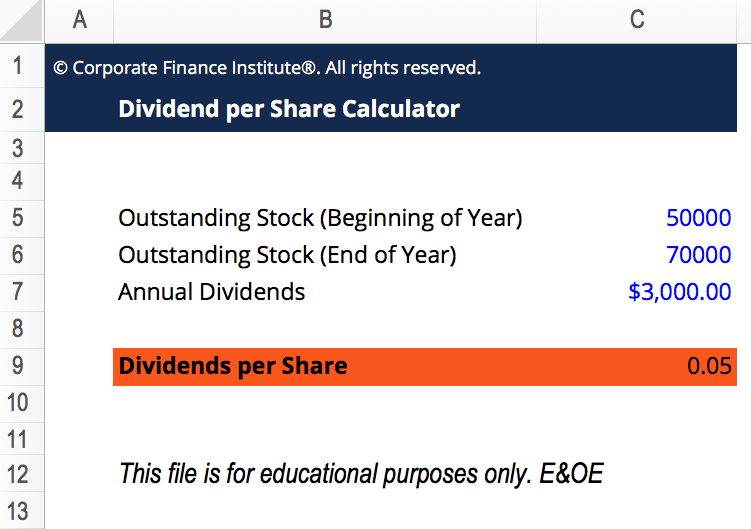
Complete the form below to download our Dividend Per Share Calculator!
Although dividends are usually a cash payment paid to investors, that is not always the case. There are several types of dividends, such as:
This is the most common form of dividend per share an investor will receive. It is simply a cash payment and the value can be calculated by either of the above two formulas.
The company issues a dividend in the form of an asset such as property, plant, and equipment (PP&E), a vehicle, inventory, etc.
The company gives each shareholder a certain number of extra shares based on the current amount of shares that each shareholder owns (on a pro-rata basis).
The company promises payment to shareholders at a later date. Scrip dividends are essentially a promissory note to pay shareholders at a future date.
The company liquidates all its assets and pays the sum to shareholders as a dividend. Liquidating dividends are usually issued when the company is about to shut down.
Company A announced a total dividend of $500,000 paid to shareholders in the upcoming quarter. Currently, there are 1 million shares outstanding.
The dividend per share would simply be the total dividend divided by the shares outstanding. In this case, it is $500,000 / 1,000,000 = $0.50 dividend per share.
If a company follows a consistent dividend payout ratio (i.e., the company is known to pay a consistent percentage of its earnings as dividends), a rough estimate of the dividend per share can be calculated through the income statement. To calculate the DPS from the income statement:
Net income is generally the last item on the income statement.
The number of shares outstanding can typically be found on the company’s balance sheet. If there are treasury shares, it is important to subtract those from the number of issued shares to get the number of outstanding shares.
Dividing net income by the number of shares outstanding would give you the earnings per share (EPS).
Alternatively:
Estimate the typical payout ratio by looking at past historical dividend payouts. For example, if the company historically paid out between 50% and 55% of its net income as dividends, use the midpoint (53%) as the typical payout ratio.
Company A reported a net income of $10 million. Currently, there are 10 million shares issued with 3 million shares in the treasury. Company A has historically paid out 45% of its earnings as dividends.
To estimate the dividend per share:
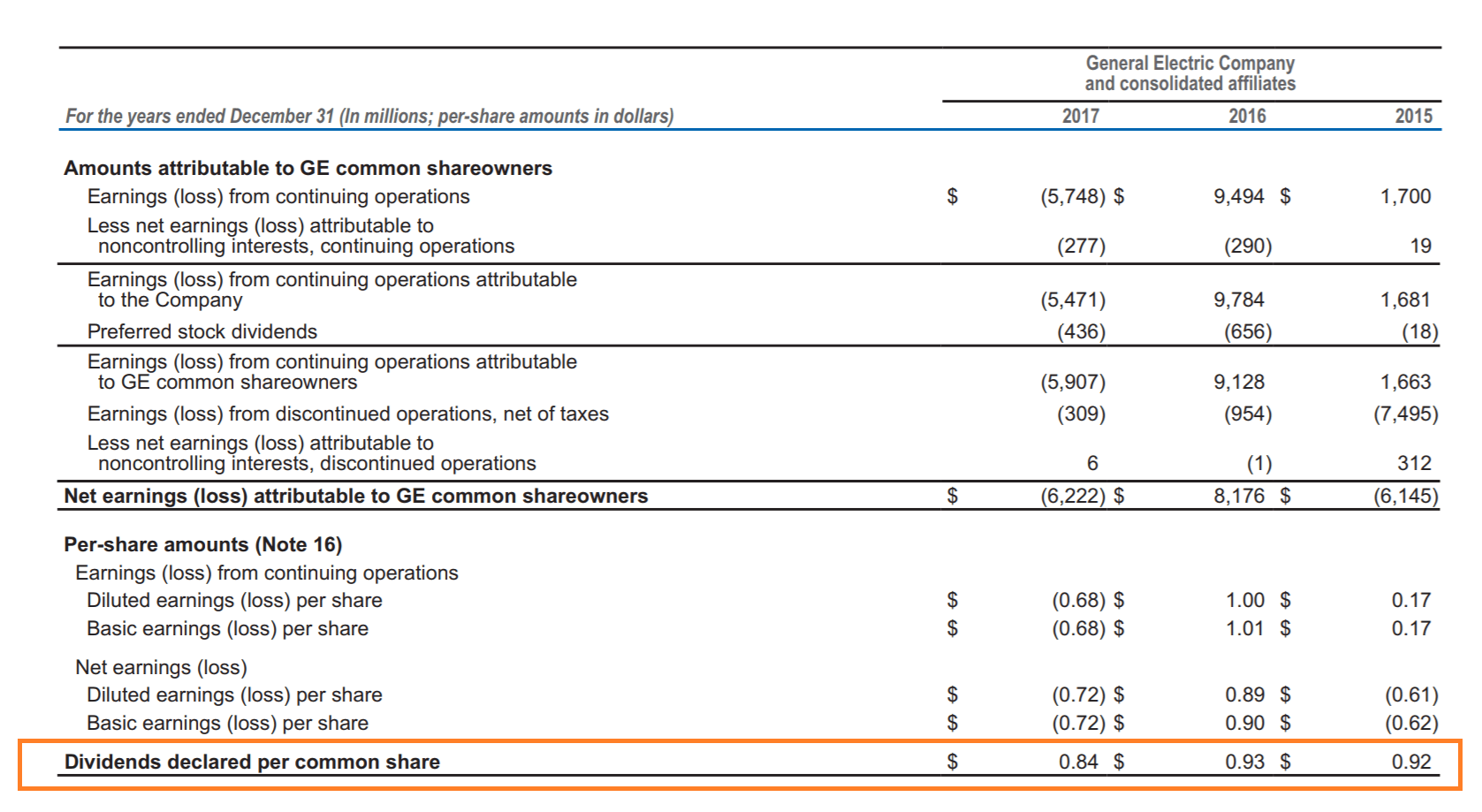
Below is an example from GE’s 2017 annual report. In their financial statements is a section that outlines the dividends declared per common share. For easy reference, you can compare the dividends to the net earnings per share (EPS) in the same period.
Let us consider two key reasons as to why companies choose to issue dividends:
Many investors enjoy receiving dividends and view them as a steady income source. Therefore, these investors are more attracted to dividend-paying companies.
Paying a dividend to shareholders may be a signaling method by the company. Dividend payments are typically associated with a strong company with positive expectations about its future earnings. This makes the stock more attractive and may increase the market value of the company’s stock.
Although dividends can be used to signal a company’s strength and attract investors, there are also several important reasons as to why companies do not issue dividends:
A company that is growing rapidly most likely won’t pay dividends. The earnings of the company are instead reinvested to help fund further growth.
A mature company may hold onto its earnings and reinvest them. The money may be used to fund a new project, acquire new assets, or pursue mergers and acquisitions (M&A).
If a company originally issues dividends but decides to pull back on its dividend payout, it can create unfavorable signaling for the company. When companies eliminate or reduce their existing dividend policy, this is typically viewed negatively by investors. Therefore, companies may avoid paying dividends at all to avoid this problem.
Thank you for reading CFI’s guide to dividend per share. To help you in your journey of becoming a world-class financial analyst, these additional CFI resources will be helpful:


