Get Certified for Financial Modeling (FMVA)®
Gain in-demand industry knowledge and hands-on practice that will help you stand out from the competition and become a world-class financial analyst.
Key IFRS standards compared to US GAAP and other accounting standards
IFRS standards are International Financial Reporting Standards (IFRS) that consist of a set of accounting rules that determine how transactions and other accounting events are required to be reported in financial statements. They are designed to maintain credibility and transparency in the financial world, which enables investors and business operators to make informed financial decisions.
IFRS standards are issued and maintained by the International Accounting Standards Board and were created to establish a common language so that financial statements can easily be interpreted from company to company and country to country.

IFRS are the standard in over 100 countries, including the EU and many parts of Asia and South America. The United States, however, has not yet adopted them and the SEC is still deciding whether or not they should move toward them as the official standard of accounting.
Below is a list of IFRS standards from http://www.ifrs.org/issued-standards/list-of-standards/
| IFRS # | IFRS Standard |
|---|---|
| 1 | First-time Adoption of International Financial Reporting Standards |
| 2 | Share-based Payment |
| 3 | Business Combinations |
| 4 | Insurance Contracts |
| 5 | Non-current Assets Held for Sale and Discontinued Operations |
| 6 | Exploration for and Evaluation of Mineral Resources |
| 7 | Financial Instruments: Disclosures |
| 8 | Operating Segments |
| 9 | Financial Instruments |
| 10 | Consolidated Financial Statements |
| 11 | Joint Arrangements |
| 12 | Disclosure of Interests in Other Entities |
| 13 | Fair Value Measurement |
| 14 | Regulatory Deferral Accounts |
| 15 | Revenue from Contracts with Customers |
| 16 | Leases |
| 17 | Insurance Contracts |
The largest difference between the US GAAP (Generally Accepted Accounting Principles) and IFRS is that IFRS is principle-based while GAAP is rule-based. Rule-based frameworks are more rigid and allow less room for interpretation, while a principle-based framework allows for more flexibility.
There are pros and cons to both approaches, depending on how they are used. For example, using a standard that fits within a “rule” but that clearly does not represent the principle behind the standard can be a downside of the GAAP. While conversely, taking an overly liberal interpretation of standards is a potential drawback to the IFRS.
If you’re looking for a career in accounting, then you should explore our Career Map to compare the various roles in the accounting industry,
Other helpful resources include our accounting interview guide and a huge database of technical articles.
Check out our free accounting courses here.
Thank you for reading CFI’s guide to IFRS Standards. To keep learning and developing your career as a financial analyst, these additional CFI resources will be helpful:
Below is a break down of subject weightings in the FMVA® financial analyst program. As you can see there is a heavy focus on financial modeling, finance, Excel, business valuation, budgeting/forecasting, PowerPoint presentations, accounting and business strategy.
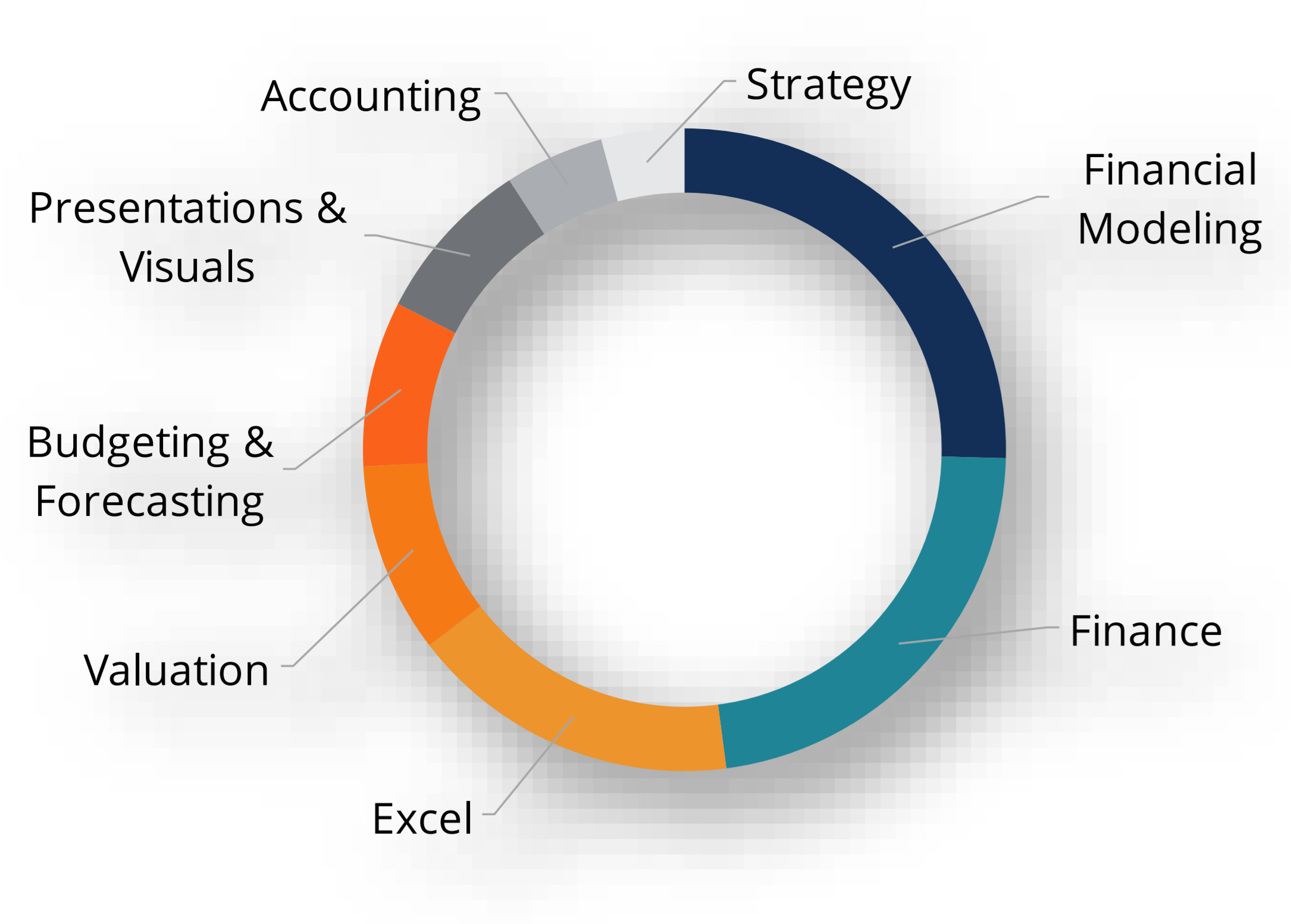
A well rounded financial analyst possesses all of the above skills!
CFI is the global institution behind the financial modeling and valuation analyst FMVA® Designation. CFI is on a mission to enable anyone to be a great financial analyst and have a great career path. In order to help you advance your career, CFI has compiled many resources to assist you along the path.
In order to become a great financial analyst, here are some more questions and answers for you to discover:


