Get Certified for
Business Intelligence (BIDA®)
Develop analytical superpowers by learning how to use programming and data analytics tools such as VBA, Python, Tableau, Power BI, Power Query, and more.
A branch of computer science that is focused on a machine’s capability to produce rational behavior from external inputs
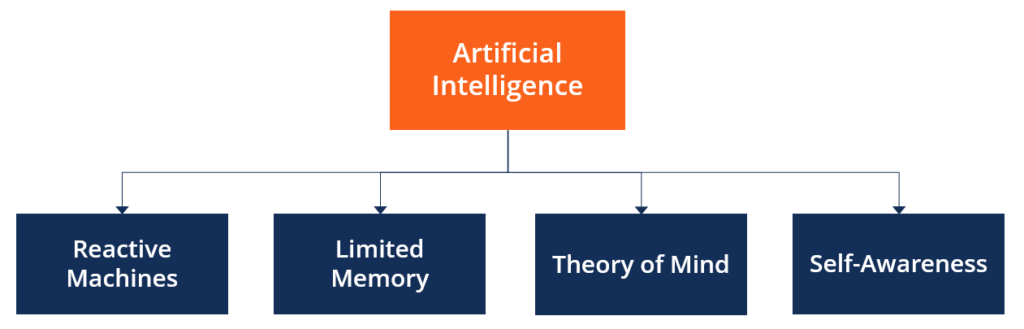
Artificial Intelligence (AI) is a broad branch of computer science that is focused on a machine’s capability to produce rational behavior from external inputs. The goal of AI is to create systems that can perform tasks that would otherwise require human intelligence. AI manifests itself in everyday life via virtual assistants, search prediction technology, and even ride-hailing services.

Reactive machines perceive present external information and plan actions accordingly. The machines perform specialized duties and only understand the task at hand. The machines’ behavior is consistent when the situation is repeated. In the 1990s, IBM developed a reactive machine named Deep Blue to play competitive chess, predicting moves by identifying each piece’s position on the board.
Limited memory machines can harness recent observations to make informed decisions. The machines consider observational data in reference to their pre-programmed conceptual framework. The observational data is retained for a limited period and then forgotten.
Theory of mind machines can form thoughts and make decisions with reference to emotional context; thus, they can participate in social interaction. The machines are still in the development stage; however, many exhibit aspects of human-like capability. For example, consider voice assistant applications that can comprehend basic speech prompts and commands but cannot hold a conversation.
Self-awareness machines demonstrate intelligent behavior through ideation, the formation of desires, and understanding their internal states. In 1950, Alan Turing developed the Turing Test to identify machines that could behave indistinguishably from humans.
Artificial intelligence’s growing popularity in the 21st century is largely due to the advancements in the subfield of machine learning. Machine learning develops systems that improve upon themselves, which is accomplished through the identification of algorithms. Some processes that machine learning optimizes include paperwork automation, forensic accounting, and algorithmic trading.
The easiest way to understand how a machine becomes intelligent with AI is to compare it to how humans learn. For example, consider a child learning how to ride a bicycle. The child mounts the bicycle, grips the handlebars, and hopes to stay upright and in control. The child does not learn how to ride a bike by understanding the physics of biking but rather through trial and error.
Over time, the child becomes instinctively adept in perceiving factors that can make him lose control of the bicycle. Just as a child learns the unwritten rules of riding a bicycle through practice, artificial intelligence is developed through repeated simulation.
Supervised learning is the most common learning method in the field of artificial intelligence. A machine attempts to derive a function from labeled sets of input-output pairs. When dealing with numerical data, regression is used. When dealing with categorical variables, classification is the preferred method. If the model provides an incorrect answer, it can be adjusted to produce more accurate outputs.
Unsupervised learning involves a machine transforming data into useful information. Common methods include clustering and association. Clustering groups similar variables together, whereas association detects correlation among variables. Data mining uses clustering and association to analyze large data sets. The process of transforming large datasets into meaningful information can be optimized using unsupervised learning.
In reinforcement learning, a machine autonomously responds to external stimuli and is conditioned through occasional rewards and punishments. The purpose of reinforcement learning is to develop a machine that can act rationally and independently.
The large investment bank, J.P. Morgan, currently uses reinforcement learning algorithms to place trades. This is accomplished through programming that accordingly awards or penalizes the algorithm depending on the decision made.
Rapid advances in artificial intelligence will result in a profound impact on productivity, employment, and competition. However, the future integration of AI into society is a controversial subject.
Increasing economic productivity leads to more satisfied customers and strengthened corporate profitability. In the airline industry, AI will drive customer satisfaction by enabling more accurate scheduling and safer flights. Businesses that harness AI can enhance their value proposition to customers while increasing profitability.
For example, Delta Airlines leverages machine learning to provide its customers with a superior flying experience. Delta analyzes Big Data to learn about aircraft positions, weather conditions, and aircraft diagnostics. Hypothetical outcomes and their probabilities are then identified. The airline then optimizes its flight scheduling regarding the potential outcomes.
Rapid expansion in the field of artificial intelligence will create more high-paying jobs, which, in turn, will require more highly educated employees. The most common criticism of AI is that it will automate low-skilled jobs and increase the unemployment rate among less-educated people.
Furthermore, low-skilled employees are more likely to be minorities due to systematic discrimination. It is therefore argued that artificial intelligence could reinforce systemic discriminatory practices.
Companies seeking a competitive advantage can leverage AI to optimize their operations. Currently, only innovators and a few early adopters are integrating AI into their businesses. Once the economic benefits of AI integration outweigh the R&D and integration costs, more companies will adopt the technology.
Assume a toy manufacturer decides to use machine learning to further optimize its supply chain. The manufacturer can take advantage of its lower cost of goods sold to offer toys at a lower price point and capture market share. This demonstrates how AI can increase competitive behavior in the marketplace.
Connect what you just learned to a clear career path with CFI’s role‑based courses and certification programs.
Artificial Intelligence in Finance and Banking