Get Certified for
Business Intelligence (BIDA®)
Develop analytical superpowers by learning how to use programming and data analytics tools such as VBA, Python, Tableau, Power BI, Power Query, and more.
The process of data collection from various sources and managing it to provide valuable business insights
Data warehousing can be defined as the process of data collection and storage from various sources and managing it to provide valuable business insights. It can also be referred to as electronic storage, where businesses store a large amount of data and information. It is a critical component of a business intelligence system that involves techniques for data analysis.
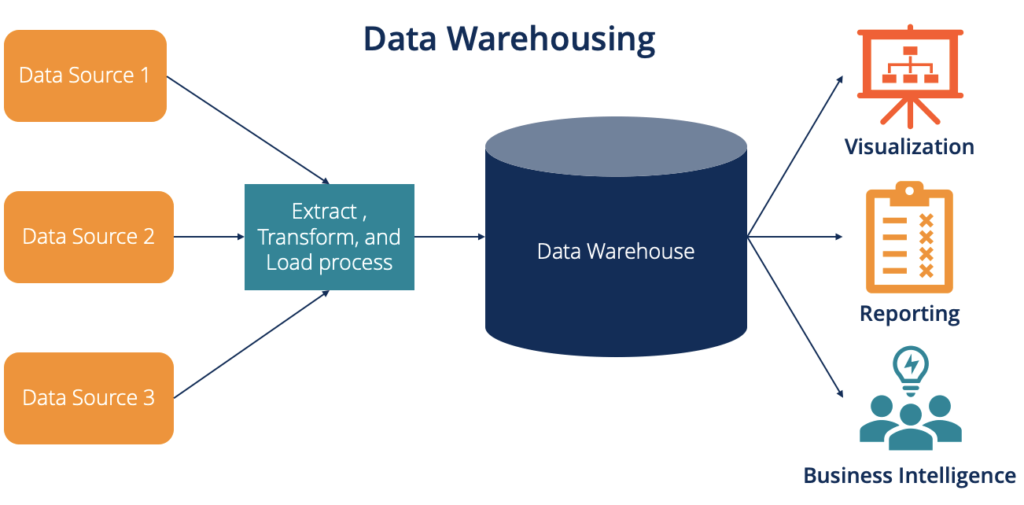
Data warehousing is a mixture of technology and components that enable a strategic usage of data. It is the electronic collection of a significant volume of information by an organization intended for query and analysis rather than for the processing of transactions. Data warehousing is a method of translating data into information and making it accessible to consumers in a timely way to make a difference.
Data analysis is used to offer deeper information about the performance of an organization by comparing combined data from various heterogeneous data sources. A data warehouse runs queries and analyses on the historical data that are obtained from transactional resources.
The idea of data warehousing was developed in the 1980s to help to assess data that was held in non-relational database systems. It was designed to enable businesses to use their archived data to help them achieve a corporate advantage. The vast volume of data in data centers comes from various locations, such as communications, sales and finance, customer-based applications, and external partner networks.
Any data that is put into the warehouse does not change and cannot be modified because the data warehouse analyzes incidents that have previously happened by concentrating on changes in data over time. Data warehousing should be done so that the data stored remains secure, reliable, and can be easily retrieved and managed.
The following steps are involved in the process of data warehousing:
Data warehousing – when successfully implemented – can benefit an organization in the following ways:
The massive return on investment for businesses that successfully introduced a data warehouse shows the tremendous competitive edge that the technology brings. The competitive advantage is achieved by enabling decision-makers to access the data that may reveal previously unavailable and untapped information related to customers, demands, and trends.
Data storage increases the efficiency of business decision-makers by providing an interconnected archive of consistent, impartial, and historical data. Data warehousing helps to incorporate data from various conflicting structures into a form that offers a clearer view of the enterprise. By translating data into usable information, data warehousing helps market managers to do more practical, precise, and reliable analyses.
Data warehousing keeps all data in one place and doesn’t require much IT support. There is less of a need for outside industry information, which is costly and difficult to integrate.
The following problems can be associated with data warehousing:
Often, we fail to estimate the time needed to retrieve, clean, and upload the data to the warehouse. It may take a large proportion of the overall production time, although certain resources are in place to minimize the time and effort spent on the process.
Hidden issues associated with the source networks that supply the data warehouse may be found after years of non-discovery. For example, when entering new property information, some fields may accept nulls, which may result in personnel entering incomplete property data, even if it was available and relevant.
Data warehousing also deals with similar data formats in different sources of data. It may result in the loss of some valuable parts of the data.
In order to help you advance your career to your fullest potential, these additional resources will be very helpful: