Get Certified for
Financial Planning & Wealth Management Professional (FPWMP®)
Learn financial analysis & planning, portfolio management, and risk assessment.
Wealth management is one of the most relationship-driven and personally rewarding careers in finance. It offers the opportunity to work closely with high-net-worth individuals and families, help them achieve meaningful financial goals, and build a practice that grows with your client base over time.
The specific role of a wealth manager varies by firm and specialization, but the work generally combines investment management, financial planning, and long-term client relationship management.
This guide walks through what wealth management is, the skills a wealth management career requires, different paths within the field, and how careers can progress.
Wealth management is a holistic financial advisory service that focuses on protecting and growing the wealth of high-net-worth individuals (HNWI) and ultra-high-net-worth individuals (UHNWI). Wealth managers provide a wide array of financial advice to clients, such as investment management, tax and estate planning, and philanthropy.
Wealth managers take a long-term view of a client’s full financial picture. They develop customized financial strategies based on each client’s specific situation, goals, and risk tolerance. Each component of a wealth management strategy must include risk management to protect clients’ wealth.
As a wealth manager, your role is to act as a trusted advisor across all areas of a client’s financial life.
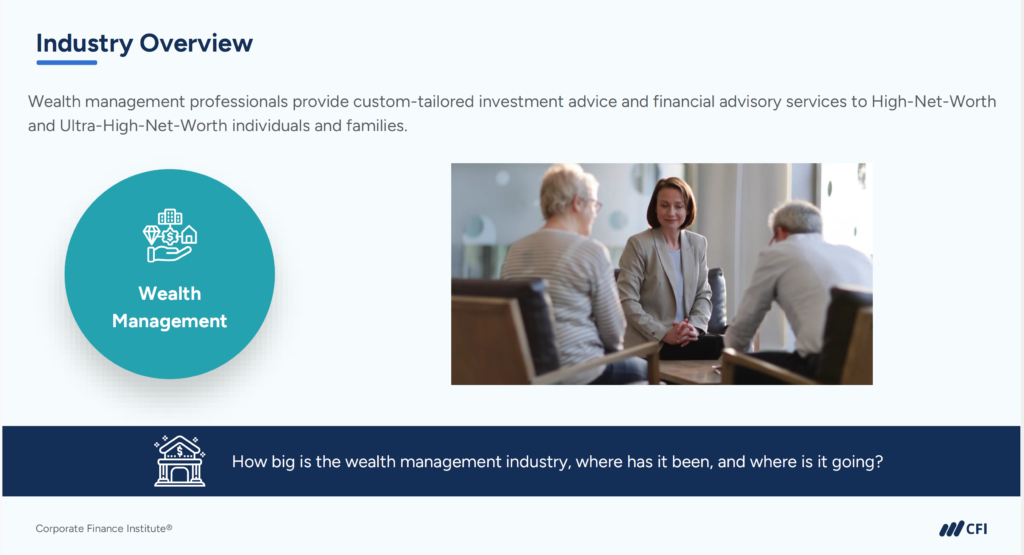
Wealth managers are the professionals who deliver that comprehensive service directly to clients. They translate financial strategy into personalized advice, coordinating specialists in tax, legal, and investment management on a client’s behalf.
Many wealth managers work for banks offering private wealth management, boutique wealth management firms, or large financial institutions. Others operate independently as registered investment advisors (RIAs). Regardless of the setting, the work focuses on delivering tailored financial guidance to a select group of clients.
A wealth management career demands more than financial knowledge. You need to evaluate complex client situations, build conviction around long-term strategies, manage relationships with discretion, and communicate clearly across a wide range of financial topics.
The exact skill mix varies depending on your role and firm. A portfolio manager, a financial advisor, and a business development professional will not draw on the same strengths every day. Even so, most wealth management careers are built on a shared foundation across the areas below.
You need a strong command of capital markets, asset classes, and portfolio construction. Clients trust you to build portfolios that reflect their individual goals, risk tolerance, and time horizon.
Investment and portfolio management skills help wealth managers:
Wealth management goes beyond investing. You need to understand how retirement structures, estate plans, and tax strategies work together to preserve and transfer wealth effectively.
Financial and tax planning knowledge helps wealth managers:
The ability to build client relationships and communicate clearly is just as important as technical knowledge in wealth management. Clients want someone who can explain complex ideas clearly, listen carefully, and make them feel confident about their financial decisions. Strong interpersonal skills influence client retention, referrals, and the long-term growth of your book of business.
As a wealth manager, your interpersonal skills combined with technical expertise help you:
Analytical and quantitative reasoning skills allow you to move from raw financial data to clear, defensible recommendations. You use this reasoning to anticipate risks and identify opportunities before they affect your clients.
Analytical and quantitative reasoning skills help wealth managers:
Wealth managers operate as fiduciaries. You are legally and ethically obligated to act in your client’s best interest at all times. Maintaining that standard builds the trust your practice depends on.
Ethical judgment and trustworthiness help wealth managers:
Growing and retaining a client base is a core part of the role. The wealth managers who advance are those who combine financial expertise with the ability to attract and keep high-net-worth clients.
Sales and business development skills help wealth managers:
Wealth management careers are known for their blend of financial expertise and relationship-driven work. For the right person, the role is both intellectually engaging and personally rewarding. The environment has its own set of demands, particularly in the early stages of your career.
Starting out in a wealth management role, you can expect:
As you advance into senior wealth manager roles, you’ll take on greater responsibility for growing your book of business, mentoring junior team members, and deepening relationships with existing clients. The focus moves from supporting others to leading your own client relationships, making independent recommendations, and contributing to the growth of your firm.
Overall, a wealth management career rewards professionals who combine strong financial knowledge with genuine interpersonal skills. For those who enjoy building long-term relationships and helping clients achieve meaningful financial goals, it offers some of the most fulfilling work in finance.
A strong educational foundation is important in wealth management. Most professionals enter the field with a bachelor’s degree in finance, economics, accounting, or a related discipline. Some firms prefer candidates with advanced degrees, such as an MBA or a master’s in financial planning.
Beyond formal education, certifications play a significant role in career development. They demonstrate specialized knowledge, signal commitment to the profession, and can open doors to more senior roles and higher-value clients. The certifications most relevant to wealth management include:
In addition to professional certifications, many wealth management roles require FINRA licenses. The Series 7 license allows you to sell a broad range of securities products. The Series 63 covers state securities regulations. The Series 65 or 66 licenses are required to provide investment advice for compensation.
Your employer will typically guide you through the licensing process, but understanding these requirements early helps you plan your path into the field.
Wealth management encompasses several distinct career tracks, each with its own focus and day-to-day responsibilities. Understanding these paths helps you identify where your skills and interests align.
In private wealth management, you work exclusively with high-net-worth and ultra-high-net-worth individuals and families. The role goes beyond investment advice. You coordinate tax planning, estate structuring, philanthropic giving, and intergenerational wealth transfer. Clients at this level often have complex financial situations that require a highly personalized and long-term approach.
Financial advisors are the most client-facing professionals in wealth management. The role centers on building relationships, understanding client goals, and delivering ongoing financial guidance. You manage your client relationships directly, which means strong communication and sales skills are essential. Many financial advisors grow their practice by generating referrals from satisfied clients over time.
Portfolio managers focus on investment strategy and asset allocation. You are responsible for constructing and managing client portfolios to meet specific return objectives and risk tolerances. The role is more analytical than client-facing. You spend most of your time evaluating markets, selecting investments, and monitoring portfolio performance.
Business development professionals focus entirely on growing the firm’s client base. Your goal is to identify and acquire HNW client prospects and cultivate high-value referral relationships. Success in this role depends on your network, your ability to open doors, and your skill in converting introductions into long-term client relationships.
A wealth manager’s day is a fast-paced blend of high-level financial planning, client relationship management, and market analysis. No two days in wealth management are exactly the same. Client needs, market conditions, and business development activities all influence how your time is spent day to day. Here’s a look at what wealth managers often do in a day.
Your day typically starts early with reviewing market news, portfolio performance, interest rate updates, and economic developments that could affect clients. You check client accounts for major changes, upcoming cash needs, or scheduled transactions.
Before client meetings, you’ll review each client’s financial plan, investment allocation, recent life events, and any open action items. For example, one client may be preparing for retirement, while another may need liquidity for a home purchase or business sale.
Midday often includes client meetings, either in person or by phone. These conversations cover investment performance, portfolio planning, cash flow needs, and any significant life changes that may affect a client’s strategy.
Lunch can also become a business development opportunity. You might meet with a prospective client, reconnect with a referral partner such as an attorney or accountant, or attend a networking event.
After client meetings, you’ll follow up on planning or investment tasks. You might work with portfolio managers, analysts, tax advisors, estate attorneys, insurance specialists, or lending teams.
For example, you might ask an investment team to rebalance a client portfolio, coordinate with an attorney on trust documents, or review tax-loss harvesting opportunities before year-end.
Wealth managers also spend time building and maintaining their client base. This work might include checking in with existing clients, asking for referrals, attending networking events, preparing proposals for prospective clients, or following up after introductory meetings.
They may also handle client service requests, such as helping a client transfer funds, update account beneficiaries, review a charitable giving strategy, or prepare for a meeting with their accountant.
Wealth management careers often follow a progression from client service and analytical support to advisor roles, relationship management, and eventually firm leadership. Titles vary by firm, but responsibilities generally expand over time.
Entry-level roles in wealth management often include analyst and client service associate positions. Research analysts focus on helping advisors and portfolio managers decide which investments to recommend to clients. Client service associates often handle onboarding, documentation, account maintenance, and routine client requests.
Through entry-level roles, you gain exposure to many parts of wealth management and develop the technical, operational, and client service skills needed to advance.
As an associate advisor, you take on a more active role in client relationships. You might assist with financial planning, prepare recommendations, and begin sitting in on client meetings. Some associate advisors begin taking responsibility for smaller client relationships or segments of a book, often under the supervision of a senior advisor.
At this level, you build advisory judgment, technical knowledge, and relationship management skills to eventually manage your own book of business.
Senior wealth managers or senior advisors lead client relationships and manage a defined book of business. They coordinate portfolio planning, investment recommendations, and ongoing client communication, often with support from planning, investment, and operations teams.
At this level, you are also responsible for deepening client relationships, retaining assets, and, in many roles, growing your client base. You may also mentor junior team members and contribute to the overall performance of your team.
Partners, managing directors, or senior executives carry significant responsibility for firm growth, client relationships, and strategic direction. You might oversee a large and high-value book of business, lead advisor teams, manage key client relationships, or help shape growth strategy.
For those pursuing a wealth management career, including recent university graduates, early-career professionals, and career switchers, here are practical ways to build the skills and experience employers look for:
Before pursuing wealth management roles, focus on building financial knowledge, clear communication skills, client service judgment, and the professionalism hiring managers and senior advisors expect from early-career candidates.
Wealth management can be an intellectually engaging and personally rewarding career path. The work requires strong technical knowledge, relationship-building skills, and the ability to earn and maintain client trust over the long term. It also offers the opportunity to make a meaningful difference in your clients’ financial lives, often across generations.
If you are exploring career options, consider how wealth management compares with other finance paths based on your interests, strengths, and long-term goals. If you want to prepare for a career in wealth management, focus on building skills in financial planning, investment management, client communication, and business development.
Your path into wealth management starts with genuine curiosity, a commitment to serving others, and the technical foundation that top firms expect from early-career professionals.
Ready to take the next step in your finance career? Check out CFI’s comprehensive course catalog to gain the knowledge and certifications that can set you apart in the world of finance and banking. Explore CFI’s Career Map to discover the best path toward your professional goals.
Connect what you just learned to a clear career path with CFI’s role‑based courses and certification programs.