Get Certified for Financial Modeling (FMVA)®
Gain in-demand industry knowledge and hands-on practice that will help you stand out from the competition and become a world-class financial analyst.
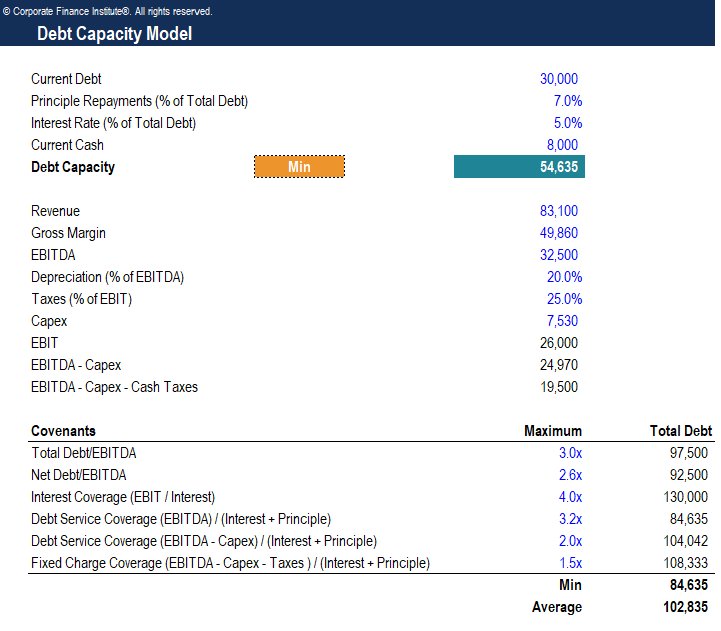
This Debt Capacity Model Template will help you assess the debt capacity based on various credit metrics and current earnings.
Here is a screenshot of the debt capacity model template:
Click the button below to download our free Debt Capacity Model template!
Debt capacity refers to the total amount of debt a business can incur and repay according to the terms of the debt agreement. A business takes on debt for several reasons, such as boosting production or marketing, expanding capacity, or acquiring new businesses. However, incurring too much debt or taking on the wrong kind can result in damaging consequences.
At the end of the day, lenders wish to seek comfort and confidence in lending their money to businesses that can internally generate enough earnings and cash flow to not only pay the interest, but also the principal balance.
The two main measures to assess a company’s debt capacity are its balance sheet and cash flow measures. By analyzing key metrics from the balance sheet and cash flow statements, investment bankers determine the amount of sustainable debt a company can handle in an M&A transaction.
Some important credit metrics to measure in assessing debt capacity:
Debt-to-equity ratios provide investment bankers with a high-level overview of a company’s capital structure.
Another set of measures investment bankers use to assess debt capacity is cash flow metrics. These metrics include total debt to EBITDA, which can be broken down further to senior debt-to-EBITDA, cash interest coverage, and EBITDA-Capital Expenditures interest coverage.
The Debt-to-EBITDA measure is the most common cash flow metric to evaluate debt capacity. This ratio reflects a company’s ability to pay off its debt and provides investment bankers with information on the time required to clear all debt, ignoring interest, taxes, depreciation, and amortization.
The cash interest coverage measure indicates how many times cash flow generated from business operations can cover interest expense on debt.
By taking the EBITDA, deducting capital expenditures, and examining how many times this metric can cover the interest expense, investment bankers can assess a company’s debt capacity.
The fixed-charge coverage ratio is equal to a company’s EBITDA – CapEx – Cash Taxes – Distributions.
For more resources, check out our business templates library to download numerous free Excel modeling, PowerPoint presentations, and Word document templates.