Get Certified for
Commercial Banking (CBCA®)
Stand out and gain a competitive edge as a commercial banker, loan officer, or credit analyst with advanced knowledge, real-world analysis skills, and career confidence.
Every major lending decision starts with a credit analyst. Businesses rely on them to assess loan risk. If you enjoy financial analysis and want to make real business decisions, credit analysis is worth exploring.
Credit analyst roles exist across a wide range of industries and institution types. Breaking into credit analysis doesn’t require a prestigious degree or years of experience. It requires the right skills, a clear plan, and the initiative to build them.
This guide answers all your questions on how to become a credit analyst. You’ll learn about education requirements, the skills that matter most, how to build experience from scratch, certifications worth considering, and how to land your first role.
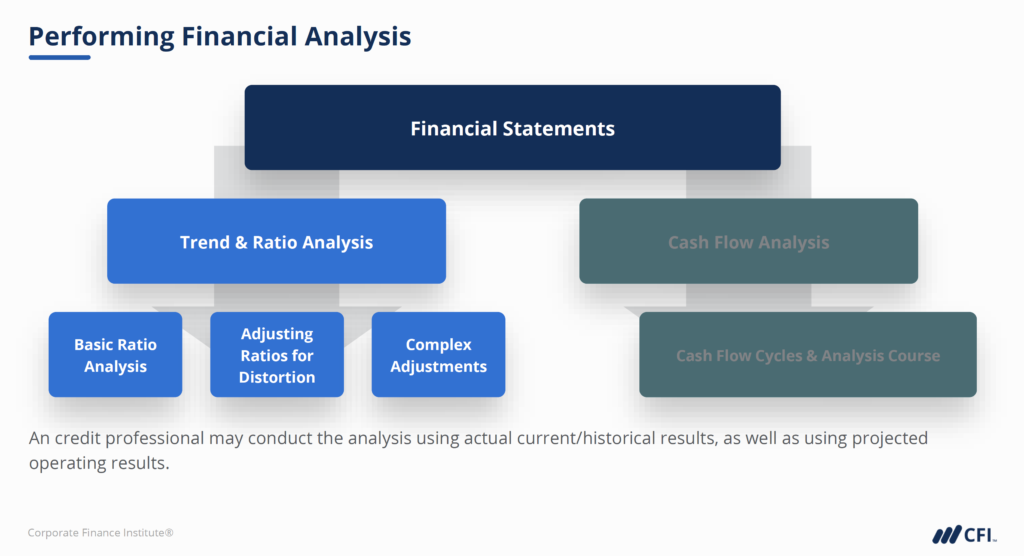
A credit analyst’s job is to answer two core questions: should we lend to this borrower, and if so, on what terms? Credit analysts assess a potential borrower’s financial health using a company’s financial statements and credit analysis ratios. They also build cash flow projections and debt schedules in Excel to test different repayment scenarios.
Analysts write credit memorandums (credit memos) to summarize their findings on qualitative risk factors such as industry trends, management quality, and competitive positioning. They also recommend whether to approve, modify, or decline a loan. In many credit roles, analysts present their recommendations to credit committees and senior stakeholders.
The day-to-day credit analyst tasks vary by sector and employer type, but financial analysis and communication are the two skills that underpin all of them.
Credit analyst roles exist across many types of institutions. Here’s what to expect from each setting:
A bachelor’s degree is the standard entry requirement for credit analyst jobs. Most employers don’t require a degree from a target school or a specific program. The most common degree paths into credit analysis are finance, accounting, economics, and business.
If you’re still in school, the most relevant coursework to prioritize includes financial accounting, corporate finance, credit risk, business statistics, and Excel and financial modeling.
You do not need an MBA (Master of Business Administration) to start or advance as a credit analyst. An MBA is useful If your goal is to advance into a senior role that requires strategic and cross-functional management skills for leading large departments.
Employers hire credit analysts with degrees in accounting, economics, mathematics, and other related fields, not just finance. The priority for employers is financial statement literacy and analytical ability, regardless of your major.
If your degree isn’t in a directly related field, your coursework matters more than your major. Finance electives, accounting courses, and quantitative subjects all build the relevant foundation. A strong academic record in these areas strengthens your candidacy for credit analyst positions.
Certifications can also help non-finance majors and career changers build the credit-specific knowledge employers look for.
When people want to know how to become a credit analyst, they’re often talking about credit analyst skills. Credit analysts rely on a mix of technical and interpersonal skills to evaluate borrower risk and communicate their findings.
Most of these skills described below are developed on the job or through courses and certifications over time. As you read through each skill, note your existing capabilities and the areas you’d like to develop.
Many people want to know how to become a credit analyst with no experience. Job descriptions often list prior experience as a requirement even for entry-level roles, but this does not necessarily mean full-time experience in a credit role.
The good news is that there are several ways to break into credit analysis without direct experience in a credit role:
Building a portfolio is one of the most practical things you can do as an early-career credit analyst candidate. A few well-executed work samples show employers what you can do, regardless of your job title or years of experience. A portfolio is one of the most effective tools to become a credit analyst with no experience.
These three portfolio pieces are a good place to begin:
If you’re working toward a CBCA® certification with CFI, the Case Study Challenges included in the program can work as portfolio pieces to show employers. They are based on real lending scenarios and give you concrete work samples to reference in interviews. Completing the program gives you proof of skills and a recognized credential.
Once you have two or three pieces ready, upload them to your LinkedIn profile or a simple personal website. Uploading your work samples allows hiring managers the ability to review them before an interview.
Certifications are a practical way to build job-ready skills and signal commitment to hiring managers, especially for candidates from non-traditional backgrounds.
Not all credit certifications are designed for the same career stage. Some target candidates are just starting out. Others are built for experienced professionals looking to formalize their expertise or move into senior roles. Choosing a certification that matches your current experience level and career goals makes a meaningful difference in how useful it is.
For those looking to become a certified credit analyst online, the table below compares the most widely recognized credentials by career stage and format. They vary in focus, format, and the career stage for which they are designed. Use this table to identify which one aligns with where you are now.
| Commercial Banking & Credit Analyst (CBCA®) | Corporate Finance Institute (CFI) | Students, early-career professionals, and career switchers | Credit analysis, risk assessment, business analysis, loan structuring | None; optional prep courses available | Self-paced, online courses & final exam |
| Certified Credit and Risk Analyst (CCRA) | National Association of Credit Management (NACM) | Early to mid-career credit professionals | Financial statement analysis, credit risk assessment | Completion of three required courses | Live online courses & final exam |
| Certified Credit Executive (CCE) | National Association of Credit Management (NACM) | Senior credit professionals and leaders moving into executive-level roles | Accounting, finance, domestic & international credit, management, law | Three eligibility paths based on designations, experience, and career qualifications | Prep formats vary; in-person final exam |
| Credit Risk Certification (CRC) | ProSight Financial Association | Experienced commercial credit and banking professionals | Commercial credit risk across seven practice areas | Minimum 3 years of relevant experience | Exam-based self-study prep |
| Chartered Credit Analyst (CCA) | Global Academy of Finance & Management (GAFM) | Analysts and managers, including international professionals | Credit analysis, diagnostic skills, borrower assessment, portfolio management | 3 years of relevant professional experience | Live or self-paced courses & final exam |
The right certification depends on three things: where you are in your career, the type of role you are targeting, and your available time and budget.
If you are early in your career or switching from another field, look for certifications with no prerequisites and a self-paced format. Programs like CBCA®, CCRA, and CCA are all solid options at this stage. If you have three or more years of experience in a credit or commercial lending role, CRC or CCE may be a better fit.
Commercial banking roles reward candidates with hands-on credit analysis and loan structuring skills. Credit rating agency roles look for strong analytical writing alongside modeling ability. The best choice is the certification that aligns most closely with core skills of the job you want.
Some certifications require live coursework on a fixed schedule. Others are fully online and self-paced. If you are working full-time or balancing other commitments, a self-paced program gives you more flexibility to complete it on your own timeline.
Some credentials require prior coursework, a minimum number of years of experience, or in-person exams. Confirming these details in advance saves you from starting a program you are not yet eligible or prepared to complete.
A career as a credit analyst offers a clear path forward. Professionals who build strong analytical foundations early are well positioned to move into senior roles, leadership positions, and higher-earning specializations over time.
The most common track runs through commercial banking, starting as a credit analyst, where you develop core skills in financial statement analysis and credit memo writing. The next step is a senior credit analyst role with greater portfolio responsibility. Many credit analysts go on to portfolio management, then relationship management, and eventually into credit director or VP-level leadership.
The rating agency track follows a different but equally structured path. You can progress from credit analyst to senior analyst, then into associate director roles with broader coverage responsibilities and more client-facing work.
Across all industries, the Bureau of Labor Statistics reports the following compensation benchmarks for credit analysts (as of May 2023):
| Entry-level | $50,000 – $62,000 |
| Mid-level | $79,000 – $109,000 |
| Senior / management | $110,000 – $165,000 |
Compensation can be higher in certain sectors, such as banking and financial services. According to Glassdoor data, commercial credit analysts can earn $76,000 to $128,000 depending on experience and employer. Glassdoor data also indicates that credit rating analysts can earn $86,000 to $155,000, though entry-level roles (0-1 year of experience) pay closer to $62,000.
Credit analysis also creates pathways beyond commercial lending and credit rating firms. Strong analysts regularly move into private credit, buy-side credit roles, corporate banking, and credit risk management. These roles come with broader responsibilities, higher compensation, and greater autonomy.
Credit analysis offers something that many finance careers do not: stability with upside. Lending decisions happen in every economic cycle. That means demand for skilled credit analysts remains consistent even when other areas of finance slow down.
The earning potential is higher than the entry-level salary range suggests. Analysts who develop strong relationship skills often move into relationship management, where earning potential increases significantly. Those who build deep credit risk expertise can move into leadership roles that shape how entire institutions manage their loan portfolios.
The analytical skills, industry knowledge, and professional network you build as a credit analyst carry value across every role that follows.
Credit analysts enter the field from several different starting points. The four scenarios described below reflect typical entry points into the field. Find the profile that most closely matches your situation and use it as a starting point.
You have a degree but no internship or full-time experience in credit:
You have strong financial statement skills but limited exposure to credit risk or lending.
You are already working in an adjacent role and want to move into a formal credit analyst position.
You earned your degree outside of the country where you are job searching and need to build credibility in a new market.
Online certification has become a widely accepted path into credit analysis. You can develop technical skills around your existing schedule without pausing your career or education. Hiring managers recognize structured online programs as credible evidence of the capabilities you build.
If you want to become a certified credit analyst online, the Commercial Banking & Credit Analyst (CBCA®) Certification is CFI’s flagship program for aspiring credit analysts. It covers the core skills commercial banking employers look for: financial analysis, loan structuring, credit memo writing, and borrower assessment. The program follows a defined curriculum that you can complete at your own pace.
Earning a CBCA® certification shows employers that you took the initiative to build credit-specific skills outside of a traditional job or internship. A certification or similar credential is especially valuable for candidates with a non-traditional educational or professional background.
The program’s case studies and financial models also serve as portfolio pieces you can use in your job search. A completed CBCA® case study demonstrates the same analytical process a credit analyst uses on the job, which makes it a concrete talking point in interviews.
Most people enter a credit analyst role within one to two years of completing a four-year degree, assuming they pursue entry-level positions or internships during that window. Career changers can shorten this timeline by earning a certification like CBCA®, which builds credit-specific skills and signals readiness to employers without requiring additional years of schooling.
Credit analysts need strong core technical skills, including financial analysis, accounting, Excel modeling, loan structuring, risk assessment, debt covenant analysis, and writing credit memos and reports. Employers also look for soft skills like attention to detail, relationship and time management, and sound analytical judgment. Building both skill sets makes you a stronger candidate at any experience level.
Credit analyst salaries vary by experience level, employer type, and geography. According to the US Bureau of Labor Statistics May 2023 data, entry-level roles typically pay $52,000–$62,000, senior analysts earn $79,000–$109,000, and top management roles can earn $165,000. Large commercial banks and rating agencies generally pay more than smaller regional lenders.
A credit analyst evaluates how likely a borrower is to repay a debt, while a financial analyst typically evaluates the financial health of businesses and assets for investment or business decision making. While credit analysts and financial analysts use similar skills like ratio analysis and financial modeling, they serve different goals and operate in different environments (e.g., commercial banking vs. investment banking, equity research, and corporate finance).
Several entry-level positions build the experience employers look for in a credit analyst. Common starting roles include junior credit analyst, loan officer assistant, credit administrator, and commercial banking trainee. Each role develops analytical and risk-assessment skills that transfer directly to a formal credit analyst position.