Get Certified for
Capital Markets (CMSA®)
From equities and fixed income to derivatives, the CMSA certification bridges the gap from where you are now to where you want to be — a world-class capital markets analyst.
A marketplace where securities are bought and sold
A stock exchange is a marketplace where securities, such as stocks and bonds, are bought and sold. Bonds are typically traded Over-the-Counter (OTC), but some corporate bonds can be traded on stock exchanges.
Stock exchanges allow companies to raise capital and investors to make informed decisions using real-time price information. Exchanges can be a physical location or an electronic trading platform. Though people are typically familiar with the image of the trading floor, many exchanges now use electronic trading.
Be on the trading floor yourself. Become a world-class financial analyst with CFI’s Financial Modeling & Valuation Analyst (FMVA)™ certification program!
Stock exchanges act as an agent for the economy by facilitating trade and disseminating information. Below are some of the ways exchanges contribute:
Through initial public offerings (IPO) or issuing of new shares, companies are able to raise capital to fund operations and expansion projects. This provides companies with avenues to increase growth.
Companies that are publicly listed on a stock exchange must conform to reporting standards that are set by regulatory bodies. This includes having to regularly and publicly report their financial statements and earnings to their shareholders.
A company’s management is constantly under public scrutiny and directly affects the company’s value. Public reporting helps ensure that management makes decisions that advance the company’s goals and those of its shareholders, thereby acting efficiently.
In addition to improving management efficiency, exchanges also enhance economic efficiency by allocating capital. Stock exchanges provide an avenue for individuals to invest their cash rather than merely saving it. This means that the capital that would otherwise remain untouched is used to generate economic benefits, resulting in a more efficient economy.
In addition, exchanges also provide liquidity, as it is relatively easy to sell one’s holdings. By providing liquidity and real-time price information on company shares, the stock exchange also encourages an efficient market by allowing investors to actively decide the value of companies through supply and demand.
Founded in 1792, the New York Stock Exchange is by far the largest exchange in the world. As of March 2018, the NYSE’s market capitalization was US$23.12 trillion.
Founded in 1971, NASDAQ is a US-based stock exchange. With a market capitalization of US$10.93 trillion as of March 2018, it is the second-largest in the world by market capitalization. Many tech and growth firms choose to be listed on the NASDAQ.
Founded in November 1990, the Shanghai Stock Exchange is the fourth-largest exchange in the world. It reported a market capitalization of US$5.01 trillion in March 2018. There are two types of stocks listed on the SSE, ‘A shares’ and ‘B shares’. Shares are quoted in RMB, with trading in A shares historically restricted to domestic investors.
In July 2018, China announced additional plans to allow foreign investors to access A shares through domestic brokerages. B shares are quoted in USD and are open to domestic and foreign investors alike.
All companies that wish to go public must satisfy certain reporting requirements as outlined by the securities commissions of their respective jurisdictions.
In the United States, the Securities and Exchange Commission dictates that companies must discuss and publish their financial statements, as well as make other disclosures. These are published in the form of quarterly and annual reports.
On top of these requirements, in order to be listed on an exchange, a company must also satisfy the requirements of the stock exchange they wish to be listed on. Below are some examples of listing requirements by the three aforementioned exchanges. Listing requirements may also differ for initial public offerings (IPO).
New York Stock Exchange (NYSE):
Shanghai Stock Exchange (SSE):
Please note this is not an exhaustive list of the requirements to be listed in each respective stock exchange.
When a company issues new securities that did not previously exist on any exchange, it is issuing securities to the primary market. Undergoing an IPO is an example of this. The company offers securities to the investors to raise capital and becomes listed on the stock exchange.
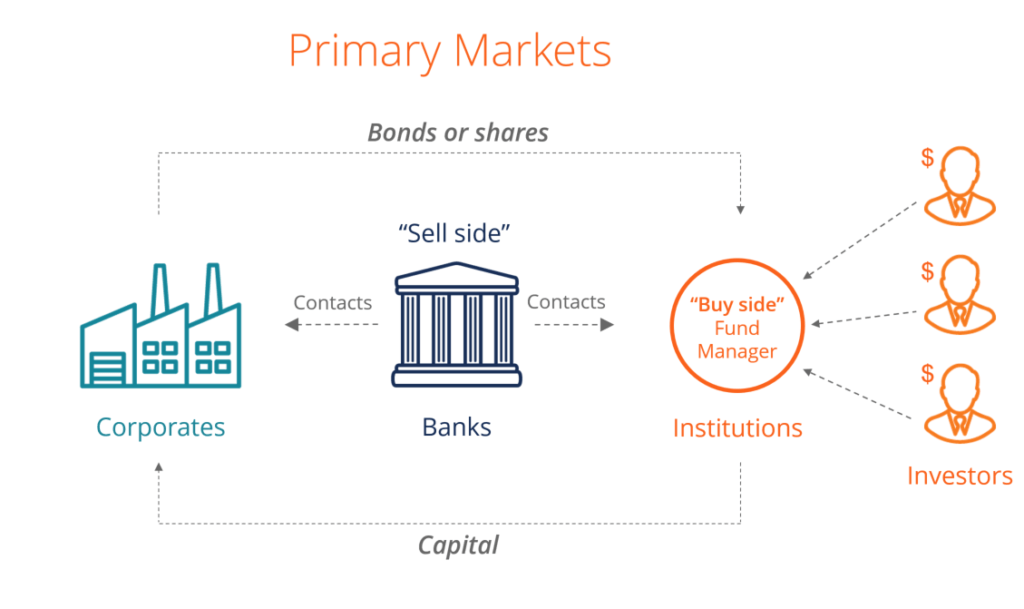
Image from CFI’s Free Introduction to Corporate Finance course.
After a company undergoes an IPO, its shares continue to be traded between investors on the market. This is referred to as the secondary market. The company is no longer involved in any of these transactions. The stock exchange facilitates trade between buyers and sellers in the secondary market.
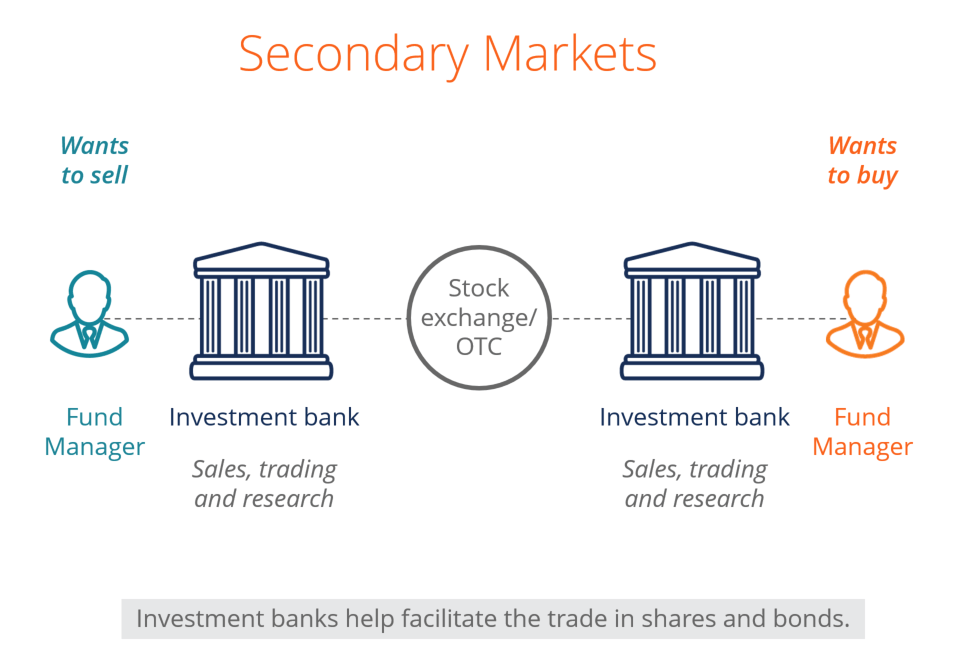
Image from CFI’s Free Introduction to Corporate Finance course.
Connect what you just learned to a clear career path with CFI’s role‑based courses and certification programs.
Thank you for reading CFI’s guide on the Stock Exchange. To keep advancing your career, the additional CFI resources below will be useful: