Get In-Demand Finance Certifications
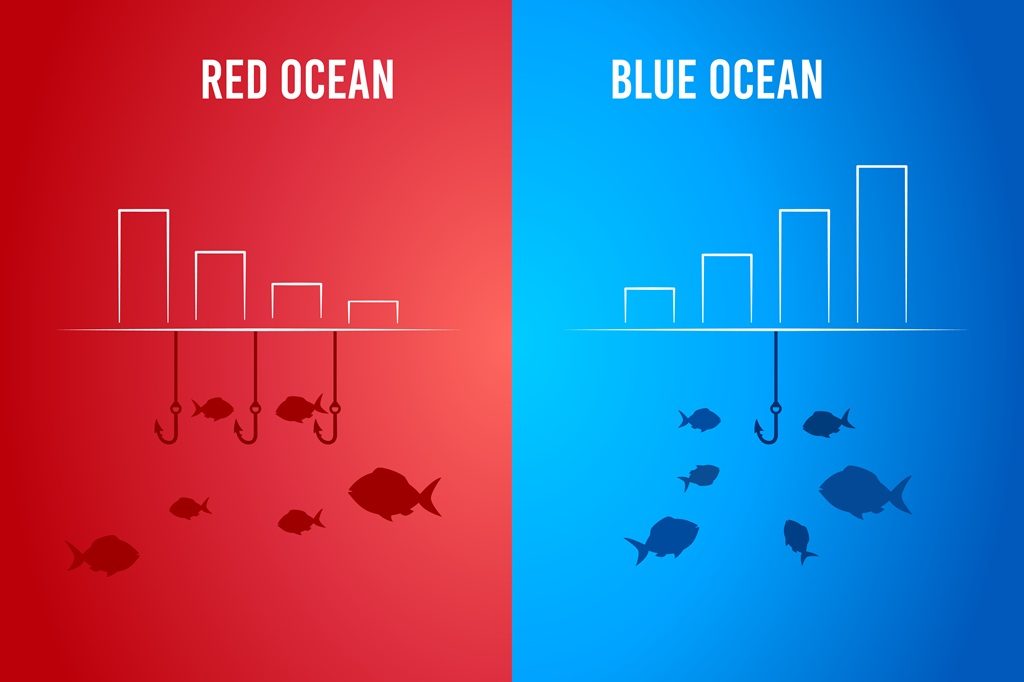
Blue Ocean Strategy is a business framework where companies create new market space instead of competing in existing markets. A “blue ocean” is an uncontested market where customer needs are underserved or entirely unmet.
Companies create blue oceans by offering a product or service that is meaningfully different from existing options. This approach shifts the focus from fighting competitors to attracting new demand.
The concept was introduced by W. Chan Kim and Renée Mauborgne in their 2005 book Blue Ocean Strategy. Their research shows that organizations can combine differentiation and low cost by reshaping the factors customers value most.
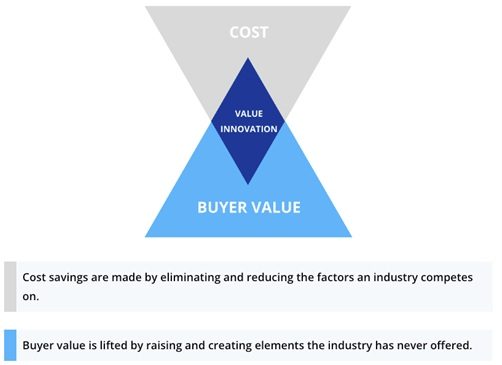
Value innovation is the core principle behind the Blue Ocean Strategy. It involves creating new value for customers with differentiated products or services, while simultaneously lowering costs.1 Companies do this by challenging industry assumptions and reshaping their offerings around what buyers care about most.
The result is a new market that attracts customers who were previously overlooked or underserved.
Examples of Value Innovation
Companies across different industries have applied the Blue Ocean Strategy by focusing on value innovation and creating offerings that attract new groups of customers. The examples of Cirque du Soleil and Apple iTunes demonstrate how eliminating outdated features and highlighting elements that buyers care about can create an uncontested market space.
Traditional circuses relied on expensive animal acts and star performers. This model targeted families with children, leaving little room for differentiation. Cirque du Soleil eliminated animals and high-cost celebrity performers, which reduced operating costs, and introduced theatrical storytelling, live music, and artistic choreography aimed at adult theatergoers.
This shift created a new category of live entertainment. Cirque attracted audiences who had never considered attending a circus, turning the circus-versus-circus competition irrelevant and redefining what a circus experience could be.
In the early 2000s, the music industry centered on physical CDs that forced customers to buy an entire album even when they wanted only a single track. Apple addressed this friction by eliminating physical distribution and album bundling and creating digital single-song downloads priced at $0.99.
iTunes made music purchasing instant, flexible, and personalized. Customers could buy individual tracks, build custom playlists, and sync directly to their devices. iTunes quickly sold billions of songs, establishing a new digital retail category and making both physical CDs and album-only purchasing far less relevant.
Blue Ocean Strategy emphasizes creating new market space with little or no competition, while Red Ocean Strategy competes in mature markets where many companies compete for the same customers. The key difference is whether a business enters a crowded space or designs an entirely new one.
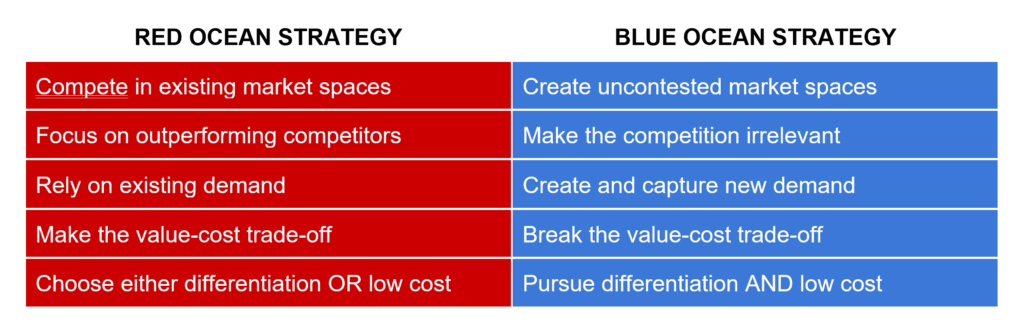
A Red Ocean Strategy focuses on outperforming competitors in mature markets. Companies try to win customers through price cuts, new features, or promotional campaigns. Competition is intense, offerings often become similar, and profit margins tighten as firms match each other’s moves. The term “red ocean” reflects the intense competition in these saturated markets.
In contrast, a Blue Ocean Strategy concentrates on unmet needs and overlooked customer groups. Companies redesign their offerings to deliver new value while lowering costs, which opens market space with few direct rivals. Instead of fighting for the same customers, they draw in buyers who had not been served well before.
Kim and Mauborgne outline a five-step process for organizations making a Blue Ocean Shift — a structured path for moving from crowded, competitive markets (red oceans) to new demand and uncontested market space (blue oceans).
The advantages of a Blue Ocean Strategy include access to new customer groups, lower immediate competitive pressure, higher profit potential, stronger differentiation, and a clearer path to ongoing innovation. Companies benefit because they grow in markets that traditional competitors have not addressed.
The disadvantages of a Blue Ocean Strategy include higher uncertainty, risk of imitation, internal execution challenges, slower customer adoption, and difficulty maintaining long-term advantages. These challenges matter because companies enter markets with little data and must build demand from the ground up.
Blue Ocean Strategy is a business strategy that involves creating new, uncontested market space, making the competition irrelevant.
Southwest Airlines eliminated traditional airline services to offer low-cost point-to-point flights. Cirque du Soleil removed animal acts while adding theatrical storytelling for adult audiences. Nintendo’s Wii eliminated HD graphics in favor of motion-sensing gameplay, attracting families and casual gamers who had never owned consoles.
The opposite of a Blue Ocean Strategy is a Red Ocean Strategy. Red Oceans represent saturated markets where many companies fiercely compete for the same customers. Competition is intense, products are similar, and companies often win by cutting prices or adding incremental features.
Considering a Career in Corporate Strategy?
Corporate strategy jobs play an essential role in shaping the future of businesses while offering professionals the opportunity to impact organizational success at the highest level. These types of roles require a unique combination of skills, which makes them both challenging and rewarding for those who are pursuing a career in corporate strategy.
To further develop your skills in corporate strategy and financial analysis, explore CFI’s comprehensive range of courses and resources. Our online courses can help you build the expertise needed to excel in corporate strategy roles and advance your career in finance.
Business Strategy vs. Business Model