Get In-Demand Finance Certifications
Twenty years ago, a team of designers quietly solved a persistent challenge: how to make better decisions when the problem itself isn’t clear. They called their solution the Double Diamond model. Since then, it has become a cornerstone of design thinking, but it rarely makes the agenda in boardrooms, strategy offsites, or MBA programs.
That’s starting to change. In a business environment defined by ambiguity and rapid change, leaders need structured tools for making better decisions. The Double Diamond model offers exactly that: a disciplined way to deeply understand a problem before committing to a solution.
This guide explains how you can apply the design thinking Double Diamond model to strategic problem solving in your organization.
The Double Diamond model is a framework for solving complex problems that includes four phases: Discover, Define, Develop, and Deliver. This model was developed by the UK Design Council over 2004–2005 and has since been adopted by design, product, and innovation teams worldwide.
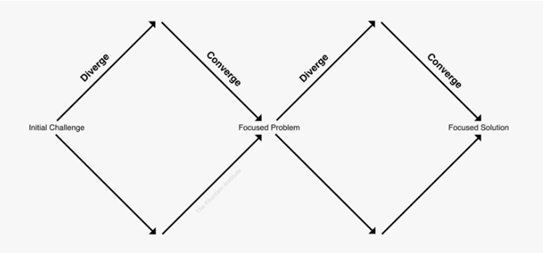
The Double Diamond name comes from the shape of the framework, which is built on two repeating cycles of thinking, each visually represented as a diamond.
This process moves you through both cycles twice: first to define the right problem, then to find the most suitable solution.
The Double Diamond model originated in design and UX communities as a visual problem-solving framework. Meanwhile, most leadership development stayed focused on strategy frameworks, financial management, and execution discipline. The Double Diamond model simply never made the crossing, leaving business leaders asking, “What is the Double Diamond model?”
The result is a costly pattern that shows up in organizations every day. Leadership teams default to “decide and execute” mode: moving rapidly from a perceived problem to a chosen solution without fully understanding the root cause. This leads to initiatives that solve the wrong problem, solutions that don’t deliver lasting results, and resources spent on rework that could have been prevented.
That gap is more costly now than it used to be. AI disruption and rapidly changing business conditions mean the cost of misdiagnosing a problem is higher than ever. The Double Diamond model explained gives leaders a battle-tested process for ambiguous, high-stakes situations where simple answers don’t exist. And in those situations, the quality of your thinking process often directly determines the quality of your outcomes. It’s one of the most practical frameworks for strategic problem solving when you’re dealing with complexity and competing constraints.
Before diving into the four Double Diamond model phases, it helps to understand the two modes of thinking that power the entire model.
Most leadership development emphasizes convergent thinking: analysis, prioritization, and decisive action. Company cultures typically reward decisiveness, and there’s often pressure to move quickly from problem to solution.
The Double Diamond deliberately builds in divergent phases because structured exploration leads to better problems, better options, and better decisions.
The Double Diamond model moves through four distinct phases: Discover, Define, Develop, and Deliver. The first two phases help you identify and define the right problem. The second two help you find the right solution. Each phase alternates between divergent thinking (opening up to explore) and convergent thinking (narrowing down to commit).
| Phase 1: Discover (Divergent Thinking) | Phase 3: Develop (Divergent Thinking) |
| Phase 2: Define (Convergent Thinking) | Phase 4: Deliver (Convergent Thinking) |
Every phase is built around three components: a core leadership question that defines its purpose, a set of activities translated into business terms, and tangible outputs you can take into the next phase.
Before committing to any solution, or even a problem statement, the Discover phase asks you to slow down and understand what’s actually going on. That means exploring your customers, employees, markets, operations, and financials with genuine curiosity rather than a predetermined answer in mind.
Discover phase activities include:
Consider a bank noticing poor satisfaction scores among small and medium enterprise (SME) customers and slow lending decision times. Rather than immediately redesigning the loan application form, a Discover phase would gather qualitative interviews with SME owners, analyze where decisions stall in the underwriting process, and review drop-off data across the lending journey.
Typical outputs from the Discover phase include:
Discover surfaces a wide field of insights and possibilities. Define is where you narrow that field down to a single, well-scoped problem worth solving. The core question shifts from exploration to commitment: what exactly are we choosing to solve, and what are we explicitly setting aside?
The Define phase involves convergent thinking by requiring you to synthesize messy, sometimes contradictory information into a clear problem statement.
Define phase activities include:
Returning to the SME lending example: after a thorough Discover phase, the bank’s leadership team has enough insight to reframe their challenge. They move away from the vague goal of “improve SME NPS.” Instead, they commit to a focused goal of reducing lending decision time from 12 days to 3 while maintaining current risk standards.
Typical outputs from Define include:
With a clearly defined problem in hand, you continue into the Develop phase. The question driving this phase is: what strategic options are on the table, and how do we manage risk before committing to a solution?
This is the second divergent phase. Rather than jumping to a single solution, you explore multiple approaches in parallel. This phase is for generating options, testing assumptions, and gathering evidence about what’s likely to work. The goal is to use allocated resources to learn what will work before investing heavily in a solution.
Develop phase activities include:
AI plays a growing role in this “test and learn” process by assisting teams with simulations, forecasts, and accelerating experimentation cycles.
Returning to our SME lending example, suppose the bank’s team designs three different approaches to streamlining the underwriting process, including one AI-augmented credit decisioning model. Each is tested with a small group of SME applicants to generate real evidence before any approach is scaled.
Typical outputs from Develop include:
This is the second convergent thinking phase. With a validated solution in hand, the focus shifts to execution. You scale what the evidence supports, align the organization behind the chosen solution, and build feedback loops to keep improving after launch.
The Deliver phase includes the following:
In the SME lending example, the bank scales its AI-augmented underwriting model across its full SME portfolio. Leadership sets clear performance metrics and establishes a quarterly review rhythm to monitor results and make adjustments. The solution is live, but the learning doesn’t stop.
That last point is worth emphasizing. Deliver is not a finish line. It’s a disciplined operating rhythm that turns a one-time initiative into a lasting capability.
Typical outputs from Deliver include:
With the Double Diamond model explained, you might be wondering how to actually use it. Even though the model was developed as a design tool, its application extends well beyond design. The Double Diamond structure provides an approach to problem exploration and solution development that makes it equally helpful to business leaders. In strategic leadership, the model offers a concrete way to balance exploration with decision-making across functions.
Consider a COO tasked with reducing a bloated month-end financial close process. This COO uses the Double Diamond model to define the problem and find the most appropriate solution:
The COO and their team achieve the target close time, with a cleaner process, better team alignment, and a documented decision trail that supports future improvement cycles.
The Double Diamond is a powerful tool, but it’s not necessarily the right tool for every situation. Matching the model to the right type of problem is part of using it well.
The Double Diamond shines when the problem is ambiguous, contested, or poorly understood. Strong candidates include:
In these situations, the Double Diamond model provides structure and a shared language that helps teams move through complexity together rather than talking past each other.
Not every problem needs a full Double Diamond process. A straightforward plan-and-execute approach is usually sufficient for:
The goal is to match the tool to the task. Applying the Double Diamond to a simple, well-defined problem adds process without adding value.
Used in the right context, the Double Diamond delivers outcomes leaders care about:
These benefits translate directly to higher ROI, reduced rework, faster learning cycles, and better-quality decisions.
The Double Diamond model is not a silver bullet. It requires time, facilitation skill, and stakeholder patience, or resources that aren’t always available. It can also feel uncomfortable in execution-focused or command-and-control cultures where leaders want to skip straight to solutions.
These constraints can be managed by setting clear timelines and decision points for each phase, and by starting with one or two pilot initiatives. Strike a balance between the stakes of the decision and the depth of the phases to make the Double Diamond model practical without diluting its value.
Understanding the Double Diamond model is the first step. The real value comes from using it with your team on problems that actually matter to your organization.
When you apply the model consistently, divergent and convergent thinking go from abstract concepts to a shared operating language. The Discover, Define, Develop, and Deliver phases become a rhythm your team moves through together. Strategic decisions become more deliberate, better informed, and easier to defend. That shift happens through practice, feedback, and guided application on real business problems. It also depends on effective problem framing, so teams start each Double Diamond cycle with a shared understanding of the challenge.
CFI’s Strategic Problem Solving Course is designed to accelerate exactly that shift. The course is built on the Double Diamond model and developed with external subject matter experts specializing in management, leadership, and strategy. It goes beyond conceptual understanding and into hands-on application:
If you’re a leader navigating complex, high-stakes decisions in an AI-driven world, this course gives you the structure, the tools, and the expert guidance to do it with greater clarity, confidence, and impact.
The Double Diamond model is a four-phase framework for moving from complex, poorly understood problems to clear, executable solutions. The four phases are Discover, Define, Develop, and Deliver. The first two phases help teams find the right problem, while the second two help them find the right solution.
The Double Diamond model focuses on finding the right problem before solving it. Traditional project management typically starts with a defined goal and focuses on planning and executing toward it. Many projects fail because they skip problem discovery and jump straight to delivery. The Double Diamond works best upstream, helping leaders define the right problem and solution. Traditional project management works best downstream, executing the validated plan.
Yes, you can use the Double Diamond model for internal, non-customer-facing problems, not just customer-facing challenges. Leaders have used it to improve internal finance processes, redesign employee experiences, and drive operational transformations. When an issue is poorly understood and the stakes are high, the Double Diamond model is a valuable tool to define the problem and find the best way to solve it.
The Double Diamond model has no fixed timeline. Duration depends on the scope and complexity of the problem. A focused initiative may move through all four phases in a few weeks. A large-scale transformation could take several months. Each phase can be scaled based on urgency and risk.
Common mistakes leaders make with the Double Diamond model include jumping straight to solutions without fully understanding the problem or skipping experimentation. Setting a fixed time limit for the Discover phase prevents open-ended exploration from stalling progress. Requiring at least two options to be tested in Develop before a decision is made prevents teams from defaulting to a predetermined solution.