Get Certified for Financial Modeling (FMVA)®
Gain in-demand industry knowledge and hands-on practice that will help you stand out from the competition and become a world-class financial analyst.
Obligations that the company must pay off within one year
Current liabilities are financial obligations of a business entity that are due and payable within a year. A liability arises when a company enters into a transaction that creates an expectation of a future outflow of cash or other economic resources.
The key operator in this definition is the word “expectation,” as a liability need not always result in an outflow of value, but must be reasonably expected to do so upon recognition of the liability.
While a current liability is defined as a payable due within a year, a broader definition may include liabilities payable within one business cycle of the operating company. In other words, if a company operates on a business cycle that extends beyond a year, a current liability for the company is any liability due within the longer of the two periods.
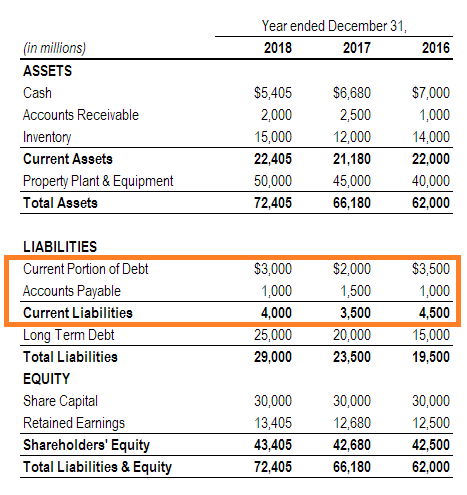
Current liabilities are critical for modeling working capital when building a financial model. Transitively, it becomes difficult to forecast a balance sheet and the operating section of the cash flow statement when historical information on a company’s current liabilities is missing.
Not surprisingly, a current liability will appear on the balance sheet’s liability side. In fact, as the balance sheet is often arranged in ascending order of liquidity, the current liability section will almost inevitably appear at the very top of the liability side.
Click the button below to download our free Current Liabilities template!
A company incurs expenses for running its business operations, and sometimes the cash available and operational resources to pay the bills are not enough to cover them. As a result, credit terms and loan facilities offered by suppliers and lenders are often the solution to this shortfall.
A company will also incur a tax payable within any operating year that it makes a profit and, thus, owes a portion of this profit to the government.
There are various categories of current liabilities. The most common is the accounts payable, which arise from a purchase that has not been fully paid off yet, or where the company has recurring credit terms with its suppliers. See how accrued expenses vs accounts payable differ in practice.
Other categories include accrued expenses, short-term notes payable, current portion of long-term notes payable, and income tax payable.
These are all important factors for forecasting and valuation.
CFI is the official provider of the global Financial Modeling & Valuation Analyst (FMVA®) certification program, designed to help anyone become a world-class financial analyst. To keep advancing your career, the additional resources below will be useful: