Get In-Demand Finance Certifications
Capital markets career paths include equity capital markets, debt capital markets, sales and trading, and research analysis for equity and fixed income securities. These roles focus on helping companies and governments raise capital, supporting investors, trading securities, and managing financial risk.
This guide explores various career paths in capital markets and insights into roles, responsibilities, skills, and qualifications required to succeed in this challenging yet rewarding field. You’ll also learn what it takes to work in capital markets, the career trajectory, and the key considerations for those interested in pursuing this exciting professional journey.

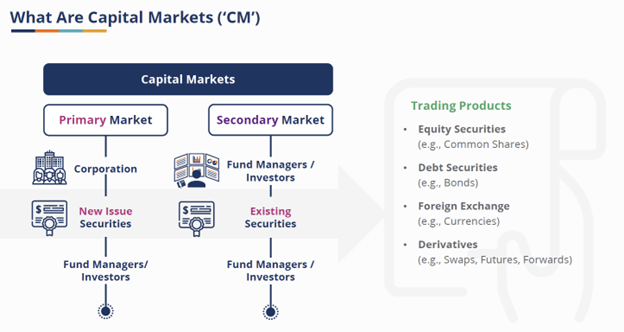
Capital markets are the financial systems where organizations raise long-term capital (funding) and individuals, companies, and governments buy and sell financial securities like stocks and bonds. Capital markets connect investors who have capital with organizations seeking funds to expand, invest, or manage debt.
The capital markets are typically divided into two main segments:
Understanding how capital markets function provides the foundation for every career in this field. Whether you work on structuring deals, analyzing market trends, or managing client relationships, each role contributes to keeping this flow of capital efficient and transparent.
Capital markets professionals help companies, governments, and other organizations raise money in financial markets. They also help investors decide where to put their money by analyzing opportunities and market trends. Put simply, they connect organizations that need capital with those looking to invest it.
These professionals work with financial products such as stocks and bonds. Depending on the role, they may analyze company performance, follow market activity, evaluate risk, or help determine the best time and way to raise or invest money. Some work within companies, helping manage funding and investor relationships, while others work at financial institutions involved in trading and investing.
Capital markets roles require strong analytical skills, attention to detail, and a solid understanding of how financial markets work. Professionals in this field need to interpret market changes, assess risk and return, and communicate financial information clearly.
Building a career in capital markets starts with developing strong technical and analytical foundations, then applying those skills in fast-paced, collaborative environments. Employers look for well-rounded candidates who combine financial knowledge with problem-solving ability, clear communication, and sound judgment under pressure.
Beyond formal education, technical and analytical skills are key to success. These include:
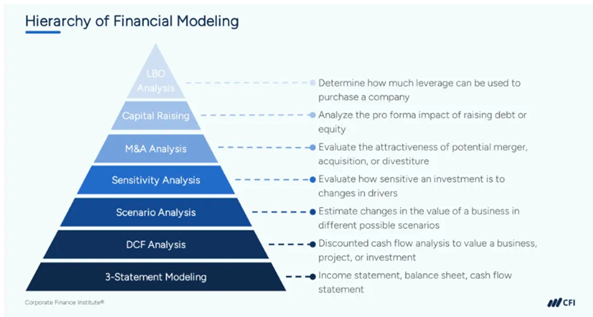
Completing a certification program can also strengthen your qualifications for internships and jobs. These programs help you build practical skills in Excel, financial modeling, valuation, and capital markets. Earning a certification demonstrates to employers that you’re committed to a career in capital markets.
Online providers like CFI offer self-paced programs that include opportunities to gain hands-on experience in building financial models and analyzing securities.
While technical ability opens the door, soft skills help professionals succeed long term. Hiring managers look for people who can communicate clearly, collaborate effectively, and maintain accuracy under pressure.
Strong attention to detail, teamwork, communication, and adaptability are especially valued, since markets can change rapidly and errors in execution can have financial consequences. Professionals who combine analytical strength with clear communication often advance quickly, as they can translate complex data into insights that drive decisions.
Working in capital markets involves analyzing financial data, executing transactions, and responding to market changes in a fast-paced, high-pressure environment. Professionals collaborate closely with teams to raise capital, trade securities, and advise clients, often working under tight deadlines that align with global market activity.
The daily work is highly analytical and team-oriented. Analysts and associates support senior staff with deal execution, research, and client presentations, developing strong financial modeling and communication skills along the way.
Hours can be demanding, especially in investment banking and research, but the roles offer steep learning curves and exposure to major financial transactions. Many professionals find the work intellectually challenging and rewarding, especially those drawn to markets, competition, and performance-driven results.
Professionals who excel in capital markets are precise, adaptable, and composed under pressure. They bring structure to fast-moving situations and stay focused on performance, accuracy, and results even when markets shift unexpectedly.
Employers in capital markets typically look for candidates with a bachelor’s degree. Majoring in finance, accounting, or business is helpful but not required. If you’re interested in the quantitative side of capital markets, a degree in mathematics or statistics is beneficial.
Graduate degrees, such as an MBA or a master’s in finance, can be helpful for advancing to higher-level management positions, but aren’t required for most entry-level roles.
Internships provide the hands-on experience and professional network needed to secure a full-time job. For many top firms, internships have become the primary pathway for full-time hires.
Career paths in capital markets span a wide range of roles that support the flow of capital between investors and organizations. Each of these career paths demands a balance of technical expertise, analytical thinking, and strong communication skills. Many professionals begin in analyst or associate roles, then progress toward management, leadership, or specialized positions as they gain experience.
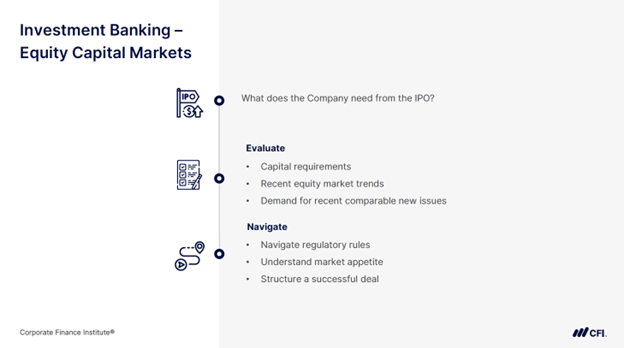
ECM teams advise clients on raising funds by issuing shares. Their work involves structuring, underwriting, and launching equity products such as initial public offerings (IPOs), follow-on offerings, and convertible bond issuances. ECM professionals are experts in market timing, valuations, and regulatory filing requirements.
DCM teams focus on raising capital through the issuance of debt instruments. These professionals structure bond issuances like corporate bonds, municipal bonds, and sovereign debt, along with loans and other fixed-income products. DCM professionals work closely with sales and trading teams on the efficient syndication and distribution of debt to institutional investors.
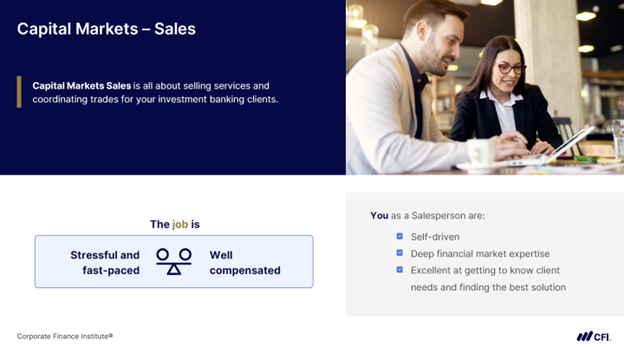
Sales and trading professionals sit at the heart of capital markets activity at investment banks and financial institutions by acting as intermediaries between buyers and sellers of securities.
Sales professionals maintain relationships with institutional investors like hedge funds, pension funds, and asset managers. They communicate market insights, pitch investment ideas, and match clients with opportunities that fit their portfolios.
Traders execute buy and sell orders for financial securities such as stocks and bonds. They manage the securities the firm currently holds and stand ready to buy or sell on behalf of clients. In some cases, they take on risk by holding securities on the firm’s own books.
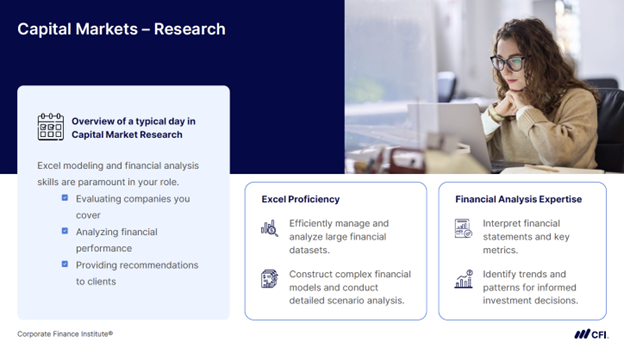
Research analysts study financial data and market trends to estimate the value and performance outlook of securities such as stocks and bonds. They primarily develop research reports that guide traders, portfolio managers, and clients on decisions like whether to buy, sell, or hold specific stocks or bonds.
To inform equity research reports, analysts evaluate company financial statements, build financial models, and analyze stock valuations. For debt research reports, analysts assess fixed income securities on factors like company financial health (for corporate bonds), credit quality, and interest rate sensitivity.
There is no single “typical” day in capital markets, because the pace and priorities vary by role. Still, most capital markets professionals start early, review overnight market news, and prepare for a day shaped by investor sentiment, economic developments, and changing market conditions.
Across the field, the day usually begins with a close look at market activity, recent trades, and new research. Many professionals join morning calls with colleagues to discuss market views, client positioning, and developments that could affect trading or capital raising activity. From there, the day often involves analyzing data, speaking with clients or internal teams, and responding quickly to new information as markets move.
A typical day in ECM and DCM often centers on issuers and market conditions. Professionals may update market materials, review comparable deals, assess investor appetite, and coordinate roadshows that connect companies or borrowers with potential investors. When a live offering is underway, the pace can intensify quickly, with long hours spent coordinating with investors, sales and trading teams, and other banks across time zones.
In sales and trading, the day tends to be even more market-driven. Sales professionals spend much of the day speaking with clients, sharing trade ideas, discussing news, and relaying market color. Traders focus on pricing, execution, risk management, and reacting to economic releases or sudden market shifts. Even after the market closes, both salespeople and traders may still be working, whether that means entertaining clients, hedging positions, or coordinating with colleagues in other regions.
For equity research professionals, the day is often split between market-facing communication and deep analytical work. After contributing to a morning call, analysts may update models, write research reports, monitor covered companies, and speak with clients or management teams. Hours can stretch longer during earnings season or other periods of heavy market activity.
A typical capital markets career progression depends on the specific path, but many core capital markets roles follow a structure like this:
Analyst → Associate → Vice President → Director → Managing Director (MD)
Analysts are entry-level professionals and often recent university graduates. In capital markets, analysts support stock and bond offerings, market analysis, research, and other work tied to raising capital and monitoring market activity. They provide the analytical support that helps teams prepare materials, track market conditions, and respond to client needs.
The primary responsibilities of analysts include:
Analysts typically spend one to three years in this role. This period is a hands-on training ground where they build technical skills, learn how capital markets teams operate, and develop the speed, accuracy, and judgment needed for more advanced responsibilities.
Associates represent the next step in the capital markets career path. Some are promoted internally from analyst roles, while others enter after completing an MBA or gaining prior experience in finance. Associates take on more responsibility for reviewing junior work, managing day-to-day processes, and helping move active stock or bond offerings forward.
The key duties of associates include:
Associates typically remain in this role for three to four years. At this stage, professionals deepen their technical judgment, gain more exposure to clients and market participants, and begin shifting from analytical support toward project ownership and team leadership.
As professionals advance in capital markets, they move into increasingly senior and strategic roles with responsibilities for client relationship management, transaction execution, market strategy, team leadership, and business development:
Vice President (VP): VPs play a central role in active stock or bond offerings. They help move the process forward, coordinate the teams involved, and advise clients on timing, pricing, and investor interest. They also manage junior team members and support senior leaders in maintaining strong client relationships.
Director: Directors take a senior leadership role in stock and bond offerings. They work closely with clients on larger decisions, including when to raise capital, how to present the offering to investors, and how market conditions may affect the outcome. They also support large client relationships, help guide the broader team, and bring more judgment to complex or high-profile offerings.
Managing Director (MD): Managing Directors are the most senior leaders on many capital markets teams. They lead major client relationships, advise companies on capital-raising decisions, and help win new business for the firm. They are often involved in the most valuable offerings and client relationships, using their experience, market insight, and relationships to guide clients and set direction for the team.
For those interested in a capital markets career, here are a few actionable tips that can help make breaking into the field and progressing easier:
Before applying for a capital markets role, it is also important to build the technical skills, market awareness, and communication ability that employers expect from early-career candidates.
A capital markets career path can offer an exciting and demanding path for finance professionals who are interested in markets, trading, investing, and helping organizations raise capital. While the work can be fast-paced and high-pressure, it also offers strong opportunities for skill development, market exposure, and experience working on stock and bond offerings, market analysis, and investor-facing activities.
For those exploring career options, it is worth considering how capital markets compare with other finance paths based on your interests, strengths, and long-term goals. If you want to deepen your financial knowledge and prepare for a career in capital markets, we recommend building skills in financial analysis, valuation, market research, and capital raising.
Your path into capital markets starts with curiosity, persistence, and a strong interest in how companies raise capital and how financial markets work.
Ready to take the next step in your financial career? Check out CFI’s comprehensive course catalog to gain the knowledge and certifications that can set you apart in the world of investment banking. Explore CFI’s Career Map to discover the best path toward your professional goals.