Get Certified for Financial Modeling (FMVA)®
Gain in-demand industry knowledge and hands-on practice that will help you stand out from the competition and become a world-class financial analyst.
Is the FMVA worth it? For many finance professionals, yes. The Financial Modeling & Valuation Analyst (FMVA®) certification delivers practical, hands-on modeling and analytical skills, a globally recognized credential, and flexible learning that fits around a full-time job.
The value of an FMVA also depends on your career goals and how you plan to use what you learn. If you’re asking whether a financial modeling certification is worth it, you’re probably weighing the time, cost, and effort against potential career payoff. You’ve likely seen the FMVA mentioned on LinkedIn, job postings, or finance forums as an option.
This guide offers an honest look at what the FMVA delivers, where it adds career value, and where it falls short. By the end, you’ll have a clearer sense of whether it fits your goals.
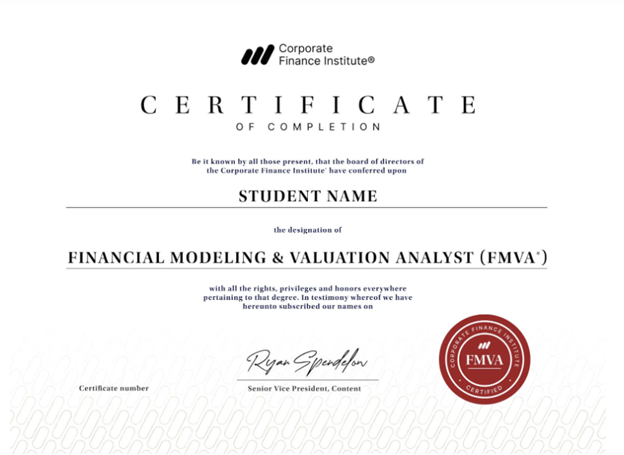
Financial Modeling & Valuation Analyst (FMVA®) is a financial modeling certification designed for working professionals, students preparing for finance jobs, and career changers who want hands-on skills in modeling, valuation, and Excel-based analysis.
Unlike academic finance programs that emphasize theory, the FMVA program focuses on practical, job-ready techniques you can apply immediately.
The program is especially beneficial for financial analyst career paths, including:
The FMVA is offered by Corporate Finance Institute (yes, that’s us!). The FMVA program covers core technical skills that analysts use daily so you’re prepared for interviews and to perform well on-the-job.
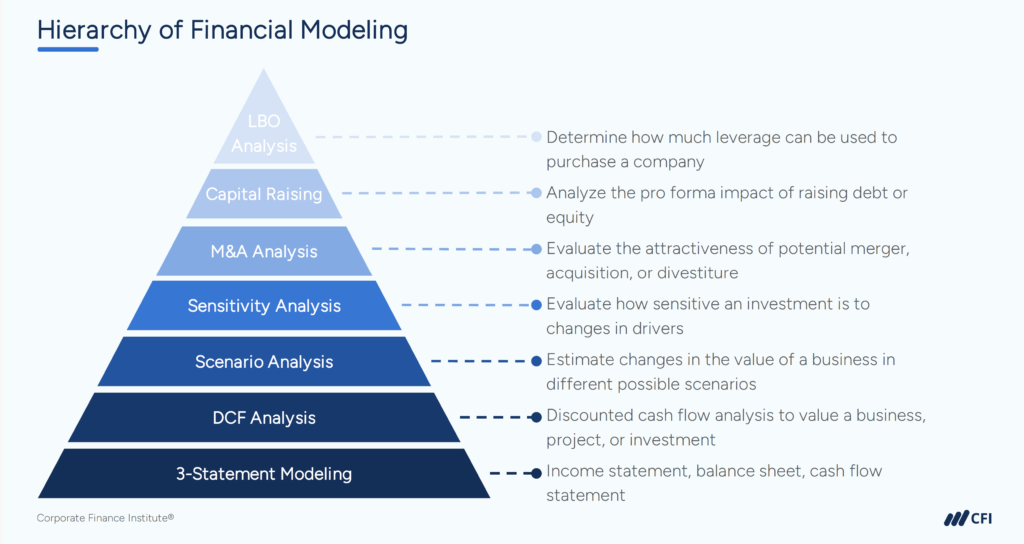
The FMVA curriculum focuses on the financial modeling and analysis skills that finance teams use daily, including:
These aren’t theoretical concepts you’ll forget after an exam. Each skill translates directly to work you’ll do as an analyst, whether you’re building a forecast for your team or preparing for a technical interview.
The FMVA is fully online and self-paced, so you can fit it around a full-time job or coursework. Most learners complete the program in 4 to 6 months on average, depending on their own pace. The format of the FMVA emphasizes hands-on exercises where you build models yourself — that’s ultimately how skills stick.
The honest answer: it depends on where you’re headed. The FMVA delivers the most value when your career path requires hands-on modeling skills. This includes roles where you’ll model financial statements and cash flow, analyze the financial health of companies, and estimate the value of businesses for investors.
FMVA helps bridge the gap between academic theory and job-ready skills. Hiring managers often worry about training time; showing up with modeling experience on day one reduces that concern.
FMVA can sharpen technical abilities that may have gone stale or fill gaps if your current role doesn’t involve heavy modeling. It’s also useful if you’re pursuing internal moves into more analytical positions.
FMVA demonstrates commitment to finance beyond a general interest. It gives you something concrete to discuss in interviews and proves you’ve invested in building foundational skills.
Will FMVA guarantee you a job? No credential can promise that. But it does strengthen your candidacy by giving you the right skills and practice with a verifiable certification.
These paths demand strong technical modeling skills from day one. Interviewers expect you to explain how to link the three financial statements, walk through a DCF model, and know the difference between NPV and XNPV functions in Excel. The FMVA prepares you for these technical interviews and builds confidence for when you’re asked to model on the spot.
The FMVA program provides opportunities for you to gain experience through projects and case studies, but you’ll still need internships, networking, and strong resume and interview skills to become a competitive candidate for jobs.
If you’re targeting corporate finance or business analysis, FMVA covers the forecasting and modeling work you’ll do daily. You’ll learn to build the same 3-statement models and scenario analysis that finance teams rely on for decision support.
For those focused specifically on financial planning and analysis (FP&A), CFI offers a dedicated program: Financial Planning & Analysis Professional (FPAP™). If you’re unsure, it’s best to compare FPAP vs. FMVA to see which certification best fits with your goals.
Corporate development professionals work alongside investment bankers on capital raising, mergers and acquisitions (M&A), and business divestitures or spin-offs. The FMVA program prepares you to build and review the models that inform these high-stakes decisions.
When you lack direct finance experience, FMVA signals that you’ve done the work to build a strong foundation of competence. It gives you tangible skills to reference in interviews and demonstrates commitment beyond simply listing “interested in finance” on your resume.
The FMVA offers several advantages that make it attractive for finance professionals at different stages:
Employers increasingly recognize that hiring someone with an FMVA means less training time for them and a lower risk for errors when assigning modeling work.
No credential is perfect, and FMVA has limitations worth considering:
Choosing the right credential depends on your goals, timeline, and budget. Here’s how FMVA compares at a high level:
One of the most common questions we hear is, “what’s the difference between FMVA versus CFA?” While the CFA offers broad, theoretical investment knowledge, FMVA covers practical, day-to-day technical modeling and analysis that the CFA program doesn’t cover in-depth. This makes a CFA/FMVA combination powerful for career growth in finance.
A Master of Business Administration (MBA) offers broad business education and networking opportunities but typically requires two years and significant tuition costs. The FMVA delivers targeted modeling skills at a fraction of the time and cost. For professionals who already have business fundamentals and want sharper technical abilities, FMVA is often the more practical choice.
University finance degree programs provide theoretical finance foundations but often lack hands-on modeling practice. The FMVA complements a finance degree by filling that practical gap, making it a strong pairing for recent graduates entering the job market.
Earning the credential is just the starting point. What you do with it determines the return on your investment.
The best way to retain what you learn is to use it. Build your own financial models outside the program — pick a public company, pull their filings, and create a model from scratch. Recreating real-world models reinforces techniques and gives you portfolio pieces to show employers.
List the credentials, but focus on what you can do. Instead of simply adding “FMVA Certified” to your profile, highlight specific skills: “Built 3-statement models and DCF valuations” carries more weight than a credential alone. Let the certification support your story, not replace it.
Use your projects as conversation starters in interviews and networking calls. Saying “I built a DCF for a SaaS company to practice subscription revenue modeling and valuation” demonstrates initiative and gives interviewers something concrete to discuss. Combine FMVA with internships, entry-level roles, or freelance projects to build a track record that reinforces the skills on your resume.
What results do FMVA graduates actually see? Here’s what FMVA holders report again and again in learner reviews:
Here’s how two FMVA graduates describe their experience.
Rida Rikka, FMVA®, Management Consulting EY
Rida pursued the FMVA to strengthen the financial rigor behind his strategy work. The skills he gained, like scenario analysis, integrated modeling, and data-driven valuations, have helped him lead projects at his own consulting firm and at EY.
As Rida puts it, “It’s not just about theory or passing exams. It’s about applying real-world tools and frameworks that consultants, analysts, and finance professionals use every day.”
Filipa Silva, FMVA®, M&A Associate, Strategy & Corporate Finance PwC
Filipa completed the FMVA to deepen her technical skills alongside her deal work. The program strengthened her ability to build dynamic models and run advanced valuation analyses more efficiently.
“I already feel more confident tackling complex modelling work and high-stakes financial analysis,” Filipa says. “I am confident that the knowledge and skills I have gained will support a faster progression within M&A.”
While these outcomes aren’t guaranteed, they show what’s possible when you combine the FMVA program with effort and application.
Is FMVA certification worth it? If you want practical modeling and valuation skills you can apply immediately, along with flexible learning and a recognized credential, the answer is yes.
The certification is especially valuable for working professionals looking to sharpen their technical toolbox, career switchers wanting to break into finance, and students looking to complement their degree with job-ready skills.
The decision comes down to three questions:
If you answered yes, FMVA can be a smart investment in your finance career.
Yes, and recognition is growing for the FMVA. Companies like Boeing, Target, Verizon, and Marriott use FMVA to train their finance teams, which signals employer trust in the credential. That said, recognition varies by region and industry. Some hiring managers will recognize FMVA, while others may be less familiar.
Yes, an FMVA can improve your chances of getting hired or promoted, though it’s not a guarantee. Over 78% of learners report significant career advancement, including promotions and raises, within months of completing the program. An FMVA shows employers you can do the job with less training, and stronger skills make you a more strategic asset when it’s time to discuss a raise.
Yes, FMVA certification is worth it for beginners with basic finance knowledge. You don’t need an advanced background to start — just a willingness to put in the effort. The program builds skills progressively, so beginners can gain job-ready financial modeling capabilities by the time they complete the coursework and exam.
Yes, FMVA can help you get a job in finance by building real skills and giving you something concrete to discuss in interviews. That said, pairing an FMVA with internships, projects, or relevant experience creates a stronger overall candidacy than the certification alone.
An FMVA should be positioned on a resume or in interviews by highlighting the models you’ve built, case studies you’ve completed, and outcomes you’ve achieved. For example, mention specific work like 3-statement models or DCF valuations. This shows employers what you can do, not just that you finished a program.
It takes most learners 4 to 6 months to complete the FMVA program, depending on how much time you can commit to courses each week. The self-paced format lets you move faster if you have more availability or stretch it out if you’re balancing full-time work or other responsibilities.