Get Certified for Financial Modeling (FMVA)®
Gain in-demand industry knowledge and hands-on practice that will help you stand out from the competition and become a world-class financial analyst.
Learn the MOU meaning, its purpose, and common uses in business, legal, and international settings — including when a memorandum of understanding may become legally binding.
A memorandum of understanding (MOU) is a formal agreement between two or more parties that outlines a mutual understanding and intended course of action. Often used in the early stages of negotiations, MOUs are commonly applied in business deals, government collaborations, and international relations.
While an MOU is a legal document, it is not typically considered a legally binding contract. Instead, it represents a shared intent or preliminary agreement between the parties involved. The document helps clarify expectations, outline general terms, and define the scope of the relationship and potential negotiations.
MOUs may be bilateral (between two parties) or multilateral (between more than two parties), depending on the context. A sample memorandum of understanding will usually include sections that detail the project, services involved, and the obligations of each party.
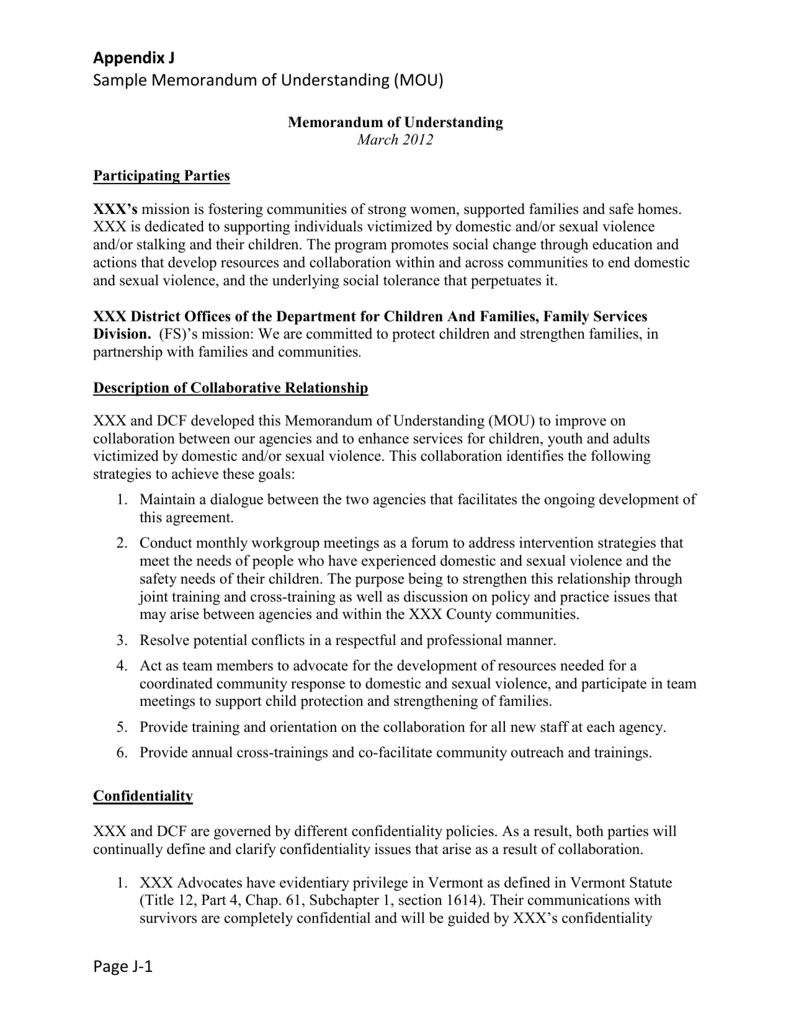
Below is a real-world sample of an MOU template used between agencies. This sample outlines collaboration goals, responsibilities, and confidentiality terms to help structure non-binding agreements in a professional context.
A comprehensive Memorandum of Understanding typically includes several important components to ensure clarity and alignment between the parties. While not usually legally binding, these elements help structure the agreement and lay the foundation for potential future contracts:
To draft an effective MOU, all parties must first reach a mutual understanding and clearly communicate their objectives and non-negotiables. Though MOUs are generally not enforceable in court, certain clauses may be legally binding. If the following elements are present, parts of the agreement may carry legal weight:
Creating a clear and effective Memorandum of Understanding requires careful collaboration and structured steps. While MOUs are often used in the early stages of partnership discussions, a defined process helps reduce misunderstandings and builds trust between parties.
MOUs are widely used across sectors to establish clear expectations and outline cooperative efforts before formal contracts are signed. Below are the most common contexts where MOUs are applied:
In business settings, MOUs help define early-stage collaborations between companies, vendors, or partners. These non-binding agreements clarify project scope, timelines, and general responsibilities, especially when dealing with intellectual property, customer relationships, or exploratory ventures. A memorandum of understanding in the private sector often serves as a strategic tool for aligning goals before committing to a legally binding contract.
Government agencies use MOUs to coordinate shared services, programs, or regulatory responsibilities. These documents help formalize cooperation between departments without requiring legislation or binding contracts. For example, multiple agencies might sign an MOU to share data, co-fund research, or define joint communication efforts.
In global diplomacy, MOUs are commonly used to outline the terms of cooperation between nations or international bodies. While they may resemble treaties, they typically serve as preliminary agreements and are not legally binding unless the language and intent suggest otherwise. Some MOUs in this category are even submitted to the United Nations Treaty Collection for public record.
MOUs offer several practical benefits for parties in the early stages of negotiation:
These advantages make MOUs especially useful in contexts where trust is being built, or when parties need time to finalize formal terms.
In summary, while MOUs help align parties and establish shared intent, their non-binding nature can be a double-edged sword without legal safeguards.
Connect what you just learned to a clear career path with CFI’s role‑based courses and certification programs.
Thank you for reading CFI’s guide to MOUs. To continue learning, explore these additional CFI resources:
Gain in-demand industry knowledge and hands-on practice that will help you stand out from the competition and become a world-class financial analyst.
A Memorandum of Understanding (MOU) clarifies the goals, responsibilities, and general terms of collaboration between two or more parties. It sets expectations early in a relationship and lays the groundwork for a potential legally binding agreement.
Most MOUs are not legally binding. However, if the document includes key contract elements — such as an offer, acceptance, intention to be bound, and consideration — it may be enforceable in court.
An MOU outlines mutual intent without legal enforceability, while a Memorandum of Agreement (MOA) typically includes more formal language and may indicate a stronger legal commitment between the parties.
An MOA defines the roles, responsibilities, and legally binding obligations between parties. It’s more formal than an MOU and often used when the parties are ready to proceed with enforceable terms.