Applied AI for Finance Certification
Build practical AI skills across finance workflows, deliver defensible analyses, and earn a verifiable credential that demonstrates your AI capabilities.
AI has become a top priority in finance, but readiness remains low. In an AICPA and CIMA survey of 1,446 finance and accounting leaders, 88% expect AI to be the most transformative technology over the next 12 to 24 months. Only 8% consider their organizations very well prepared, and 56% cite generative AI as their biggest skills gap.
This gap creates opportunities to develop valuable AI skills. The right training can also strengthen your résumé, LinkedIn profile, and career prospects.
In this guide, we compare 14 of the best AI certifications for finance professionals. We examine each credential or course for relevance, finance focus, learning requirements, and cost to help you find the right fit for your learning goals.
The following programs offer different ways to develop and demonstrate AI skills. The table provides an overview of each program’s intended audience, learning format, and time commitment.
| AI Finance Professional (AIFP™) Certification | Corporate Finance Institute (CFI) | Financial analysts and analysts in FP&A, business intelligence, corporate development, and equity research | Online, self-paced courses, final exam | Flexible; no fixed duration within annual CFI memberships |
| Chartered Financial Intelligence Architect (CFIA) | International Council for Derivative Trading (ICFDT) | Investment professionals | Online, remotely proctored exam | Preparation time varies; 4-hour exam |
| AI for Business & Finance Certificate | Columbia Business School and Wall Street Prep | Finance professionals | Online, cohort-based schedule, final assessment | 8 weeks; 64–80 total hours |
| No Code AI for Finance Certificate | Association for Financial Professionals (AFP) | Finance and treasury professionals | Online, self-paced, no final assessment/exam | 8 hours of online content, plus coursework |
| AI in Finance Micro-credential | Institute of Management Accountants (IMA) | Accounting and FP&A professionals | Online, self-paced, final assessment | 15–20 hours, plus coursework |
| AI in Finance Certificate | eCornell | Senior finance professionals | Online, live, instructor-led, required attendance | 6 weeks; 4–6 hours per week |
| Certificate in AI for Finance Professionals | Association of Chartered Certified Accountants (ACCA) | Accounting and finance professionals | Online, self-paced, final exam | 15 total hours |
The AI Finance Professional (AIFP™) Certification is best suited for financial analysts and professionals in FP&A, business intelligence, corporate development, and equity research who need to learn how to use AI in finance.
The AIFP program is fully online and self-paced, with courses and labs developed by experienced CFI instructors. AIFP courses feature video lessons, interactive exercises, quizzes, prompt guides, Excel templates, and assessments.
Learn at your own pace with an active CFI annual membership.
No formal prerequisites or coding experience required. Finance experience is recommended.
Candidates must pass individual course assessments and an online, remote-proctored final certification exam.
Pricing as of October 2026. Confirm current pricing and eligible discounts with CFI before enrolling.
Graduates earn a blockchain-verified digital certificate that they can add to their résumés and LinkedIn profiles. Eligible AIFP courses may qualify for CPE credits through CFI’s NASBA registration.
AIFP is CFI’s newest practical finance certification. CFI has over 3 million registered learners across 200+ countries and more than 85,000 certified professionals. The Higher Learning Commission (HLC), which accredits over 1,000 US colleges and universities, endorses CFI as a short-term credential provider. Six other CFI certifications are accredited by Walbrook Institute London (formerly LIBF).
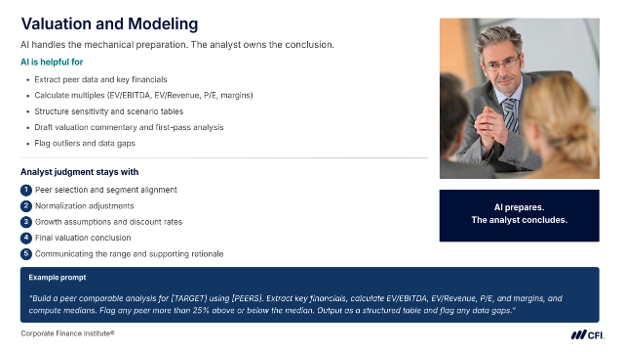
The Chartered Financial Intelligence Architect (CFIA) is for investment professionals who evaluate and oversee the use of AI rather than develop AI systems. It is particularly relevant for portfolio managers, investment analysts, traders, and chief investment officers (CIOs).
The CFIA is an exam-based credential. Candidates prepare independently using the official CFIA textbook or through an ICFDT-Approved Prep Provider.
ICFDT does not specify an estimated preparation time.
No technical prerequisites to sit for the exam.
The online exam includes 200 multiple-choice questions with a four-hour time limit. Passing scores are determined through a standard-setting process.
Prices as of October 2026. Confirm current pricing with the ICFDT before enrolling.
Successful candidates earn a CFIA charter that is verifiable through a public registry. CFIA appears in FINRA’s professional designations directory, although FINRA does not approve or endorse credentials.
The AI for Business & Finance Certificate provides early- to mid-career business and finance professionals with practical AI skills and an understanding of how AI works. It is especially relevant for financial analysts, FP&A professionals, investment analysts, and portfolio managers.
This eight-week cohort program includes eight self-paced modules with recorded lectures, hands-on exercises, industry case studies, and electives.
Eight weeks, with an estimated 8–10 study hours per week.
No prior coding, programming, or technical experience required.
Learners must complete an assessment after each module and achieve a combined score of at least 75% to earn the certificate.
Prices as of October 2026. Confirm current pricing with Columbia Business School before enrolling.
Graduates receive a Digital Certificate of Participation from Columbia Business School Executive Education and Wall Street Prep, plus five credits toward Columbia Business School’s Certificate in Business Excellence.
The program also qualifies for 65 CPE credits through Wall Street Prep’s NASBA-registered sponsorship.
The No Code AI for Finance Certificate helps finance and treasury professionals apply AI without coding. It is particularly relevant for FP&A professionals, financial analysts, finance managers, and those responsible for evaluating AI initiatives, managing implementation risks, or leading adoption.
The program is 100% online and self-paced, with practical exercises, templates, reference guides, and implementation resources.
Eight hours of on-demand content, plus additional time for learning activities.
No formal prerequisites or coding experience required.
Learners must pass quizzes in all four modules. No exam requirement.
Prices as of October 2026. Confirm current pricing with AFP before enrolling.
Graduates earn a professional education certificate and digital badge from AFP, a global nonprofit association of corporate treasury and finance practitioners. The program qualifies for 9.6 continuing education credits toward renewal of AFP’s CTP, FPAC, and CCM credentials.
AFP is a NASBA-registered CPE sponsor, but the program page does not specify the number of CPE credits. Contact AFP to confirm eligibility.
The AI in Finance Micro-credential is for accounting and finance professionals to develop practical AI skills. It is particularly relevant for management accountants, FP&A professionals, financial analysts, controllers, and finance managers.
The program is 100% online and self-paced, with interactive content, videos, podcasts, articles, and practical activities.
IMA estimates 15–20 hours of learning across six pathways.
Experience with financial software, including Excel and enterprise resource planning (ERP) systems, and familiarity with financial data and models are recommended.
Learners must pass a final assessment demonstrating their understanding and ability to apply AI concepts in finance.
Prices as of October 2026. Confirm current pricing with IMA before enrolling.
Graduates earn the AI in Finance Micro-credential badge and six additional digital badges, one for each completed module. IMA is a global association for management accounting and financial management professionals that also administers the Certified Management Accountant (CMA) designation.
The program qualifies for up to 20 NASBA continuing professional education (CPE) credits.
The primary audience for eCornell’s AI in Finance Certificate is mid-career and senior finance professionals responsible for AI strategy and adoption in financial services. The program is particularly relevant for banking leaders, investment banking and advisory professionals, asset managers, and fintech executives.
The program is 100% online, with scheduled live instruction from Cornell faculty and industry practitioners, as well as facilitated group discussions.
Six weeks, requiring an estimated 4–6 hours per week (24–36 hours total).
No technical prerequisites.
No assessments or exams.
Tuition: $4,999, payable upon registration. The program page does not specify financial aid options. Contact eCornell to confirm availability.
Pricing as of October 2026. Confirm current tuition and fees with eCornell before enrolling.
Graduates earn a non-credit online professional certificate from Cornell Duffield College of Engineering and Cornell SC Johnson College of Business, plus 33 Professional Development Hours (3 CEUs).
eCornell is Cornell University’s online education platform. Financial institutions and other employers recognize its certificates. The US News & World Report ranked Cornell No. 14 among nearly 1,500 schools in its 2027 Best National Universities rankings.
Accounting and finance professionals seeking to understand AI applications in their work can benefit from the Certificate in Artificial Intelligence for Finance Professionals. The program is particularly relevant for management accountants, controllers, FP&A professionals, and finance leaders.
100% online and self-paced through on-demand interactive learning modules.
Approximately 15 hours.
No technical prerequisites.
Candidates must pass a one-hour online assessment to earn the certificate.
Prices as of October 2026. Confirm current pricing with ACCA before enrolling.
Successful learners earn a professional education certificate and digital badge from ACCA, the global professional accountancy body that administers the ACCA Qualification. This program also qualifies for 15 verifiable continuing professional development (CPD) units.
The best AI courses for finance professionals offer targeted training in specific finance skills without requiring a full certification program. The following courses vary in their focus, intended audiences, and time commitments.
| AI in Finance | AI CERTs via Coursera | Finance pros seeking broad, intermediate-level AI training | Online, self-paced | 9 hours |
| Introduction to AI for Finance Professionals | AI Business School via Coursera | Beginners learning AI fundamentals and prompting | Online, self-paced | 6 hours |
| AI for Finance Professionals | Microsoft via edX | Finance pros applying AI to forecasting, risk analysis, and automation | Online, self-paced | 5–10 hours |
| The AI-Driven Financial Analyst | LinkedIn Learning | Financial analysts exploring AI-assisted research and modeling in Excel | Online, self-paced | 35 minutes |
| Generative AI in Finance | Board Infinity via Coursera | Beginners exploring AI-assisted financial analysis | Online, self-paced | 5 hours |
| Finance with AI: AI Tools & Real Use Cases | Udemy | Beginners applying Meta AI in FP&A and accounting | Online, self-paced | 4 hours, 16 minutes |
| AI for Finance | DataCamp | Finance pros building AI prompting, research, and automation skills | Online, self-paced | Approx. 3 hours |
Finance professionals seeking a short, practical introduction to AI can start with the AI in Finance course from AI CERTs on Coursera. It is particularly relevant for financial analysts, FP&A and banking professionals, and beginners with basic finance knowledge.
Online and self-paced, with nine modules featuring video lessons, financial industry case studies, interactive activities, and quizzes.
Approximately nine hours of learning, plus additional time for assignments and coursework.
No prior AI or coding experience is required.
Each module includes a 30-minute quiz.
Prices as of October 2026. Confirm current pricing with Coursera before enrolling.
Finance professionals with little or no AI experience can explore practical applications through this Introduction to AI for Finance Professionals course available on Coursera. It is particularly relevant for financial analysts and FP&A professionals interested in using AI tools at work.
Online and self-paced, featuring video lessons, readings, interactive prompting exercises, and assignments. The course is part of the AI for Finance Specialization on Coursera.
Approximately six hours of learning, plus additional time for assignments and coursework.
No prior technical knowledge required.
Passing a 30-minute final online assessment is required to earn the course certificate.
Microsoft’s AI for Finance Professionals course helps accounting, FP&A, banking, and corporate finance professionals build practical AI skills. It also suits finance managers evaluating AI initiatives, collaborating with data science teams, and overseeing AI adoption.
Online and self-paced, delivered through edX.
Approximately one week, requiring 5–10 hours of study depending on your pace.
No technical prerequisites or prior coding knowledge.
None specified on the public course page.
Pricing information as of October 2026. Confirm the current course price with edX before enrolling.
Financial analysts and other finance professionals seeking a short, practical introduction to AI can explore its everyday applications through The AI-Driven Financial Analyst course on LinkedIn Learning.
Online and self-paced, with video lessons and practical demonstrations of AI tools for finance.
Approximately 35 minutes of video instruction, plus additional time for coursework.
None listed.
One knowledge-check quiz at the end of the course.
Prices as of October 2026. Confirm current pricing and free-trial eligibility with LinkedIn before subscribing.
Finance professionals seeking a beginner-level introduction to generative AI can explore its financial applications through the Generative AI in Finance course. The course is particularly relevant for financial analysts, investment professionals, risk and compliance officers, and business leaders.
Online and self-paced, featuring video lessons, readings, practical exercises, and quizzes.
Approximately five hours, including video lessons and coursework.
No prior AI or programming experience required.
Two graded quizzes and seven practice quizzes.
Prices as of October 2026. Confirm current subscription pricing and trial eligibility with Coursera before enrolling.
Financial analysts, accounting professionals, finance students, and small business owners seeking a beginner-friendly introduction to AI applications may benefit from the Finance with AI: AI Tools & Real Use Cases course on Udemy.
Online and self-paced through Udemy, with nine chapters divided into shorter modules.
Approximately 4 hours and 16 minutes of video content, plus coursework.
No prior AI, finance, or programming knowledge required.
Chapter quizzes and a cumulative quiz at the end of the course.
Prices as of October 2026. Confirm current pricing with Udemy before enrolling.
Financial analysts, FP&A professionals, and those working in financial research and reporting can develop practical AI skills without programming through DataCamp’s AI for Finance course.
Online and self-paced through DataCamp, with short video lessons and interactive exercises.
Approximately three hours, plus additional time for coursework.
DataCamp lists its Introduction to ChatGPT course as a prerequisite; no coding experience required.
No separate final exam is listed on the course page.
Prices as of October 2026. Confirm current pricing with DataCamp before enrolling.
The best AI certifications for finance professionals depend on individual responsibilities, skill gaps, and learning goals. Some programs focus on financial statement analysis, modeling, forecasting, scenario analysis, investment research, or risk assessment. Others cover treasury decision support, financial reporting, and broader finance transformation initiatives. When comparing programs, consider the specific tasks or workflows where you want to use AI.
AI training programs and courses range from no-code options that require no programming to low-code courses involving basic coding or modifying existing scripts. More technical programs may require advanced programming skills. Your experience and learning goals can help determine which level is right for you.
For quantitative or data-focused finance roles, programs covering Python, application programming interfaces (APIs), data science, machine learning, or natural language processing may be valuable. These skills support financial data analysis, predictive modeling, and more advanced AI applications.
AI certification programs use a variety of assessment methods, including quizzes and assignments, case studies, capstone projects, and certification exams. Consider how each program evaluates your knowledge and whether its assessments demonstrate practical skills.
Some credentials require renewal, continuing education, or recertification. Industry recognition also matters, as credentials recognized by employers and professional organizations may carry more weight on your résumé or LinkedIn profile, depending on your target role and employer.
No matter which of the best AI certifications for finance professionals you pursue, focus on developing practical skills you can demonstrate to employers. Look for training that teaches you to use AI responsibly across finance workflows and apply professional judgment.
CFI’s AI Finance Professional (AIFP™) Certification focuses on applying AI to financial analysis, modeling, forecasting, and scenario analysis. Built around real finance tasks, the program teaches you to prepare financial data, evaluate AI-generated models, verify results, and exercise professional judgment in financial decisions.
With AIFP, you earn a verifiable credential that demonstrates your ability to apply AI in finance. Strengthen your professional credibility and help you show employers that you’re prepared for AI-enabled finance roles.
Develop your AI skills with CFI and earn a certification that demonstrates your ability to apply AI in finance.
Yes, AI certificates can help finance professionals develop practical skills, advance their careers, and pursue internal opportunities. They can also strengthen your credibility in AI-enabled finance initiatives and demonstrate your qualifications to employers through your résumé or LinkedIn profile. Independently assessed certifications provide additional evidence of your skills beyond course completion. Their value depends on how well the curriculum, assessments, and credentials align with your career goals.
FP&A professionals should prioritize AI skills for financial forecasting, scenario analysis, modeling, and management reporting. Other valuable skills include interpreting financial data, automating repetitive tasks, and using AI to support business decisions. You should also learn to review AI-generated models, verify calculations and assumptions, and apply AI governance principles to produce accurate, reliable financial analyses.
No, finance professionals don’t need Python to use AI effectively. No-code and low-code AI assistants can support financial analysis, modeling, forecasting, and automation without extensive programming knowledge. Python is valuable for more technical roles in data science, investment research, quantitative finance, and advanced analytics. Whether you need it depends on your current or target role and how extensively you plan to work with AI.
An AI course teaches specific skills, while an AI certification typically validates competencies through formal assessments against defined standards. Courses may include quizzes, assignments, or exams and award completion certificates or assessed credentials. Some certifications require continuing education or renewal. A credential’s value depends on the provider, assessment rigor, and industry recognition. Course completion alone does not necessarily demonstrate the same competency as an assessed certification.