For Individuals
For Teams
  • FMVA® certification program
  • 38 total courses (18 required)
  • Self-Paced & 100% Online
  • Translated Subtitles
  • Get this program and CFI's full training catalog for your organization
  • Manage learning, create custom paths & measure progress
  • For teams of 2 or more learners
Self-Study Plan
Full Immersion Plan
Get FMVA and unlimited access to all courses, certifications, specializations, and comprehensive financial models.
Get FMVA and unlimited access to all courses and certifications, plus 1-on-1 guidance, AI course tutor, financial model reviews, and more.
Get FMVA® Certified with our Self-Study Plan
Get FMVA and unlimited access to all courses, certifications, specializations, and comprehensive financial models.
96%
improved how they build models, analyze data, and deliver insights at work
93%
felt better prepared for roles in FP&A, investment banking, and corporate finance
43%
use CFI models and templates in their day-to-day work
Why Choose FMVA®

Go From Reviewing Models to Building Them

Most analysts can read a model. The FMVA teaches you to build three-statement models, run DCF valuations, and stress-test assumptions until the numbers tell a clear story you can defend. That's what FMVA-certified professionals bring to FP&A, investment banking, and ...

Most analysts can read a model. The FMVA teaches you to build three-statement models, run DCF valuations, and stress-test assumptions until the numbers tell a clear story you can defend. That's what FMVA-certified professionals bring to FP&A, investment banking, and corporate finance roles.

Read More
“The FMVA accelerated my ability to produce robust, auditable valuation work and shortened the time from idea to implementation.”
George Slabbert headshot
Recognized Across the Industry
The FMVA is globally recognized by financial modeling and valuation professionals across investment banking, FP&A, private equity, and corporate development. It signals to hiring managers that you arrive ready to contribute to deals, planning cycles, and financial analysis from day one.
Built by Finance Practitioners
Every course is designed by professionals who have worked in the roles you are preparing for. The curriculum reflects what analysts, managers, and directors actually need to produce in their day-to-day work.
Trusted by 3 Million Finance Professionals Worldwide
Analysts, FP&A managers, investment bankers, and corporate development directors across 180 countries have made the FMVA their globally recognized credential of choice for financial modeling and valuation.
A Credential That Travels With Your Career
The FMVA delivers value at every level of a finance career. Early-career professionals build job-ready financial modeling and valuation skills. Mid-level analysts formalize and validate what they already know. Senior professionals add a globally recognized certification to credentials they have spent years building.

Skills & Learning Objectives in Financial Modeling & Valuation

353

Financial Modeling
Financial Modeling
35%
Accounting
20%
Valuation
15%
Financial Planning & Analysis (FP&A)
10%
Excel
8%
Data Visualization
7%
Qualitative Business Analysis
5%

Financial Modeling

Financial modeling is the core of most finance roles. Whether you are supporting a planning cycle, evaluating an acquisition, or presenting to leadership, the ability to build a model from scratch, rather than inherit one you do not fully understand, changes how you work and how you are perceived.

Skills You’ll Learn
  • Build a dynamic, logically structured three-statement model with clear assumptions and outputs managers can review and trust

  • Create multi-year forecasts across the income statement, cash flow, and balance sheet

  • Run scenario and sensitivity analyses so you can show what happens to the numbers when conditions change

Accounting

A strong grasp of accounting is what separates analysts who can read financial statements from those who know exactly what is driving them. This foundation shows up in every model you build and every analysis you present.

Skills You’ll Learn
  • Read and interpret financial statements with confidence, understanding how each component connects to the others

  • Apply the accounting principles that underpin the standards financial analysts encounter most

  • Understand how accounting decisions affect your models and the outputs that follow from them

Valuation

Valuation is where financial analysis becomes a business decision. Knowing how to determine what a company is worth, and being able to defend that view, is one of the most valued skills in corporate finance, investment banking, and private equity.

Skills You’ll Learn
  • Understand the main valuation methodologies, when to use each, and the tradeoffs between them

  • Build comparable company and precedent transaction analyses from real data

  • Construct a DCF model in Excel and calculate the weighted average cost of capital

Financial Planning & Analysis (FP&A)

FP&A professionals sit at the intersection of finance and business decisions. The skills in this section prepare you to do more than report on numbers. They prepare you to explain what is driving them and what to do next.

Skills You’ll Learn
  • Build financial forecasts that support planning cycles and strategic decisions

  • Monitor results, identify the key drivers behind changes in revenue, costs, and profitability, and communicate them clearly

  • Translate financial data into insights that give management what they need to act

Excel

Excel is still the primary tool in finance. The difference between an analyst who is slow and one who is trusted with complex work often comes down to how well they use it.

Skills You’ll Learn
  • Work faster and more accurately using keyboard shortcuts and efficient workflows

  • Conduct data analysis using pivot tables, data tables, and the functions finance teams rely on most

  • Build advanced formulas and functions that make your models more dynamic and easier to audit

Data Visualization

Numbers tell a story. Data visualization is how you make sure the right people can read it. The ability to turn a complex analysis into a clear, well-structured output is what gets your work in front of decision-makers.

Skills You’ll Learn
  • Build professional dashboards and charts that surface the key drivers instead of overwhelming the reader with data

  • Present financial analysis in a format that supports investment and business decisions at every level

  • Design reports and presentations that make trends, risks, and valuation insights easy to act on

Qualitative Business Analysis

The strongest financial models are built on a clear understanding of the business behind the numbers. Qualitative analysis gives you the context to make your models more accurate and your recommendations more credible.

Skills You’ll Learn
  • Assess industry trends, competitive dynamics, and macroeconomic factors that affect how a business performs

  • Bring strategic and operational context into your models so your assumptions are grounded in reality

  • Evaluate business risks and opportunities in a way that strengthens both your analysis and your point of view

Financial Modeling

35%

Financial modeling is the core of most finance roles. Whether you are supporting a planning cycle, evaluating an acquisition, or presenting to leadership, the ability to build a model from scratch, rather than inherit one you do not fully understand, changes how you work and how you are perceived.

Skills You’ll Learn
  • Build a dynamic, logically structured three-statement model with clear assumptions and outputs managers can review and trust

  • Create multi-year forecasts across the income statement, cash flow, and balance sheet

  • Run scenario and sensitivity analyses so you can show what happens to the numbers when conditions change

Accounting

20%

A strong grasp of accounting is what separates analysts who can read financial statements from those who know exactly what is driving them. This foundation shows up in every model you build and every analysis you present.

Skills You’ll Learn
  • Read and interpret financial statements with confidence, understanding how each component connects to the others

  • Apply the accounting principles that underpin the standards financial analysts encounter most

  • Understand how accounting decisions affect your models and the outputs that follow from them

Valuation

15%

Valuation is where financial analysis becomes a business decision. Knowing how to determine what a company is worth, and being able to defend that view, is one of the most valued skills in corporate finance, investment banking, and private equity.

Skills You’ll Learn
  • Understand the main valuation methodologies, when to use each, and the tradeoffs between them

  • Build comparable company and precedent transaction analyses from real data

  • Construct a DCF model in Excel and calculate the weighted average cost of capital

Financial Planning & Analysis (FP&A)

10%

FP&A professionals sit at the intersection of finance and business decisions. The skills in this section prepare you to do more than report on numbers. They prepare you to explain what is driving them and what to do next.

Skills You’ll Learn
  • Build financial forecasts that support planning cycles and strategic decisions

  • Monitor results, identify the key drivers behind changes in revenue, costs, and profitability, and communicate them clearly

  • Translate financial data into insights that give management what they need to act

Excel

8%

Excel is still the primary tool in finance. The difference between an analyst who is slow and one who is trusted with complex work often comes down to how well they use it.

Skills You’ll Learn
  • Work faster and more accurately using keyboard shortcuts and efficient workflows

  • Conduct data analysis using pivot tables, data tables, and the functions finance teams rely on most

  • Build advanced formulas and functions that make your models more dynamic and easier to audit

Data Visualization

7%

Numbers tell a story. Data visualization is how you make sure the right people can read it. The ability to turn a complex analysis into a clear, well-structured output is what gets your work in front of decision-makers.

Skills You’ll Learn
  • Build professional dashboards and charts that surface the key drivers instead of overwhelming the reader with data

  • Present financial analysis in a format that supports investment and business decisions at every level

  • Design reports and presentations that make trends, risks, and valuation insights easy to act on

Qualitative Business Analysis

5%

The strongest financial models are built on a clear understanding of the business behind the numbers. Qualitative analysis gives you the context to make your models more accurate and your recommendations more credible.

Skills You’ll Learn
  • Assess industry trends, competitive dynamics, and macroeconomic factors that affect how a business performs

  • Bring strategic and operational context into your models so your assumptions are grounded in reality

  • Evaluate business risks and opportunities in a way that strengthens both your analysis and your point of view

Step 1 Optional

Prep Courses

Choose from 8 optional courses to learn or review the fundamentals.

Excel Fundamentals - Quick Start Guide
2h 33min
Excel Fundamentals - Formulas for Finance
2h 14min
Accounting Fundamentals
2h 28min
Reading Financial Statements
1h 45min
Corporate Finance Fundamentals
1h 36min
Math for Finance Professionals
1h 46min
Workflow Best Practice for Analysts
1h 56min
The Role of The FP&A Professional
1h 2min
Step 2

Core Courses

Complete 15 required core courses to build your skill set in financial modeling & valuation analyst.

Financial Analysis Fundamentals
2h 4min
Financial Modeling Guidelines
2h 9min
Introduction to 3-Statement Modeling
3h
3-Statement Modeling
3h 15min
Auditing and Balancing a 3-Statement Model
1h 45min
Operational Modeling
3h 45min
Introduction to Business Valuation
3h 9min
DCF Valuation Modeling Fundamentals
1h 12min
Applied DCF Valuation Modeling
3h 44min
Comparable Valuation Fundamentals
1h 28min
Forecasting Techniques
49min
Scenario & Sensitivity Analysis in Excel
48min
Excel Data Visualization and Dashboards
1h 30min
PowerPoint & Pitchbooks
2h 23min
Professional Ethics
50min
Step 3

Elective Courses

Choose a minimum of 3 electives (out of 11 available) to master more advanced topics and specialized areas.

Monthly Cash Flow Modeling
1h 34min
Advanced Excel Formulas & Functions
2h 14min
Comparable Valuation Analysis
2h 14min
Mining Financial Model & Valuation
1h 40min
Startup / e-Commerce Financial Model & Valuation
2h 9min
Corporate & Business Strategy
2h 24min
Introduction to Bank Valuation
2h
Normalizing Income Statements
1h 30min
Real Estate Financial Modeling
2h 14min
Communication and Presentation Skills for Finance Professionals
1h 30min
Strategic Problem Solving
2h 7min
Step 4 Optional

Case Study Challenges

These case study challenges allow you to apply your knowledge and skills by solving real-world problems.

Renewable Energy - Solar Financial Modeling
2h 8min
Using IBISWorld to Analyze and Benchmark a Business
1h 1min
AI Prompting for Financial Analysis
27min
AI-Assisted Peer Group Selection
28min
Step 5

Final Exam

After completing the required courses, take the final exam (with a minimum passing grade of 70%) to earn your program certification.

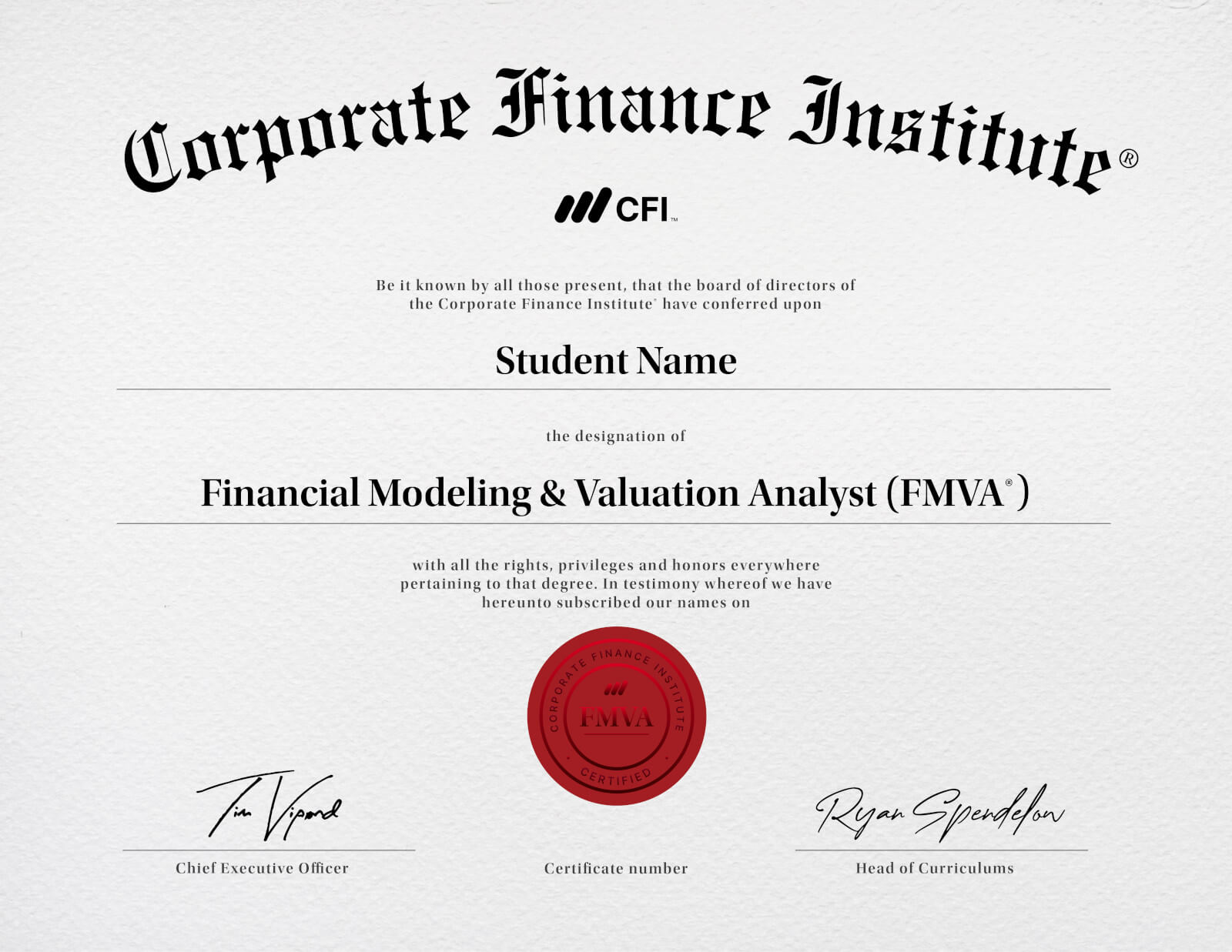
CFI FMVA Certificate FMVA Program Badge

Get FMVA® Certified

Congratulations on becoming a certified Financial Modeling and Valuation Analyst! Upon completion of the program, you will receive a blockchain digital certificate with your new credentials.

“The FMVA® was incredibly valuable during the Goldman Sachs interview process.”

I had it open on my second screen while working through the case study, which required building a model and presenting strategic alternatives. When I interviewed at Goldman Sachs, two of the three interviewers were familiar with the FMVA® and spoke highly of it. I felt the program was very comprehensive, I aced all my interviews thanks to the knowledge and skills I gained. I always recommend the FMVA® to colleagues looking to transition into investment banking or corporate finance.

Alonso Saponara Rivva, FMVA®
Investment Banking Analyst, Goldman Sachs
AI Ready Finance Skills

AI for Finance, Built by Experts

  • Go beyond theory and use AI in real financial workflows & decisions
  • Enhance analysis, forecasting, and productivity with AI-powered tools
  • Gain in-demand skills through CFI’s AI for Finance Specialization

Meet Your Instructors

A combined 100+ years of industry experience to help you unlock your potential.

Duncan McKeen

Duncan McKeen

EVP, Financial Modeling
Duncan is the Executive Vice President, Financial Modeling at CFI. Since 2014, Duncan has been focused on designing courses and teaching financial modeling to employees working in accounting, valuation, investment banking, equity research, and private equity.
Previously At:
Duncan is fascinated with pedagogy and loves course creation and design. He is an effective communicator with extensive experience teaching financial modeling, accounting, analysis, and valuation.
Scott Powell

Scott Powell

CFI Co-Founder
Scott is the Co-Founder of CFI. Over the past 30 years, he has focused on designing and delivering learning solutions for clients in the financial services sector, particularly in the areas of commercial banking, investment banking, capital markets, and asset
Previously At:
Scott is a CFI co-founder. Now based in Vancouver, Scott spent a significant portion of his career in London, New York, and Hong Kong.
Jeff Schmidt

Jeff Schmidt

VP, Financial Modeling
Jeff is the Vice President, Financial Modeling at CFI. Prior to joining CFI, Jeff Schmidt taught financial modeling and valuation to thousands of learners all over the world for over a decade.
Previously At:
For over a decade prior to joining CFI, Jeff Schmidt taught financial modeling and valuation to thousands of students all over the world.
Tim Vipond, FMVA

Tim Vipond, FMVA

CEO & Co-Founder
Tim is the Co-Founder and CEO of CFI Education with an extensive background in entrepreneurship, financial analysis, and investment banking.
Previously At:
Over the past decade, Tim founded and built an online education and training company that educated over 2.8 million registered students. Tim is Co-Founder and CEO of Corporate Finance Institute® (CFI) and Co-Owner of Vipond Ventures. Prior to founding CFI he worked in investment banking, corporate development, strategy and financial planning & analysis (FP&A) at both public and private companies. Since 2005, Tim have been an active participant in capital markets across a wide range of industries and transactions including mergers, acquisitions, divestitures, and capital raising totaling more than $3 billion in value. Honors & Awards: → Top 25 Education Software CEOs (The Software Report · Jan 2019) → Top Forty Under 40 (Business in Vancouver · Jan 2015)
Ryan Spendelow

Ryan Spendelow

VP, Content
Ryan joins CFI having spent over a decade designing and delivering training solutions for the investment banking and investment management industries around the globe. Based in London, Ryan is experienced at creating innovative training solutions that deconstruct complex products and
Previously At:
Ryan started his finance career based in London working in asset management. He then moved to a corporate finance and capital markets training role, with these roles being based in Europe and then Asia, before joining CFI in 2023. Ryan is passionate about making learning about the finance markets as accessible as possible.
Sebastian Taylor

Sebastian Taylor

VP, BIDA
Seb started his career in risk management, managing the implementation and operations of quantitative energy hedging strategies. Having since worked in several different industries, from finance to retail and service, Seb’s business intelligence skills were developed within the realities of
Previously At:
Seb has worked in a range of companies with differing levels of data maturity, from start-ups with zero data infrastructure to large multinationals with centralized global data.
Carl Seidman

Carl Seidman

Subject Matter Expert
Carl’s FP&A development methodologies and curriculums have been implemented by leading organizations as part of their financial leadership development programs (FLDPs) for top talent and emerging leaders.
Previously At:
Carl Seidman is a trusted business advisor specializing in financial planning & analysis (FP&A) and business strategy. As Principal of Seidman Financial, Carl serves as an FP&A advisor, fractional CFO, and management consultant to entrepreneurial businesses throughout North America and Europe and assists them with strategic financial planning, value enhancement, and revitalization.
Antoine Bishara

Antoine Bishara

Instructor
Antoine is Vice President of Business Development at Learning Strategies Group (LSG) in the USA. Antoine is responsible for building LSG’s presence in the US market, as well as delivering in-class facilitation and developing new learning solutions for our clients. Prior
Previously At:
"Antoine is Vice President of Business Development at Learning Strategies Group (LSG) in the USA. Antoine is responsible for building LSG’s presence in the US market, as well as delivering in-class facilitation and developing new learning solutions for our clients. Prior to joining Learning Strategies Group, Antoine worked on numerous projects, including the issuance of a $1BN high-yield bond; project financing for renewable energy assets totaling $200M; and structuring and managing a derivative book valued at more than $3BN. Antoine graduated from the University of British Columbia with a Bachelors of Commerce (Honours) in Finance & Accounting. He is a Chartered Professional Accountant (CA) and a Chartered Financial Analyst (CFA)."

Careers in Financial Modeling & Valuation

icon fpa card
Financial Planning & Analysis
Develop budgets and forecasts that support a corporation’s strategic planning process.
icon private equity
Investment Banking
Perform financial modeling, valuation, presentations and pitch decks, AI tools, and strategy.
Private Equity
Evaluate potential investments, conduct financial modeling, and support portfolio companies.
Corporate Development
Corporate development roles focus on identifying and executing strategic growth opportunities for a company.
icon fpa card
Financial Planning & Analysis
Develop budgets and forecasts that support a corporation’s strategic planning process.
icon private equity
Investment Banking
Perform financial modeling, valuation, presentations and pitch decks, AI tools, and strategy.
Private Equity
Evaluate potential investments, conduct financial modeling, and support portfolio companies.
Corporate Development
Corporate development roles focus on identifying and executing strategic growth opportunities for a company.

Accreditation & Recognition

CFI is the #1 ranked finance training provider in perceived quality (In a national provider ranking, CFI placed ahead of CFA, CFP, ACCA, and others). In its Program Recognition efforts, CFI aims to create value for its certification holders, spread awareness of the FMVA program, and increase global recognition of our designations.

National Association of State Boards of Accountancy

Helps keep the accounting industry effective, enabling professionals to protect the financial interests of the public.

The London Institute of Banking & Finance

Professional body accredited by the Financial Conduct Authority, focused on banking and finance education globally.

Higher Learning Commission (HLC)

Independent accreditation body for colleges and schools across the United States and North Central region.
Target logo
TARGET
Deloitte.
Verizon logo
verizon
exxon logo
EXXON
Boeing logo
BOEING
Marriott logo
Marriott

As a CFA Charterholder who put a good 900 hours into that designation, I found just as much value in your FMVA® program.

In all honesty, as a CFA Charterholder who put a good 900 hours into that designation, I found just as much value in your FMVA® program. This designation only took me about 60-70 hours to complete. What I like about the approach is that it's very practical for the workplace as opposed to just pure theory. I also appreciate CFI focusing internationally and giving a financial break to those who are struggling to afford it.

chris caldwell headshot
Chris Caldwell, FMVA®
Director, Treasury

Choose the Right Plan

Over 75% of CFI learners report significant career advancement within months of program completion

Full-Immersion
AI Tutor, personalized guidance, and exclusive discounts to fast track your career.
$
$
592.90
592.90
$$847847
30% OFF
Estimated per year
Includes all Self-Study features, plus:
  • Ask an Expert: Personalized 1-on-1 Guidance
  • Instant Answers with AI Tutor
  • Personalized Financial Model Review and Feedback
  • Advanced AI Resume & Cover Letter Creator
Self-Study
Designed for independent learners who prefer to study at their own pace.
$
$
347.90
347.90
$$497497
30% OFF
Estimated per year
  • 7 Accredited Certification Exams including FMVA & FPAP
  • 17 Skill-Focused Specialization Programs
  • On-Demand Access to 250+ Courses
  • Personalized Learning Recommendations
  • Multilingual Captions in Courses
  • Interactive Quizzes, Assessments & Case Studies

Frequently Asked Questions

If you haven’t found your answer from our FAQ, please send us a message.

If you haven’t found your answer from our FAQ, please send us a message.