Get In-Demand Finance Certifications
A competitive strategy where business entities operating at the value chain level and within the same industry merge to increase the production of goods and services
Horizontal integration is a competitive strategy where companies operating at the same stage of the value chain in the same industry combine to expand their production of goods and services and strengthen their market position. The goal is typically to increase market share, realize economies of scale, and enhance profitability by reducing competition and sharing resources.
Horizontal integration is a form of business expansion in which a company grows by combining with another company that operates at the same stage of production or distribution within the same industry. In practice, this often means two competitors joining forces to serve similar customers with related products or services.
Because both entities occupy the same point in the value chain, integration allows them to consolidate overlapping activities and leverage their combined scale. From a corporate strategy and finance perspective, horizontal integration is attractive when the expected increase in market power, cost efficiencies, and revenue opportunities generates more value than the firms could create independently.
Horizontal integration can be contrasted with conglomerate integration, in which a company expands into entirely different industries or product lines to pursue growth and diversification. While conglomerate integration spreads risk across unrelated markets, horizontal integration deepens a company’s presence in its existing industry.
Horizontal integration can happen in several ways, but most real‑world cases fall into three broad categories:
In a horizontal merger, two companies of similar size operating at the same value‑chain stage combine into a single entity. Management teams agree on governance, ownership structure, and integration plans, with the expectation that the combined organization will be more competitive and efficient than either firm on its own.
In a horizontal acquisition, one company acquires control of another company operating at the same stage of the value chain. The acquirer typically purchases a controlling interest in the target and then integrates the target’s operations, employees, and assets into its own structure.
This approach is common when a firm wants to quickly increase market share, enter new geographic markets, or gain complementary products and capabilities without building them from scratch.
A firm can also expand horizontally by investing internally to broaden its product lines, brands, or geographic reach while remaining in the same stage of the value chain. Although no external merger or acquisition takes place, the strategic effect is similar: the company increases its presence and influence in its existing industry.
Regardless of the mechanism, the core logic of horizontal integration is synergy. Management expects that the combined entity will generate higher cash flows and a better risk–return profile through shared resources, elimination of duplicate activities, and stronger market positioning.
When executed well, horizontal integration can deliver multiple strategic and financial benefits:
Despite the potential upside, horizontal integration is risky and can destroy value if not carefully planned and executed:
Because of these risks, horizontal integration must be rigorously evaluated using scenario analysis, synergy modeling, and careful integration planning.
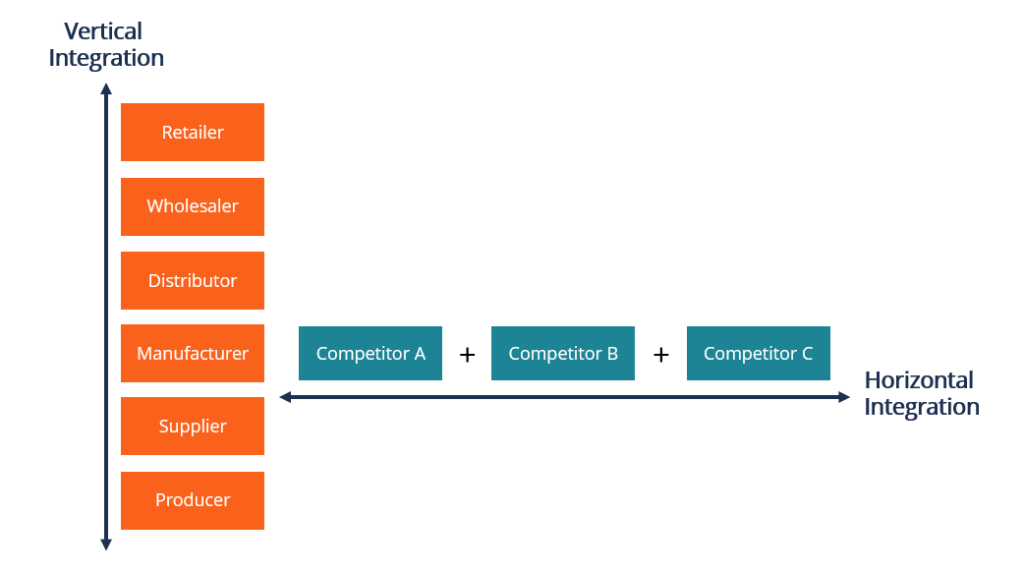
Horizontal integration and vertical integration are strategic alliances by companies in the same sector.
The horizontal integration of companies within the same industry attracts businesses that target to reach a broader market or offer more products/services. It can lead to product diversification, increased company size, narrow competition, and economies of scale.
A successful horizontal integration equips companies with the ability to cut down on costs by using the same research and development, technologies, marketing and advertising, production, and distribution. The need to acquire a new customer segment can also be a reason for horizontal integration.
In a vertical integration, a business entity acquires another business operating in the production process of the same industry. They are combinations with companies that are upstream or downstream of the same product supply chain.
Companies may choose to undergo vertical integration to increase profitability, reduce production costs, and strengthen their supply chain. Integrating vertically requires one company that is higher or below in the supply chain process. They can draw several benefits from vertical integration, including increased profits from the new business operations, efficiency in the production process, and enhanced distribution and delivery.
Horizontal integration is not the only way firms at the same value‑chain stage can collaborate. A horizontal alliance (or partnership) is a cooperative agreement between companies at the same stage that allows them to work together while remaining independent.
Alliances can deliver some of the benefits of horizontal integration, such as access to new markets, shared capabilities, and cost efficiencies, without the full capital outlay, integration risk, or regulatory scrutiny associated with a merger. However, they also come with risks around coordination, alignment of incentives, and potential conflicts of interest.
Below are illustrative examples that show how horizontal integration can play out in different industries.
A large entertainment company acquires another major studio to expand its film and television library and strengthen its position in streaming. After the deal closes, the combined company can offer a broader range of franchises on its platform, negotiate better licensing terms, and spread production and marketing costs over more content.
This kind of horizontal integration typically increases market share because the firm now controls more of the industry’s most popular titles. Margins can improve as overlapping operations are consolidated and duplicate spending on marketing and distribution is reduced. However, there is also risk: integrating creative teams and production cultures is difficult, and if key talent leaves or projects underperform, the expected value creation may not fully materialize.
Two regional airlines serving similar routes decide to merge to form a single, larger carrier. By integrating fleets, consolidating overlapping routes, and harmonizing schedules, the combined airline can increase load factors (seats filled), optimize aircraft utilization, and reduce per‑unit operating costs.
From a benefits perspective, the merged airline gains a larger route network and a bigger customer base, which can help grow revenue. Economies of scale in maintenance, procurement, and airport operations can support higher operating margins over time. On the risk side, the airline must align different labor contracts, integrate IT and reservation systems, and satisfy regulators that the deal will not unduly harm competition on specific routes.
A global hotel group acquires another chain that operates in complementary regions and market segments. The acquiring company integrates the acquired properties into its loyalty program, central reservation system, and brand portfolio while rationalizing overlapping back‑office functions.
In this scenario, horizontal integration can accelerate market share gains because guests have more locations to choose from under a single loyalty ecosystem. The combined company may achieve better terms with online travel agencies and vendors due to its larger scale, supporting margin improvements. At the same time, there are meaningful integration challenges, including aligning brand standards, managing property‑level transitions, and ensuring that service quality does not suffer during the change, which could erode long‑term brand value if mishandled.
A major packaged‑food company acquires another business that produces similar categories of snacks and beverages. After the acquisition, the combined entity uses its broader distribution network to place the acquired brands in more stores and channels, while consolidating manufacturing, warehousing, and procurement activities.
This type of horizontal integration can boost market share because the company now controls a larger share of shelf space and brand awareness in key categories. Scale synergies, such as bulk purchasing of ingredients and shared production lines, can improve gross margins and operating margins.
The risk is that managing a larger brand portfolio can complicate marketing priorities, and if demand shifts or a brand underperforms, the company may have to write down assets or accept lower‑than‑expected returns.
A dominant social media platform acquires a fast‑growing rival application that serves a similar audience but offers different features and user experiences. The acquirer maintains the acquired app as a separate brand but integrates advertising technology, data infrastructure, and some product development efforts across both platforms.
Here, horizontal integration can significantly increase total user reach and engagement, strengthening the company’s position with advertisers and driving revenue growth. Sharing infrastructure and sales resources can improve margins by reducing duplicated costs.
However, regulators may scrutinize the deal for potential anti‑competitive effects, and users may react negatively if they perceive that innovation slows or privacy practices change, creating long‑term value risks.
Horizontal integration is most attractive when strategic fit, synergy potential, and financial capacity align.
Strategic fit: The target’s products, markets, and capabilities reinforce the acquirer’s core business rather than distract from it. A good fit enables a clear, coherent strategy for the combined entity.
Synergy potential: There are realistic opportunities for revenue synergies (cross‑selling, geographic expansion) and cost synergies (consolidated operations, shared technology) that exceed the costs of integration and any acquisition premium.
Industry structure: The industry is fragmented enough that consolidation can improve profitability, and antitrust risk is manageable.
Financial capacity: The acquiring company has the balance sheet strength and access to capital to fund the transaction without taking on unsustainable leverage.
Executable integration plan: Management has a detailed plan for integrating systems, processes, people, and culture, with clear milestones and metrics.
From a corporate finance viewpoint, horizontal integration should be evaluated using discounted cash flow analysis, scenario modeling, and sensitivity tests to ensure that expected value creation justifies the risks and investment.
The main types are mergers between similar‑sized companies at the same stage of the value chain, acquisitions where one firm takes control of another competitor, and internal expansion that builds new capacity or product lines at the same stage.
Horizontal integration focuses on combining with competitors at the same value‑chain level to increase scale and market share, while vertical integration involves acquiring suppliers or distributors to control more stages of the supply chain.
Companies pursue horizontal integration to grow revenue, gain market share, realize economies of scale, diversify products within their industry, and strengthen their competitive position.
Key risks include integration difficulties, cultural clashes, reduced organizational flexibility, regulatory and antitrust scrutiny, and the possibility that expected synergies do not materialize, leading to lower‑than‑expected returns.
Horizontal integration describes the strategic pattern, expanding at the same value‑chain stage, while a merger is a specific legal structure for combining companies. Horizontal integration can occur via mergers, acquisitions, or other transaction forms.
Connect what you just learned to a clear career path with CFI’s role‑based courses and certification programs.