Get Certified for Financial Modeling (FMVA)®
Gain in-demand industry knowledge and hands-on practice that will help you stand out from the competition and become a world-class financial analyst.
Adjusted for a specific time period
In accounting and finance, prorated means adjusted for a specific time period. For example, if an employee is due a salary of $80,000 per year, and they join the company on July 1, their prorated salary for that year would be $40,000.
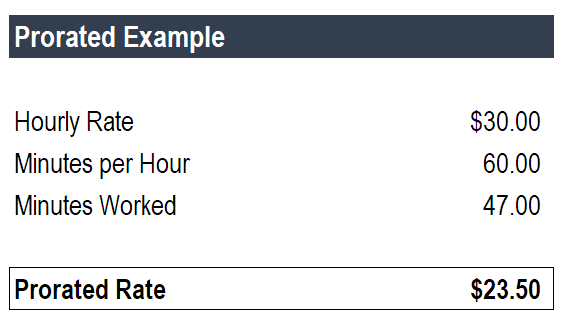
Let’s look at an example. Susan is supposed to earn $30 per hour, paid to the nearest minute. She works for 47 minutes. What is her prorated compensation?
To calculate the answer, follow the steps below:
= ($30 / 60) x 47 = $23.50
Download CFI’s free Prorated Calculator.
There are many instances when a prorated amount is required. Let’s review a list of the most common situations.
Examples include:
While there are lots of situations that require prorating numbers, there are also many instances where numbers are not prorated. One of the most common is that of payment of stock dividends. Shareholders are paid a dividend based on the date of record when they became shareholders, not based on how long they have owned their shares. Everyone who is a shareholder as of the date of record receives the same dividend amount per share when they are paid.
Here is an example of a conversation between an Analyst (A) and a Vice President (VP), talking about numbers in a financial model.
VP: Did you update the model to include the new office lease figures?
A: Yes, I increased the office rent number to reflect the higher rate starting in July.
VP: Did you prorate it?
A: Yes, I prorated it based on a move-in date of July 23.
VP: Okay, great. Thanks!
Connect what you just learned to a clear career path with CFI’s role‑based courses and certification programs.
CFI is the official global provider of the Financial Modeling and Valuation Analyst (FMVA)® designation, a leading financial analyst certification program. To continue learning and advancing your career, the following additional CFI resources will be helpful: